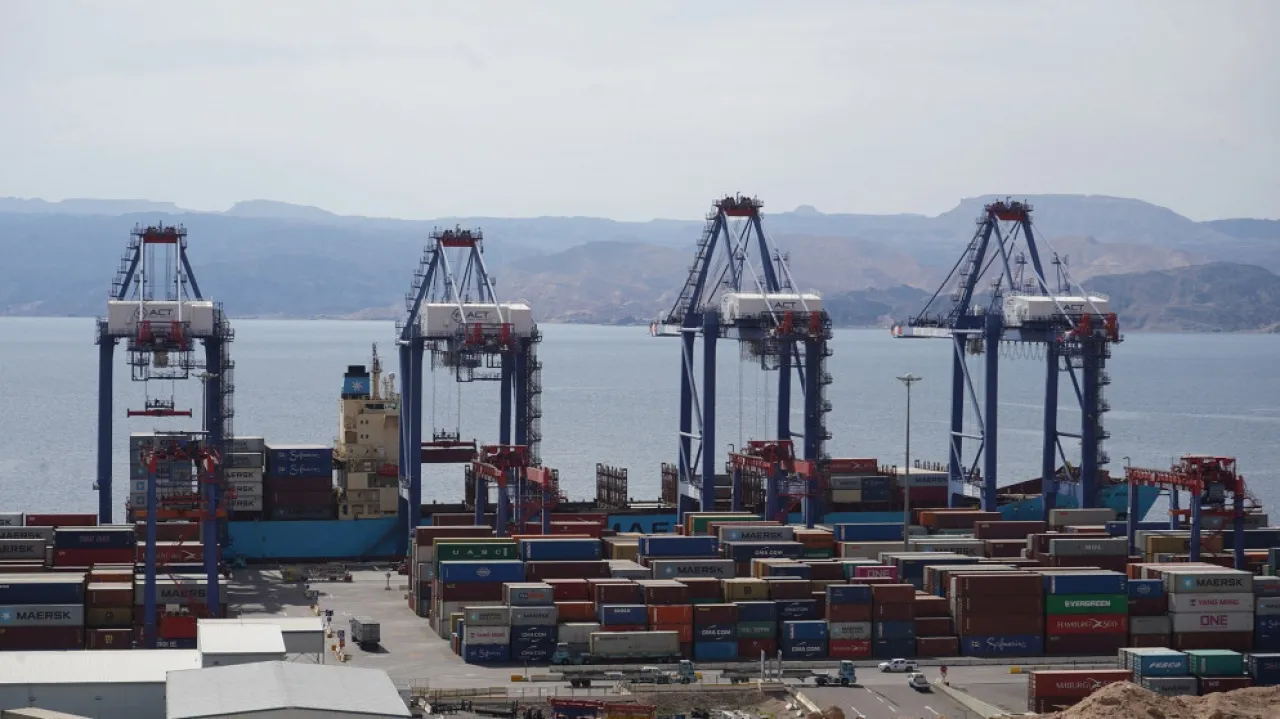
Khaberni - Aqaba ports logged considerable activity in maritime and trade handling during the first five months of the current year 2026, after experiencing a growth rate of 35%, driven by an increase in the number of ships and incoming and outgoing cargo.
This comes following a decision by the Prime Minister's Office to offer a package of economic incentives aimed at enhancing supply chains, which included enhancing maritime transport and stepping up coordination with relevant entities to facilitate the reception of ships and ensuring the continuous operation of supply and provisioning chains through the Aqaba port system, under close monitoring by the Aqaba Special Economic Zone Authority of these procedures which contributed to the seamless operation of the ports and the rising role of Aqaba as a pivotal logistical and commercial hub in the region.
The Aqaba port system is one of the main pillars of the national economy, possessing an advanced operational infrastructure and sophisticated logistical capabilities including a container port, the main port, the oil and gas port, and a passenger terminal, in addition to being equipped to receive various types of ships and cargo according to the highest operational standards. Dr. Mahmoud Khleifat, General Manager of the Aqaba Port Management and Operation Company, said that the Aqaba ports are witnessing an accelerated operational activity and active maritime movement, supported by the development of the port system and its operational efficiency, which directly reflected on increased handling volume and improved performance indicators during the current year.
Khleifat also indicated that performance metrics recorded up to May 20, 2026, showed that the total handling volume in Aqaba ports rose to about 4.85 million tons, compared to 3.58 million tons for the same period last year, with a growth rate of 35% and an increase that exceeded 1.26 million tons.
Moreover, Khleifat mentioned that the oil and gas port achieved a noticeable growth of 42%, as the handling increased from 1.41 million tons to more than two million tons, while the handling at the main port increased by 34% to reach 2.23 million tons.
In relation to dry bulk movement, Khleifat pointed out that it recorded an increase of 42%, driven by increased handling of several basic commodities, most notably bulk barley by 99%, and bulk corn by 37%, in addition to the entry of bulk sugar handling for the first time at 234 thousand tons.
Khleifat further noted that petroleum derivatives also witnessed significant growth, with gasoline handling increasing by 59%, diesel by 38%, and kerosene recording a substantial rise of 160% compared to the same period last year.
He confirmed that these results reflect the efficiency of the port system and its ability to handle the increasing growth in trade movement, alongside efforts made to develop operational services and enhance handling efficiency and the speed of completing logistical operations.
He explained that the maritime movement saw clear activity with the total number of ships that completed their operations in the ports rising to 683 ships compared to 661 ships during the same period last year, an increase of 22 ships, noting the arrival of 7 ships in the past few hours within the active operational movement observed at the ports.
Additionally, he mentioned that the passenger terminal also recorded a growth of 21% in handling volume, alongside a rise in passenger numbers by 29%, and vehicles and equipment by 71%, reflecting the growth in tourism and trade movement through Aqaba port.
Khleifat asserted that what Aqaba port is witnessing today in terms of increased numbers of ships and handling quantities reflects a national success story supported by Jordanian efforts and human competencies operating with high dedication and efficiency around the clock within an integrated system that has bolstered Aqaba's position as a reliable logistic center in the region.
He added that this came as a result of the great trust that Jordanian ports, particularly from the Iraqi brethren, have gained, thanks to the quality of services, speed of procedures, and the efficiency of staff across various work sites within the port.
He elaborated that the success was not the result of a single entity but rather the fruit of integration and cooperation among various institutions and entities, primarily the Jordanian Customs, security devices, the Ministry of Transport, and customs brokers, in addition to all partners working in the logistical system, confirming that this ongoing coordination has contributed to facilitating procedures and enhancing the confidence of investors and stakeholders in the Jordanian ports.
He pointed out that Aqaba today presents an advanced model in institutional work and logistical services, backed by Jordan's security and stability, which directly reflected on the increased movement of goods and ships and rising handling quantities.