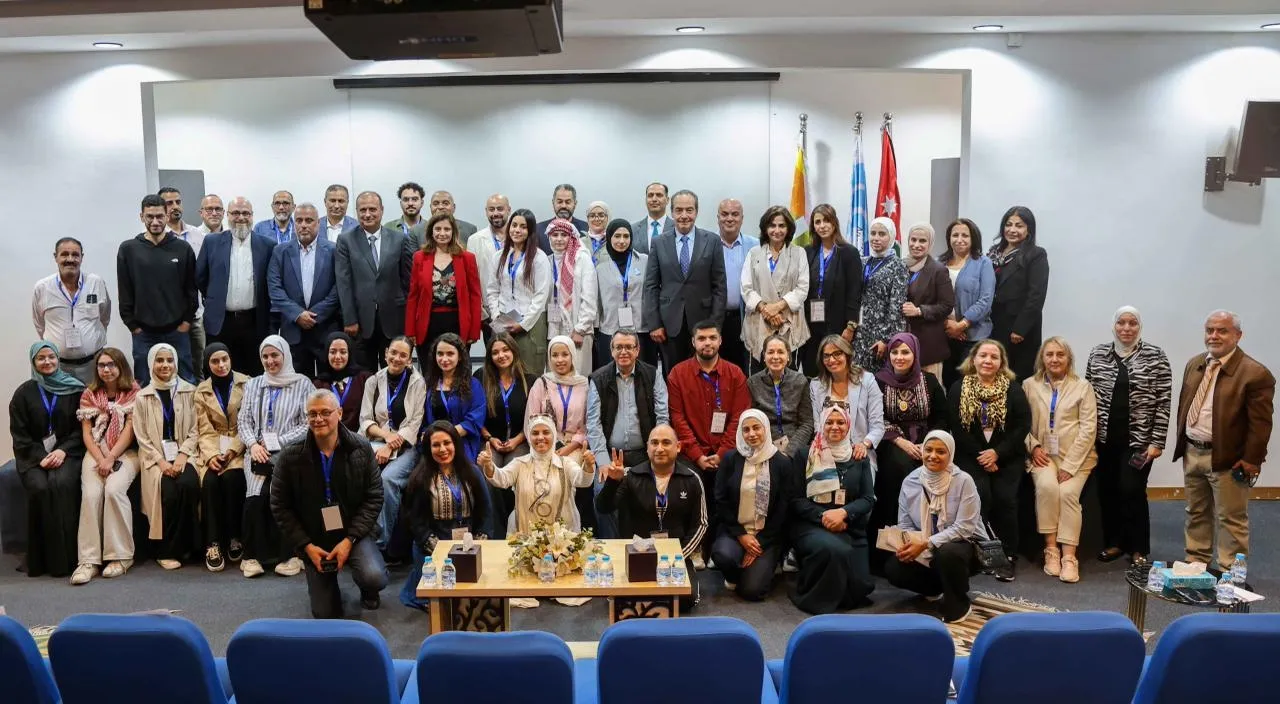
Khaberni - Her Royal Highness Princess Dana Firas, Vice President of the International Council on Monuments and Sites (ICOMOS International) and President of ICOMOS Jordan, sponsored the conclusion of the events “Amman – Dialogue of Heritage and Humanity” organized by the Architectural Division at the Engineers Association in cooperation with the Greater Amman Municipality and the British Council for Research in the Levant, within the “Amman Tourist Promenade – Downtown”.
Her Royal Highness Princess Dana Firas emphasized that celebrating the World Heritage Day is not only about honoring historical sites, but also an occasion to rethink the profound connection between heritage and our daily lives, and between the past and the future of cities, warning that the lack of awareness of the importance of heritage threatens the identity of cities, their relationship with their inhabitants, and their urban development.
She said that Amman is not a city to which heritage is added as a decorative element or a memory, but a city that cannot be understood or developed without understanding its historical layers that form its deep structure, pointing out that the Ain Ghazal site, which dates back more than 9,000 years, reflects the historical and urban extension of the capital and confirms that it is one of the oldest continuously inhabited cities in the world.
She added that modern urban studies confirm that culture and heritage are fundamental elements in the quality of life, and that cities that invest in their heritage achieve higher levels of social cohesion, belonging, and civic engagement, in addition to improving the quality of life and mental health and enhancing attractiveness and economic stability.
Her Highness explained that heritage in Amman is represented not only by historical buildings but also by the city's logic itself, from its network of mountains and distribution of neighborhoods to building styles and the relationship between public and private spaces, stressing that understanding this logic helps in urban planning in a way that preserves the city's continuity and identity.
She pointed out that traditional architecture in Amman, with its climate-adapted solutions to terrain and water scarcity, still offers inspiring models for the present and future, affirming that heritage provides a source of meaning, uniqueness, and soul in everyday life, and grants cities their human depth.
Her Highness indicated that “every engineering project and every urban plan is, at its core, a heritage act, because it either enhances the city's character and continuity or disconnects it from its origin and history,” emphasizing that heritage in Amman “is not behind us, but among us, in the way we build and live and imagine our future.”
The President of the Jordanian Engineers Association, Engineer Abdullah Ghosheh, said that despite rapid transformations, Amman has managed to maintain its soul, identity, and memory, and that protecting heritage is not a cultural luxury, but a civilizational, national, and humanitarian responsibility, praising the role played by Her Highness Princess Dana Firas in defending human and cultural heritage at both the national and international levels.
He noted the importance of efforts made by the Greater Amman Municipality in developing and activating tourist and heritage trails that rediscover the city and introduce it to new generations in a deeper and more humane way, pointing out that preserving identity in an era of city similarities has become “an act of resistance to forgetting.”
Ghosheh explained that heritage is not limited to old buildings but also represented in the daily details that form the memory of the place, from the smell of coffee downtown to the sounds of vendors and the steps of Amman and the stories hidden behind old doors, affirming that downtown remains the cultural, social, and emotional heart of the capital.
He emphasized that developing and marketing downtown Amman as a cultural and tourist product must be seen as a project to protect the collective memory and connect people to the city and its history, affirming that protecting heritage is a shared responsibility that requires the integration of efforts between official institutions, unions, cultural entities, and the local community.
Ghosheh pointed out that the event aims to turn heritage into a living experience felt and lived by people.
He reiterated that the interest in heritage and national identity forms part of the modern state project led by His Majesty King Abdullah II, which balances between preserving identity and openness to the world, also noting the interest of His Royal Highness Prince Hussein bin Abdullah II, the Crown Prince, in empowering youth and enhancing their connection to place and national identity through modern tools.
In turn, the Head of the Architectural Division in the Engineers Association, Engineer Imad Al-Debas, confirmed that heritage is not just silent stones, but “the memory of human and place and the identity of the city,” emphasizing that protecting heritage is a collective responsibility in which the roles of official institutions, unions, universities, and the local community are integrated.
Al-Debas highlighted the role played by the Greater Amman Municipality in spotlighting heritage sites through tourist and cultural trails that rediscover the city and connect people to the history of the place in a contemporary way that enhances belonging and social awareness.
He added that the Architectural Division, through the Urban Heritage Conservation Committee, conducts activities, seminars, field tours, and documentation visits aimed at keeping the urban heritage file present in professional and social awareness.
Al-Debas emphasized the importance of involving youth in reading and documenting the city through social media tools and digital content creation, contributing to transforming heritage into a daily and circulating living experience among new generations.
Al-Debas mentioned that about 80 participants took part in the Amman Walk, creating videos (reels) that reflect the heritage significance of the heritage buildings along the trail, which were voted on in the competition for the best (reels).
The Deputy Director of the City of Amman for Public Works, Engineer Naima Qatnani, confirmed that the Municipality regards urban and cultural heritage as a developmental, investment, and strategic asset that forms part of the modern city project, explaining that the capital has witnessed a qualitative transformation in the concept of heritage protection, transitioning from traditional conservation to an integrated developmental approach that links identity preservation with economic development and urban sustainability.
She noted that the Municipality has worked on establishing the National Heritage Register for Urban Heritage in Amman and launching projects to revive historical sites and heritage trails, in addition to rehabilitating heritage buildings and spaces and transforming them into cultural and community spaces, including Ras Al-Ain Hangar, Habes Al-Majali Museum, House of Poetry, House of Art, Hashemite Plaza, King Faisal Square, and King Ghazi Street.
Qatnani added that the Municipality adopted an advanced vision towards “smart urban heritage,” based on employing modern technology and digital transformation in protecting and interpreting heritage sites through digital archiving and the use of virtual and augmented reality technologies, providing an interactive advanced experience that connects the visitor to the place's history and spirit.
Qatnani highlighted that the Amman Municipality has worked through the Neighborhood and Tourist Trails Development Directorate to design and activate 19 heritage and tourist trails, including prominent ones such as the Ammonite Towers Trail, the Quraysh Elaf Trail, the Hejaz Railway Trail, the Sundial Trail, the Ammonites Trail and the Roman Street, and the Cave of Al-Raqeem Trail, confirming that the “Amman Tourist Promenade” launched as part of the event represents an advanced model of smart urban heritage that integrates historical identity with digital technology.
Engineer Marah Khayyat, Chairperson of the Urban Heritage Conservation Committee in the Architectural Division, confirmed the role of the Division in collaborating with public and private sector institutions, the British Council for Research in the Levant, and ICOMOS Jordan and Heritage Technologies to raise awareness about heritage sustainability and documentation.
During the closing ceremony, a film was showcased about Amman's tourist heritage trails, and the winners of the best (reels) competition were announced, involving 14 teams from various Jordanian universities that participated in the tour organized by the Division in the heritage tourist trail of downtown Am