Khaberni - In one of the most sensitive maritime passages in the world, ship tracking data reveals that the American maritime blockade imposed on Iranian ports has failed to halt the transit movement associated with Iran through the Strait of Hormuz, despite the unprecedented American military buildup in the Arabian Sea and the Gulf of Oman.
After a month of implementing the American decision, dozens of ships linked to Iranian ports or listed on sanctions registries continued their crossing through the strait.
An analysis conducted by "Al Jazeera’s Open Source Unit" revealed that 87 ships included in the American maritime blockade imposed by Washington on April 13, 2026, involved vessels coming to or from Iranian ports, in addition to those flying the Iranian flag.
According to "Marine Traffic" data, the ships violating the American decision continued to pass through the Strait of Hormuz during the period from April 13 to May 13, 2026, whether linked to Iranian ports or listed on American sanctions registries.
According to the analysis, during the period of the blockade, 87 ships linked with Iran crossed the strait, including 16 ships listed on American sanctions registries.
Furthermore, 34 other ships listed on the sanctions registries but not linked to Iranian ports crossed, bringing the total number of non-compliant ships to about 120 out of 225 ships that crossed the Strait during that period, which represents about 53% of the total transit traffic.
The data also showed that 13 ships failed to cross the strait during the same period, managed by companies based in China, India, Pakistan, Turkey, and Qatar.
The analysis was based on monitoring ships that activated the Automatic Identification System (AIS) while crossing the Strait, while the Open Source Unit had previously observed some ships turning off their tracking devices before crossing, indicating that actual figures could be significantly higher than reported.
Did the American blockade succeed?
The American Central Command had announced that the blockade targeted ships entering or leaving Iranian ports, without including ships traveling between non-Iranian ports through the Strait of Hormuz, before Washington later expanded the scope of the decision to also include ships listed on American sanctions registries.
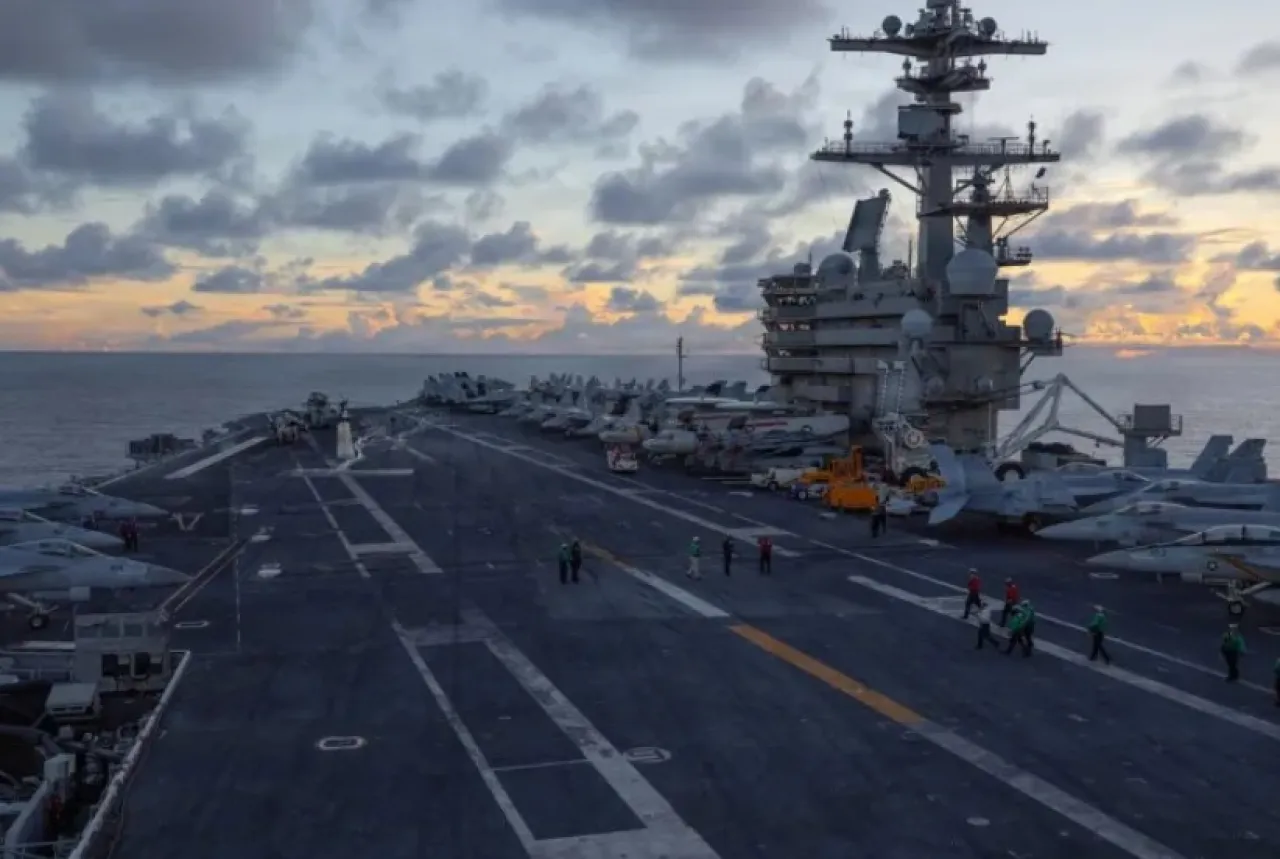
In parallel, the United States deployed significant naval reinforcements to the region, including at least 15 naval pieces, among them an aircraft carrier and 11 destroyers, as reported by "CNN" from an American official.
However, tracking data during the first 24 hours of the decision's implementation showed the continuation of Iran-linked transit movement without interruption, as 5 ships flying the Iranian flag crossed the Strait of Hormuz, while 6 other ships were linked to Iranian ports, whether heading there or departing.
Despite the American Central Command "CENTCOM" redirecting 39 non-compliant ships, tracking data reveals that 50 other ships managed to cross to and from Iranian ports during the same period.
An analysis of the types of ships shows that general cargo ships topped the list of the offenders with 72 ships, followed by oil tankers with 49 ships, and bulk cargo carriers with 33 ships. The list also includes 21 general cargo vessels, and 20 container ships, as well as 13 liquefied petroleum gas carriers.
The highest rate of non-compliant ships crossing occurred on April 28, with 9 ships crossing the strait in both directions, indicating an escalation in crossing rates despite increasing American threats.
In terms of ship management, Iranian companies led the list with 10 ships, followed by companies based in the UAE with 7 ships, and Chinese companies with 6 ships, while 9 ships hid their ownership and management data.
Regarding departure and arrival ports, UAE ports topped the list with 21 ships, followed by Omani ports with 14 ships, then Iranian ports with 12 ships, and Chinese ports with 10 ships.
Crossing despite the blockade
The continued crossing of non-compliance ships coincides with extensive American naval positioning in the Arabian Sea and Gulf of Oman, according to satellite images analyzed by "Al Jazeera’s Open Source Unit."
Images taken on April 26 show the American aircraft carrier "Abraham Lincoln" sailing accompanied by at least two destroyers, believed to be of the "Arleigh Burke" class, at a distance of about 323 kilometers south of the Iranian coast.
This positioning places the American carrier within a relatively close range to the pathways leading to the Gulf of Oman and Strait of Hormuz, where tensions related to the American maritime blockade escalated during the past weeks.
Imagery also spotted the American amphibious assault ship "USS Tripoli" operating about 117 kilometers off the Omani coast, accompanied by a modern American destroyer from the "Arleigh Burke" class.
The measurements indicate that "Tripoli" was about 140 kilometers away from the aircraft carrier "Abraham Lincoln", reflecting the presence of two significant American naval pieces within a closely operational range in the Arabian Sea.
In the midst of escalation, a White House official confirmed that the Chinese President Xi Jinping informed Washington of his country's rejection of militarizing the Strait of Hormuz or imposing tolls on its use, referring to an American-Chinese agreement on not allowing Iran to possess a nuclear weapon.
Reuters reported from the US Department of State that officials from the two countries agreed on the necessity of not allowing any country or entity to impose transit fees on international passageways, including the Strait of Hormuz.
In contrast, the Iranian Foreign Minister Abbas Araghchi confirmed that the Strait of Hormuz is still open to all commercial ships, but he emphasized the necessity of cooperation with the Iranian naval forces by transiting ships.