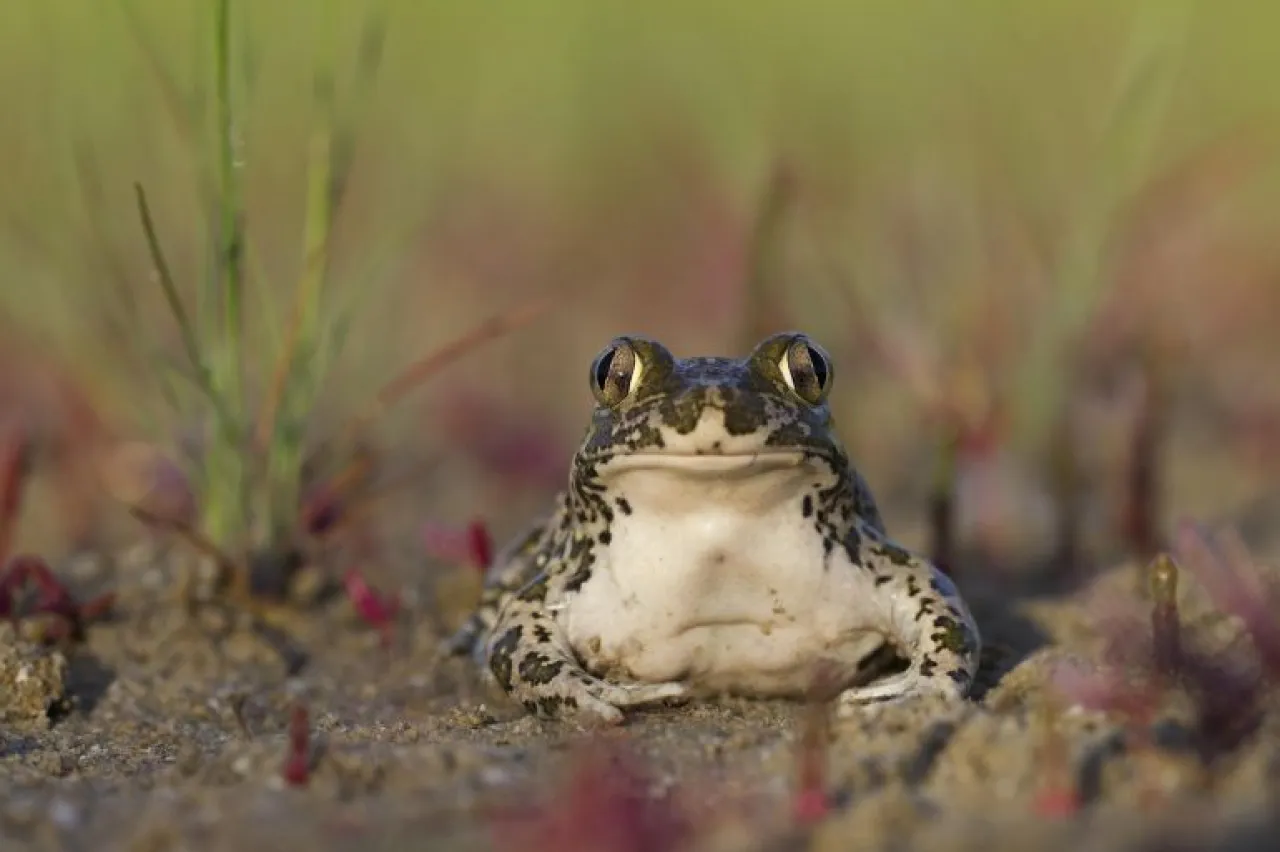
Khaberni - The frog known as "Spadefoot Toad" or "Shovel", because it has a protrusion resembling a "shovel" on its hind foot which helps it in digging and hiding under the soil, is one of the most elusive amphibians, as it spends most of its life buried under the ground and only emerges for short periods during the breeding seasons in humid environments.
This frog gained the Syrian identity (Syrian Spadefoot), as it was discovered for the first time in Syria over 135 years ago, after being described by the German scientist Oscar Boettger in 1889 based on a sample collected from there, according to data from the Global Biodiversity Information Facility.
Dr. Johnny Packlin, a professor in the Department of Natural Resources and Environmental Sciences at the University of Illinois at Urbana-Champaign, led a research team that, with the assistance of a group of wildlife enthusiasts in Syria, succeeded in rediscovering it, according to their study published in Herpetological Conservation and Biology.
Discovery that Removes Doubts
According to the study that documented the discovery, the only historical record of this species in Syria was based on a specimen preserved in the Natural History Museum in London, which long cast doubt among scientists about its actual presence in Syria.
The most significant shift came through what is known as "citizen science," where groups of wildlife enthusiasts on social media contributed to documenting new field observations, which led to the recording of larvae in a humid plain area in rural Hama, in addition to spotting adults in rural Tartus.
The study indicates that these locations are tens of kilometers apart from each other, and are significantly distant from the nearest known cluster of the species in Lebanon, suggesting the presence of stable local populations inside Syria that were previously undocumented.
While the environmental authorities in Hama Governorate, Syria conducted a field visit to one of the frog farms a few days ago to ensure that the environmental conditions required to resume export activities to Europe after a long hiatus are met, Packlin uses this event to call for more research on the Spadefoot Toad.
Frog exporting activity in Syria dates back to the 1980s, before stopping in recent years during the long war in the country. With the resumption of activity, Packlin says that "it is likely that water frogs, specifically from the genus Pelophylax, are larger in size and more suitable for human consumption in Europe, but the Syrian Spadefoot deserves research attention."
Concerns about Disturbing the "Syrian Spadefoot"
Despite the scientific importance of the Syrian Spadefoot Toad, which is not targeted for export, Packlin emphasizes the necessity to ensure that this export activity does not disturb its presence in Syria.
In his opinion, the concern comes from the fact that the export frogs from the genus "Pelophylax" might share some breeding ponds or wetland habitats with the Spadefoot Toad; thus, without clear regulation at the species level, precise monitoring, and a strict breeding program in captivity, the commercial frog export might cause harm to the environments that the rare or poorly known species depend on.
Packlin adds that with a species like the Syrian Spadefoot Toad, which we still know very little about, the situation becomes extremely risky, as it may be present in the wetlands, affected by the pressures of collection or disturbance, and disappear before anyone knows of its existence.
Bridging a Geographic Gap
Regarding the significant appreciation Packlin has for the rediscovery of the Syrian Spadefoot Toad, he clarifies that the importance of the discovery is not limited to documenting its presence in the country bearing its name, but also extends to bridging a large geographic gap in its scientifically known distribution map.
He says that "the discovery broadened the understanding of scientists of this species of frogs, which play important ecological roles within the natural system, feeding on insects and small invertebrates, and serving as a food source for a number of birds, reptiles, and mammals, while its burrowing nature helps in soil aeration and contributes to the nutrient cycle within the environment."
He added that this species primarily depends on seasonal ponds and wetlands for breeding, making the protection of these habitats necessary for its survival.
Despite this importance to humans and the ecosystem, Packlin stresses that the real value of living creatures should not be reduced to this, explaining that the Syrian Spadefoot Toad is important because it is a living being belonging to this land and carries a part of its natural and historical memory.
He said it further gains special symbolism because the species bears the name of Syria itself, and its continued existence despite years of disturbances serves as evidence of the resilience of local life even in the midst of violence.
Packlin believes that the concept of nature conservation should not be limited to protecting species only, but should also include protecting people's relationship with their land and local wildlife, reminding that this discovery would not have been possible without the efforts of a group of Syrian wildlife enthusiasts, most of whom lacked specialized academic training, but possessed curiosity, attentiveness, and a deep connection to the natural life in their country.
He concluded by saying that the Syrian Spadefoot Toad reminds us that these lands are not "empty or finished" but are still teeming with life, and as the export activity for commercial species has resumed, attention must be paid to searching for unknown populations of rare species, like the Syrian Spadefoot."