Khaberni - A regular press conference by the US Department of Defense turns into a platform that revived one of the most bizarre military stories in recent history.
According to «Business Insider», the story involves the use of marine mammals in military operations, in a scene that combines humor with seriousness in an unusual way.
The spark came from a question directed at US Defense Secretary Pete Higgsith and Chairman of the Joint Chiefs of Staff General Dan Kin about intelligence reports on Iran possessing what was described as "kamikaze dolphins" capable of carrying out suicide attacks against warships.
The question, which initially seemed akin to a fictional movie plot, elicited responses that were a mix of ridicule and caution.
General Kin laughed, saying that he had never heard of such dolphins, while Minister Higgsith chose a more cryptic answer, stating he could neither confirm nor deny such capabilities for his country, but he affirmed that Iran did not possess them.
However, the significant irony, according to the website, is that the real and more advanced program in this field does not exist in Iran, but rather within the United States itself.
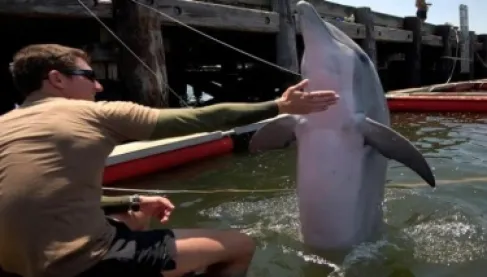
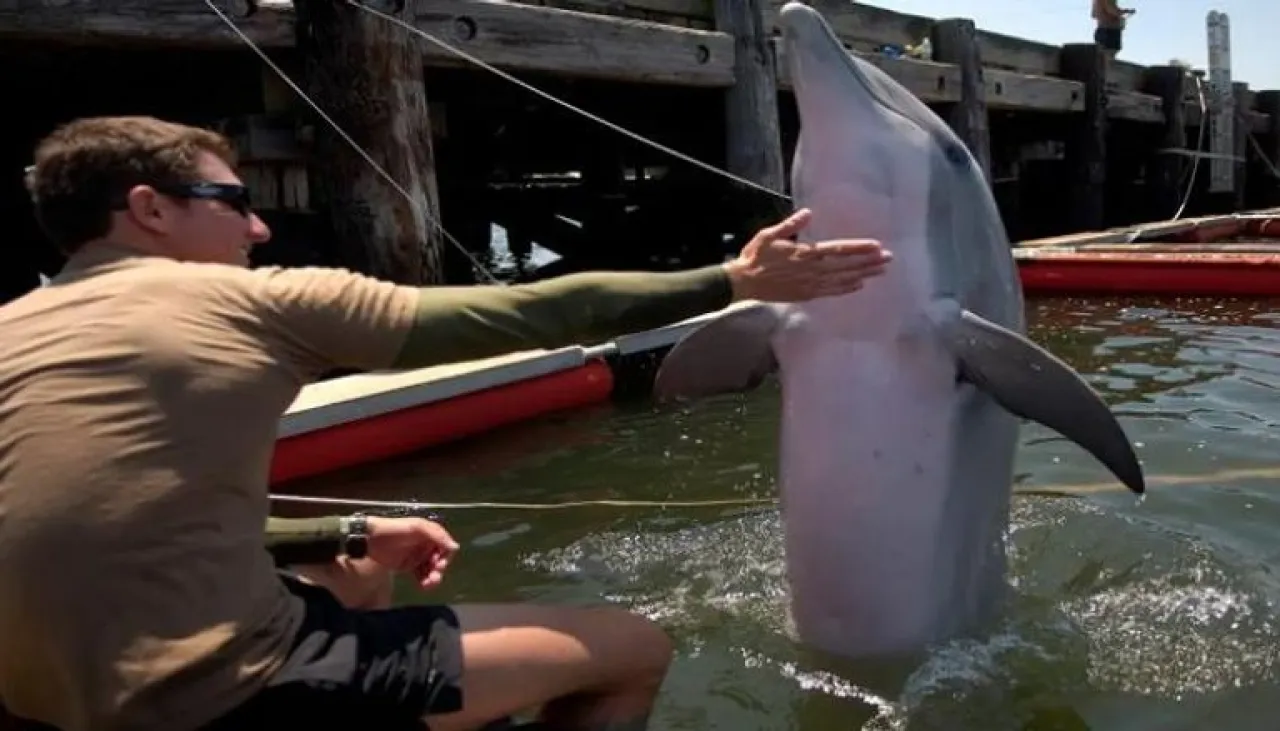
Since the late 1950s, the US Navy began exploring the military potentials of bottlenose dolphins, after researchers discovered their exceptional abilities in using echolocation, or biological sonar.
This unique natural ability enabled dolphins to outperform many modern electronic systems in detecting metallic objects underwater and differentiating between them even in highly complex environments, where visibility is zero and traditional sensors malfunction.
This discovery led the US Navy to establish a specialized program to train marine mammals to carry out precise military tasks, including mine detection, ship and port protection, and monitoring infiltrating divers.
Over the following decades, these intelligent creatures became an active component in a number of real operations.
They were used in the Vietnam War to protect sensitive naval installations, before reappearing during the preparations for the invasion of Iraq in 2003, where they contributed to detecting sea mines and securing waterways.
However, the most controversial aspect of this program has always been shrouded in mystery: Did the role of these dolphins limit to surveillance and reconnaissance, or did it extend to offensive tasks? This question has haunted the US Navy for decades.
In the 1990s, reports emerged from former trainers claiming that some dolphins had been trained to attack enemy divers using tools or charges fitted to the front of their bodies.
At that time, the US Navy quickly denied, emphatically stating that the animals were not trained to kill humans.
Nevertheless, the thrilling narratives did not stop. In his memoirs, the famous deep-sea explorer Robert Ballard talked about an offer he received during the Vietnam War to participate in a program for training dolphins to carry out attacks against divers, confirming that he declined it for ethical reasons.
Some members of the US special operations forces later testified that the military training included simulations of confrontations with offensive dolphins, as part of preparations for unconventional battlefield scenarios at sea.
Despite significant advancements in marine robotic technologies and unmanned vehicles, the US Navy has not abandoned its special marine mammal program, according to the same source.
In 2022, the American military establishment studied the possibility of reducing the program in favor of modern smart systems, yet operational assessments showed that current technology is still unable to replicate the biological efficiency of dolphins, especially in complex environments requiring a heightened sensory response.
Today, the program continues under the oversight of the Maritime Information Warfare Center in the Pacific, with an official confirmation that its missions are limited to detection, monitoring, and non-combat interception; however, the secretive nature surrounding it and the history of conflicting narratives about it keep it one of the most mysterious military programs in the world.