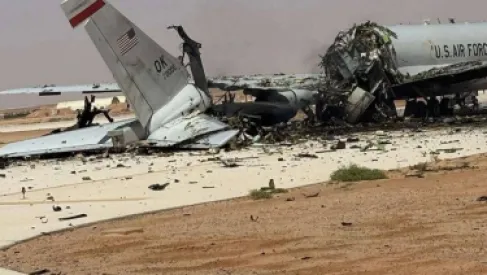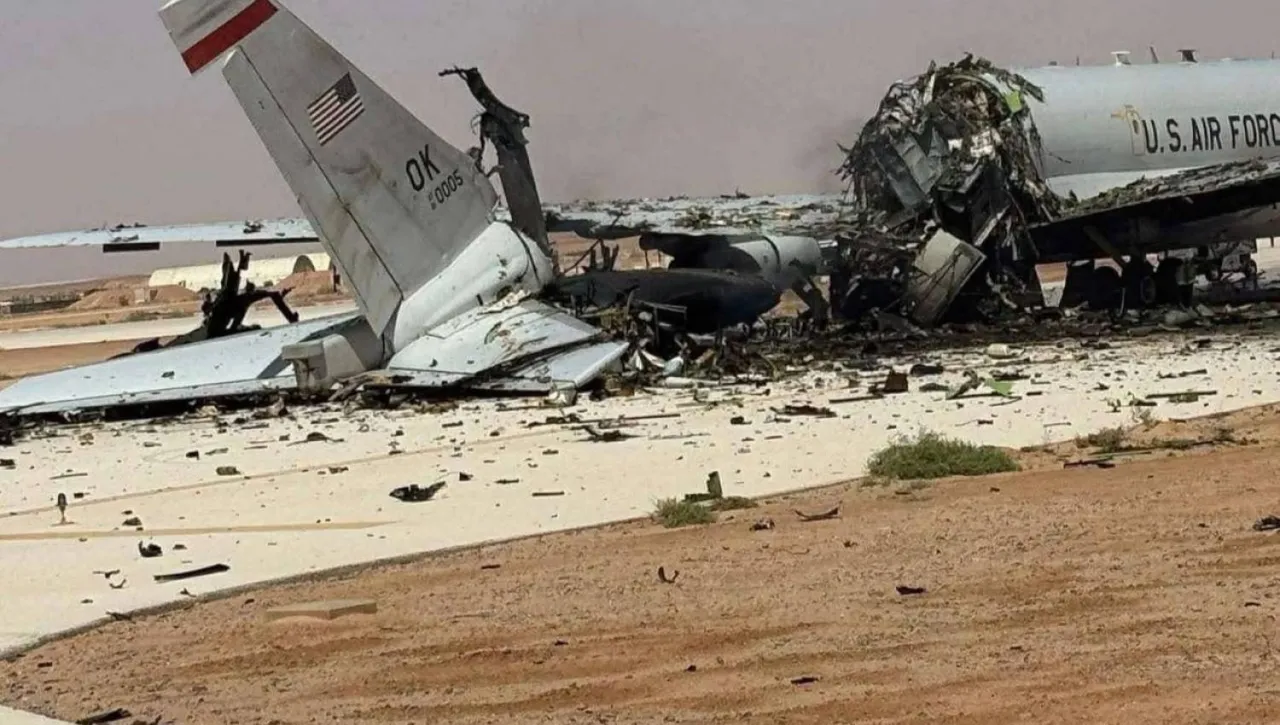
Khaberni - The "Washington Post" reported that Iranian airstrikes have destroyed or damaged at least 228 American facilities or military equipment in the Middle East since the war began on February 28th.
According to the newspaper's analysis of satellite images, the damage included aircraft hangars, barracks, fuel depots, aircraft, radar and communication equipment, and air defense systems, in a scale of destruction far exceeding what the US government had previously announced.
Due to the Iranian threat, the US command had to evacuate most of its bases in the region at the start of the war. The US military reported seven soldier deaths in the attacks on their facilities (six in Kuwait and one in Saudi Arabia), and over 400 soldiers injured by the end of April, including 12 with serious injuries.
The newspaper had difficulty obtaining recent satellite images, as the companies "Vantour" and "Planet" complied with the US government's request to block images of the region during the war. However, Iranian media published high-resolution images that documented the damage. The newspaper verified the authenticity of 109 Iranian images by comparing them with images from the European "Copernicus" system and "Planet," dismissing 19 inconclusive images, and found no evidence of manipulation.
The Post also noted another 10 damaged facilities in "Planet" images that did not appear in the Iranian photos, bringing the total damage to 217 facilities and 11 equipment across 15 military sites.
Military experts, including Mark Cancian from the Center for Strategic and International Studies, confirmed that the Iranian attacks were precise and targeted residential sites to cause the maximum number of casualties.
They pointed out that the US military underestimated Iran's targeting capabilities and failed to adapt to the drone warfare, leaving some bases inadequately protected.
The damage included sensitive equipment such as "Patriot" and "THAAD" radars, "E-3 Sentry" aircraft, satellite communication sites, power stations, fuel tanks, and "soft" targets like gyms and dining halls. The damage was mainly distributed at the Fifth Fleet's headquarters in Bahrain, and at three Kuwaiti bases.
Experts inferred that the bases in Bahrain and Kuwait suffered more damage because they allowed the US military to launch attacks from their territories, while other Gulf countries refused to do so.
Analyzers believed that Iranian forces demonstrated flexibility exceeding American expectations, and that Washington's plans underestimated the depth of Iranian intelligence for targeting fixed US infrastructure. US and Israeli air defense stocks were significantly depleted, with the US military using about 53% of "THAAD" missiles and 43% of "Patriot" missiles during the war.
As a result, military planners are considering tough options: either withdraw forces to safer locations with reduced combat capability, or maintain the bases as they are and accept more casualties. The headquarters of the Fifth Fleet has already moved to MacDill Air Force Base in Florida, and it is unlikely that forces will return to some regional bases en masse in the near future.