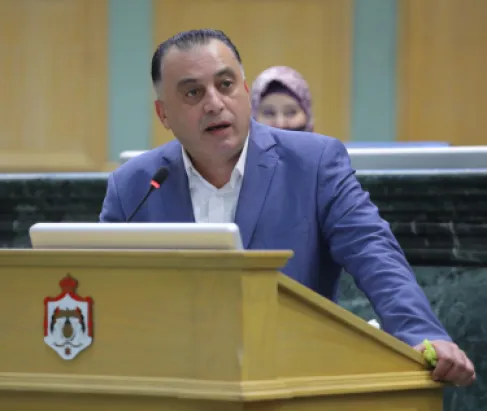
Khaberni - The first deputy speaker of the House of Representatives, Dr. Khamis Atiyah, confirmed that the Jordanian constants in the region form a solid political approach led by His Majesty King Abdullah II, based on moderation and the defense of Arab issues, foremost among which is the Palestinian cause, along with the protection of supreme national interests and enhancing internal stability.
During a lecture titled "Jordanian Constants in the Region," which was organized by the Cultural Forum Association/General Assembly of Hebron Governorate and hosted by Halhul Association, Atiyah emphasized that these constants represent the compass that governs the Jordanian state's stance amidst the region's rapid transformations, attended by political, cultural, and academic figures.
Atiyah began by emphasizing the depth of Jordanian-Palestinian relations, describing them as transcending geographic boundaries to a unity of identity and destiny, emphasizing that these historical ties are a fundamental pillar in understanding the Jordanian stance towards regional issues.
He explained that the discussion on Jordanian constants is not limited to current political stances but reflects a comprehensive strategic vision established by His Majesty the King over the years, based on balance, openness, and the ability to handle various challenges, pointing to the growing role played by His Highness Crown Prince Hussein bin Abdullah II in embodying this vision with a modern youthful spirit that enhances Jordan's presence in regional and international forums.
Atiyah stressed that the Palestinian cause remains at the core of these constants, being a matter of right, justice, and identity, affirming that Jordan will persist in its support for the Palestinian people's right to establish their independent state on their national territory with East Jerusalem as its capital, and its vehement rejection of any attempts at resettlement or imposing solutions at its expense, as well as upholding the right of return, noting that this stance reflects a political and moral commitment that is non-negotiable.
He affirmed that the Hashemite custodianship of Islamic and Christian holy sites in Jerusalem represents a historical trust and an ongoing responsibility, through which Jordan continues to defend these sanctities and protect them from violations.
He noted that Jordan has maintained its steadfast commitment to international legitimacy and has adopted a dialogue- and political solution-based approach to crises, making it a balanced and rational voice in the region, capable of building bridges of understanding between different parties, away from policies of sharp polarization, affirming that Jordanian foreign policy is based on moderation and balanced diplomacy, preserving the independence of its national decisions and enhancing the Kingdom's stature.
Atiyah affirmed that Jordan's security and stability, despite the surrounding crises, are due to wise policies and strong national institutions, including the armed forces and security agencies, which play a pivotal role in protecting the borders and maintaining national security, noting that this stability is fundamental for any effective regional role.
He pointed to the humanitarian dimension in Jordanian policy, indicating that the Kingdom has presented an advanced model in dealing with refugee crises, despite economic challenges, reflecting the authentic values of Jordanian society and enhancing the state's ethical and humanitarian stature internationally.
In domestic affairs, Atiyah emphasized that national cohesion represents the basic pillar for the success of foreign policy, explaining that the unity of Jordanians and their rally around their Hashemite leadership, and their trust in state institutions, forms the real basis for stability.
He also underscored the importance of the role of the House of Representatives, political elites, and civil society institutions in consolidating institutional work and enhancing political life, pointing out that Jordan's ability to adapt to regional and international changes without compromising its constants reflects a political maturity in crisis management, and this flexibility represents one of the strengths of Jordanian policy.
Atiyah indicated that the reform process led by His Majesty the King is an integral part of these constants, by working to enhance the modern civil state, establishing the rule of law, expanding the base of political participation, empowering parties, and developing parliamentary life, contributing to strengthen the state's resilience and its ability to face challenges.
He mentioned the role played by His Highness the Crown Prince in supporting this journey, through his engagement with the youth and encouraging them to participate in public life, considering them the pillars of the future, affirming that investing in the youth's capacities guarantees the continuation of the reform approach and enhances stability.
Atiyah concluded by affirming that the Jordanian constants in the region are not just slogans, but a comprehensive system of values and principles that govern the state's orientations, enhance Jordan's strength and regional role, and consecrates its commitment to the issues of the nation, foremost among them the Palestinian issue, Jerusalem, and its holy sites.