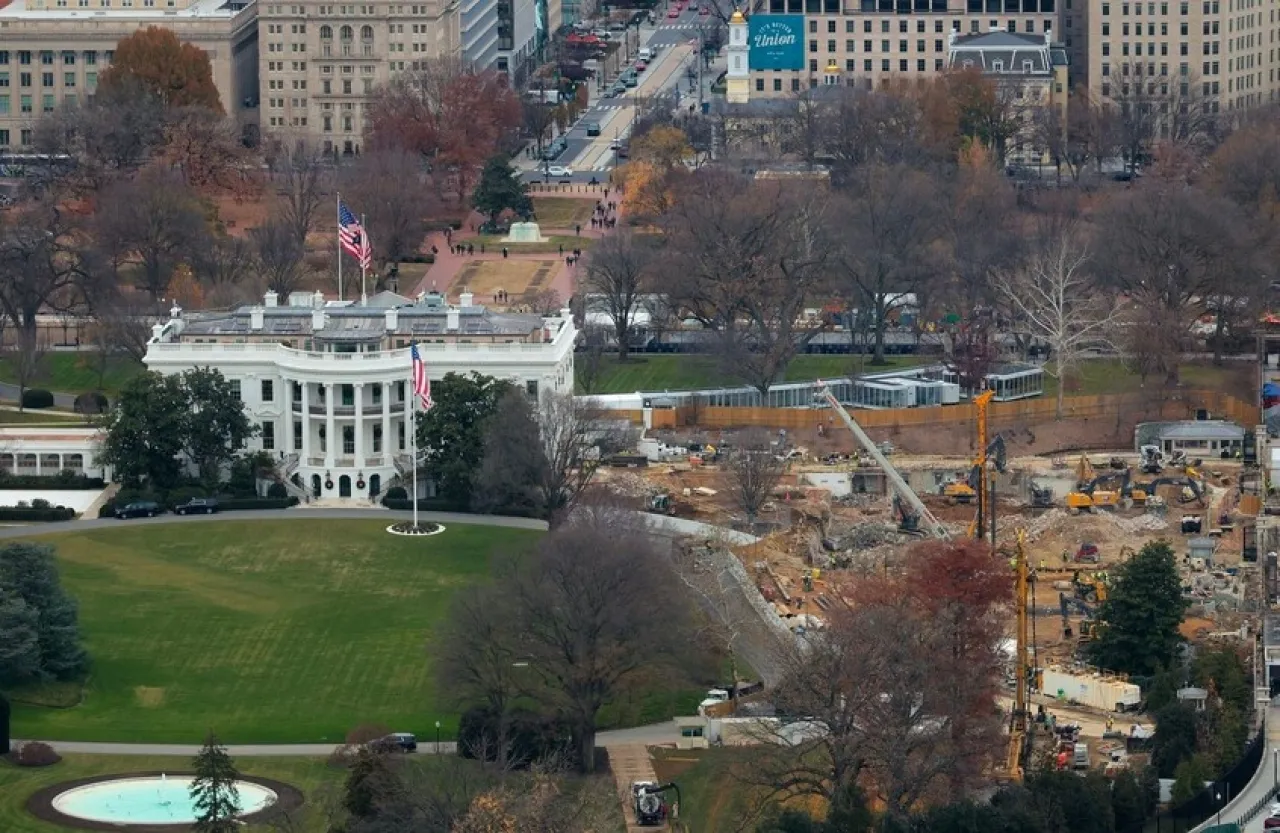
Khaberni - The banquet hall that US President Donald Trump is eager to build at the White House has turned into "rich material for debate," as The Atlantic exposes a radical and worrisome shift in the philosophy of the venerable presidential residence.
Observers believe that Trump's favored project distorts the architectural design of the White House, a building specifically designed to embody the values of democracy, transparency, and openness, far from the exaggerated isolation and fortifications.
There is growing concern about this historic edifice turning into something resembling a "military fortress," especially after Trump and his allies doubled down on their assurances that the new hall is crucial for securing the safety of the US president.
These justifications are based on precise technical details, with Justice Department memos referring to "bulletproof glass" and "heavy steel," and a sophisticated roof specifically designed to fend off drone attacks.
Furthermore, Republican congressmen have revealed plans to equip the building with windows 7 inches thick, at a time when they are pushing to spend 400 million dollars of taxpayer money on the project.
While the current administration attempts to counter lawsuits that seek to halt the construction, legal and architectural issues arise, as experts believe that the building's design blatantly violates established classical architectural norms.
Moreover, a federal judge's decision to temporarily halt the construction has sparked widespread controversy, particularly after allowing construction work on secret military installations located under the new "East Wing" of the building to continue.
In response to these developments, corridors of the White House have started to promote the idea that the upper parts of the building are closely linked to national security, altering the traditional view of the historic prestige of the American presidency.
Although tightening security is not a new issue, this straightforward emphasis on "fortifications" represents a departure from the modesty and stability approach that US presidents have maintained for decades.
Previously, officials adopted an apologetic tone when discussing security measures, always emphasizing the need to balance protecting the "First Family" with keeping the presidential residence "a house for all people."
However, highlighting this defensive infrastructure today undermines the symbolism of democracy, as the humble materials and the visibility of the building from the street used to suggest that the government remains always accountable to its citizens and under their surveillance.
From this perspective, every iron fence or armored glass panel becomes a physical and metaphoric barrier reinforcing the growing gap between the ruling authority and the general public always demanding transparency.
Previous presidents preferred discretion, practicing a kind of "optical illusion" to demonstrate openness despite the risks, but the current approach offers a bleak alternative based on total isolation behind steel walls.
Justice Department lawyers explicitly affirm that the new hall will free the president from leaving the secure confines of the White House, negating the tradition of attending major public events in the historic capital's hotels.
Looking back in history, secrecy has been the hallmark of the Secret Service since 1901, as the officers would dress in civil clothes and avoid attracting attention to ensure peace and tranquility.
The public was only aware of the defense perks during accidental incidents, as secrecy was considered an integral part of an effective and efficient presidential protection system.
Franklin Roosevelt established the first rules for this system, replacing random barriers with a sturdy iron fence while maintaining easy public access to the north side of the building.
During World War II, Roosevelt built secret bunkers underground, yet they remained completely hidden from view, preserving the image of a strong, confident state that never fears its citizens.
The security changes quietly evolved during the Cold War years, and the dramatic scene only changed after the Oklahoma bombing in 1995, as concrete barriers started to become clearly visible on Washington streets.
Although Pennsylvania Avenue was closed then, Bill Clinton addressed the public apologetically, cautioning against succumbing to a "bunker mentality" that might build a barrier between the president and the general American populace.
Today, this mentality seems to have completely taken over the political scene, with Trump openly boasting about the perks of his new "fortress," thereby breaking decades of political traditions and solid architectural symbols.