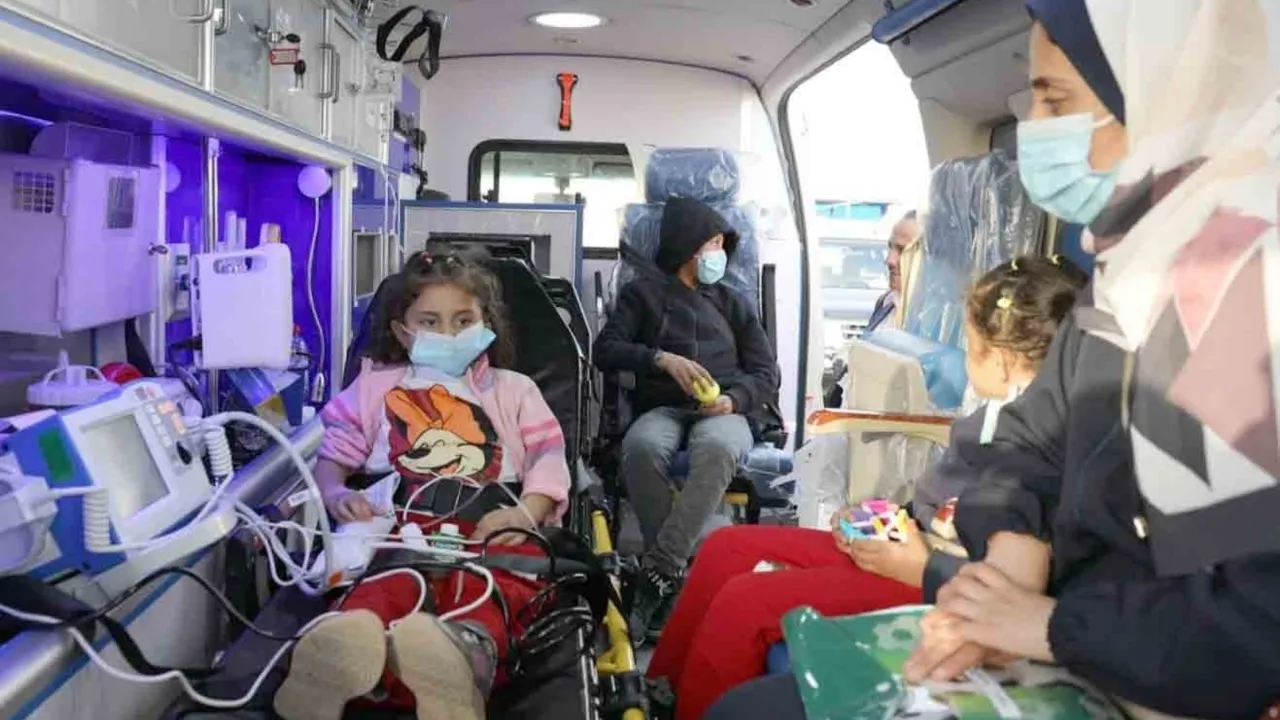
Khaberni - - The journey of Gazan children to Jordan is no longer just a transfer for treatment, but has transformed into a complete humanitarian narrative with figures and faces, encapsulated by the Jordanian Medical Corridor initiative that was launched under the directives of His Majesty King Abdullah II in March 2025, putting the lives of hundreds of children on a new path.
The reception of cases continued successively until the 26th batch arrived a few days ago.
Dr. Fawzi Hammouri, the president of the Private Hospitals Association, stated to the Jordan News Agency (Petra) that the total number of children who arrived in the kingdom has exceeded 700, accompanied by more than 1700 caregivers, in a numerical indicator that reflects the magnitude of the logistical and medical effort expended, and confirms the expansion of the Jordanian response.
He explained that the cases received by hospitals varied from direct war injuries, including limb amputations, severe head and spinal injuries, to fractures and burns, in addition to complex medical conditions such as congenital heart defects and childhood cancers, which required highly specialized medical interventions.
He noted that the Jordanian medical sector provided comprehensive care for the patients and their companions, including full coverage of expenses, precision surgical operations, and the installation of prosthetic limbs, affirming that these interventions were successful and contributed to improving the health condition of a large number of children.
Regarding the challenges, he pointed out that a significant proportion of the children coming from Gaza suffer from severe malnutrition, anemia, and advanced infections due to the acute shortage of food, medicine, and medical supplies in the sector, in addition to very difficult psychological conditions affecting both patients and their companions.
He elaborated that these challenges were addressed through specialized psychological support programs supervised by specialists, in addition to involving the children in social and recreational activities, especially during the month of Ramadan and the holidays, aiming to restore their psychological balance and alleviate the impacts of the trauma.
Hammouri affirmed that this initiative directly contributes to alleviating the pressure on the health sector in Gaza, which suffers from a severe shortage of medical staff due to targeting and depletion, and the exit of several hospitals and medical centers from service.
Behind these numbers are stories that encapsulate the extent of the tragedy, captured by (Petra), including Akram (16 years old) who had only a simple intention when he left his house in search of firewood to cook food for his family, after gas became an unattainable dream. His hesitant steps among the rubble were preempted by an explosion that claimed his destination, returning without his legs.
Today, Akram talks not so much about the pain as about "standing up again," while he undergoes a rehabilitation program in Jordan that includes fitting prosthetic limbs.
Mohammed (15 years old) tells another story that begins with a morsel of food and ends with the loss of his left leg and damage to the other, saying that the shell that fell near his house not only took part of his body but also changed the shape of his dreams, yet his treatment journey in Jordan restored his sense of a future not entirely closed off.
And Yusuf, who went out carrying a small bowl to fetch water for his family, returned with a question larger than his age: how will I walk? His injury, which cost him both legs, made his days heavy, before he found in the Medical Corridor a chance to reclaim part of his life, through limb fitting and rehabilitation programs.
The stories do not stop at these individuals; mother of Mohammed narrates how her son (10 years old) lost his hand from an explosion of a strange object he was playing with, before the shock of the injury turned into a window of hope after his case was included in treatment in Jordan, where he underwent a rehabilitation program and fitting of prosthetic limbs.
In a professional review of the numbers, Hammouri explains that the cases received by hospitals ranged between direct war injuries, including amputations of limbs and brain and spinal injuries, alongside fractures and burns, and complex medical conditions such as congenital heart defects and cancers, which required costly and specialized medical interventions.
He adds that all patients and their companions were covered completely, including treatment, accommodation, and logistical care, complex surgical operations were performed, and prosthetic limbs were fitted successfully, in addition to daily psychological support programs supervised by specialists, as well as social and recreational activities.
According to Hammouri, these numbers confirm that the initiative is not just about saving individual cases but contributes to alleviating the pressure on the health sector in Gaza, which suffers from a severe shortage of medical staff and the closure of several of its hospitals.
Between a number exceeding 700 children and the story of each one of them, a comprehensive picture of an initiative is formed not only measured by the number of operations or prosthetic limbs but by its ability to redefine hope when those who lost their legs find an opportunity to stand again.