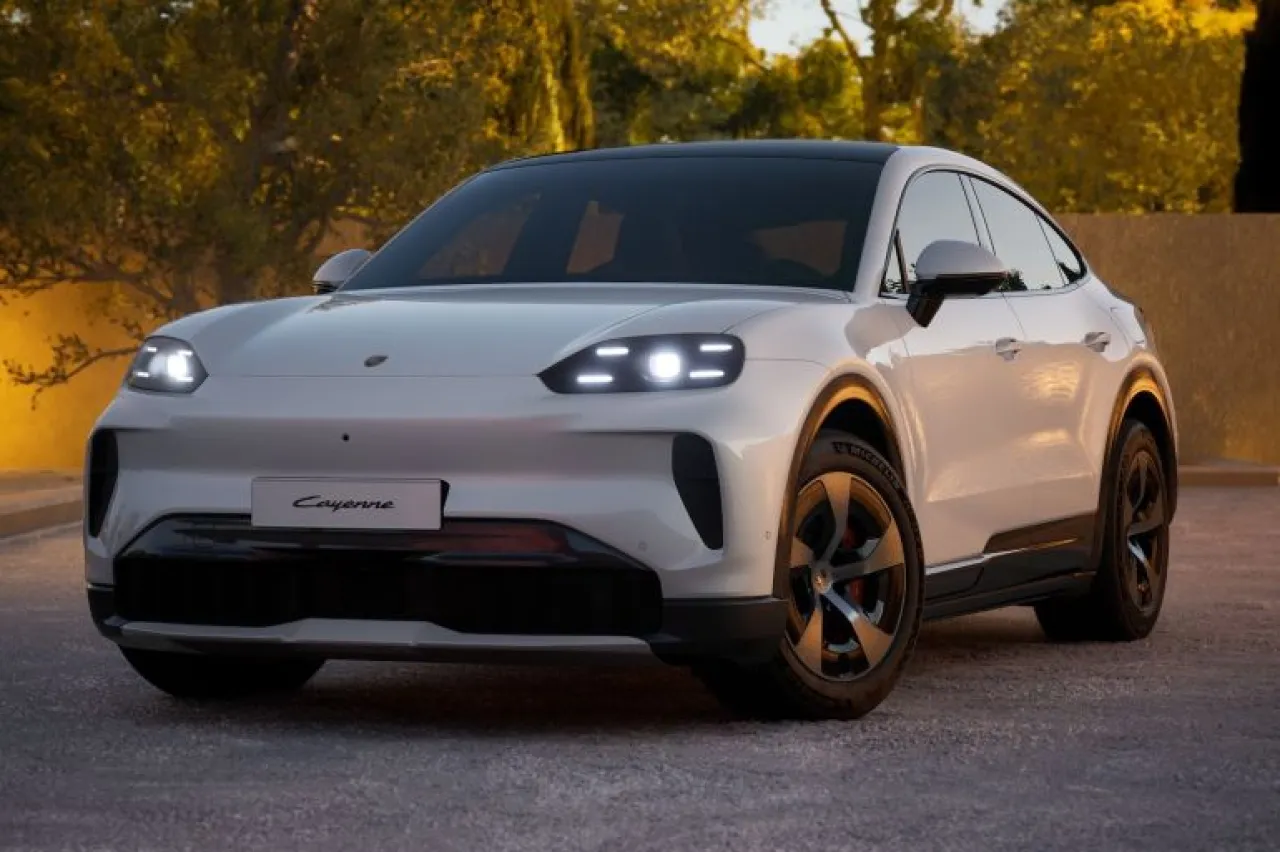
Khaberni - In a striking engineering event witnessed by the Beijing International Auto Show 2026, Porsche unveiled its anticipated model "Cayenne Coupe 2027" electric, in a step that was not just a reveal of a new car, but a clear declaration of redefining the boundaries of power in the history of the German manufacturer.
This launch represents the technical peak of Porsche's electric project. While the "Taycan Turbo GT" ruled the performance throne, the "Cayenne Coupe" has officially snatched the title, becoming the most powerful production car in Porsche’s 75-year history.
Porsche succeeded in combining unprecedented performance figures with the brand's rooted sports identity, overcoming mechanical challenges to offer an SUV that excels in acceleration and total power over its most intense sports cars, signaling that the era of electricity has provided the tools necessary to break performance barriers that were insurmountable in the era of conventional engines.
Holistic Engineering
The concept of performance at Porsche is no longer limited to the usual linear acceleration, but has moved to the stage of "holistic engineering" that integrates raw power and superior digital intelligence.
The technical pillars that made the "Cayenne Coupe 2027" the most powerful car in the brand's history can be summarized as follows:
Digital Power Sovereignty: Through the "Turbo" class, Porsche has unleashed an astonishing total power of 1156 horsepower (850 kilowatts). The (Overboost) feature stands out here as a decisive technical factor; it works to release additional horsepower and torque through an intense momentary energy flow for a brief period.
This engineering superiority not only gives the drive system an explosive response but places this SUV in direct technical comparison with the "hypercar" class, surpassing all conventional power scales in the world of commercial production cars.
Extreme Acceleration Dynamics: The car has achieved a breakthrough in response time, translating the instantaneous power of electric motors into acceleration from 0 to 100 km/h in just 2.5 seconds.
This figure not only reflects the speed of launch but also demonstrates the efficiency of the traction control system and torque distribution among the axles for a vehicle of this size and mass.
Charging Engineering Revolution" 800 volts: Porsche has invested in advanced charging architecture based on an 800-volt system, allowing the charging capacity ceiling to be raised to 400 kilowatts. This technical breakthrough addresses the biggest challenge in electric cars (the time factor), reducing the charging time from 10% to 80% to be within the range of 16-18 minutes, setting a new standard for operational efficiency.
Aerodynamic Perfection: Engineers have managed to reduce the drag coefficient to 0.23 Cd, a record number for SUVs. This high fluidity is not just aesthetic but is "silent engineering" aimed at reducing air resistance, directly contributing to battery efficiency and achieving a practical range of 669 kilometers according to the (WLTP) standard, thus combining monstrous performance and long sustainability.
Has the "Cayenne Coupe" maintained Porsche's identity?
The biggest challenge for Porsche is to transfer the "sports spirit" from the internal combustion era to the digital age without losing the sensory connection between the driver and the road.
In "Cayenne Coupe 2027", the answer appears through an integrated engineering system that ensures the car remains faithful to its heritage:
(Porsche Active Ride) system: This system is not just an advanced air suspension, but a revolution in vehicle dynamics. It operates via smart hydraulic pumps that independently control each damper, completely eliminating centrifugal forces and tilting (Roll and Pitch) during aggressive maneuvers.
The result is "flattening" the car's body movement, giving the driver the agility typically associated with the 911 models, and cleverly masking the actual mass of the batteries.
Mechanical connection via rear steering: To ensure sharp maneuvering in tight corners and stability at high speeds, Porsche has adopted the Rear-Axle Ste...