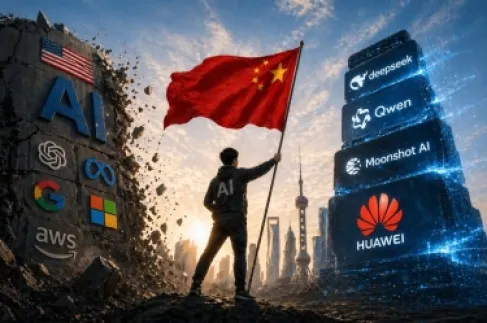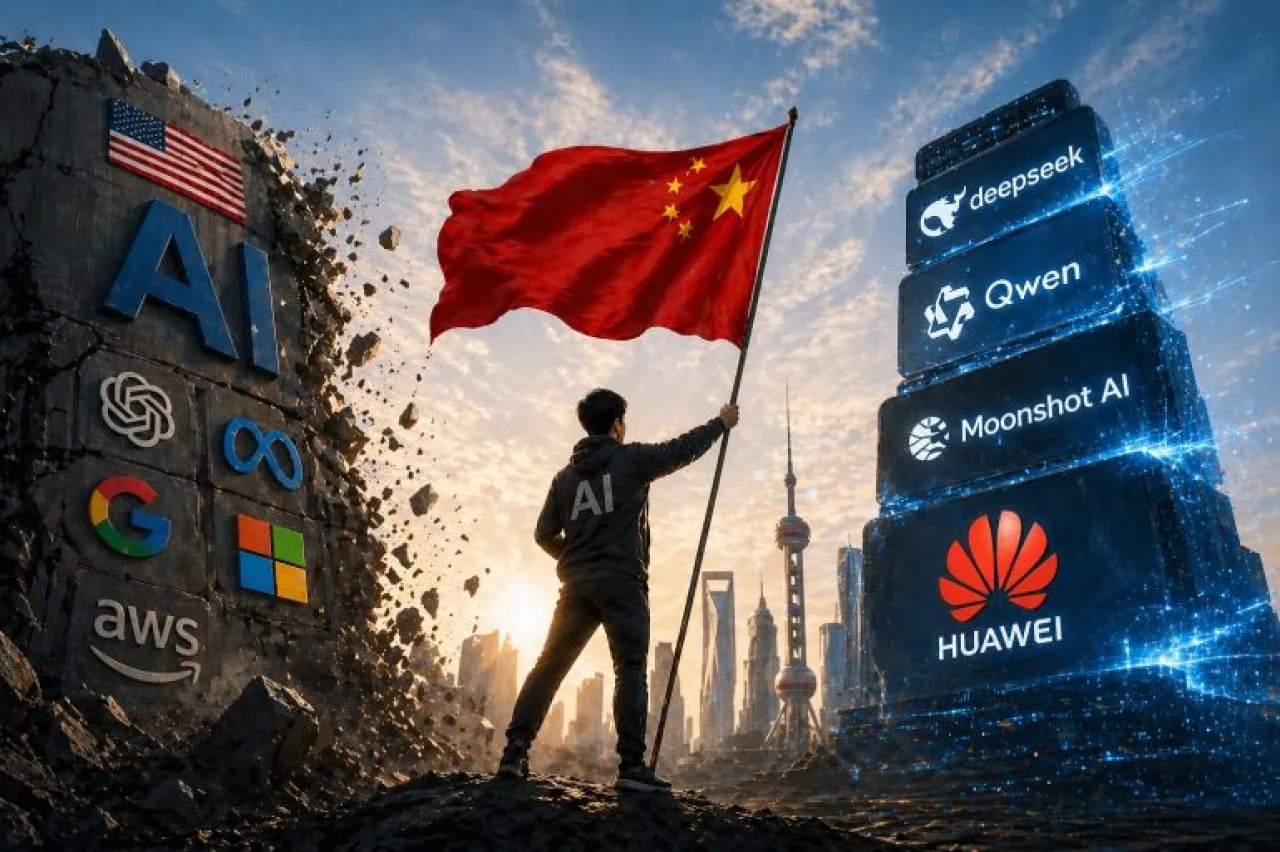
Khaberni - The competition in the artificial intelligence industry has significantly heated up in recent months between the two tech giants, represented by American and Chinese companies, each adopting a different philosophy in developing and selling their products to the end consumer.
Chinese companies find themselves unable to keep up with the financial strength of their American competitors, in addition to the sanctions imposed on them by the US government, which prevent them from accessing the latest AI chips, according to a report published by Bloomberg.
However, this has not prevented them from developing their own models capable of competing with American models at a much lower cost, and these models are surpassing US leadership in the AI industry, according to the report.
These models raise fundamental questions about the future of the AI industry and its service prices, in addition to relying on the American infrastructure that has bolstered Western dominance of the AI industry.
So, will the Chinese dragon's models succeed in usurping the throne of AI from Western companies, or at least undermine their influence in some countries?
A Completely Different Philosophy
Chinese AI companies have adopted a completely different philosophy than their American counterparts. Instead of keeping the source codes of their models and their training mechanisms secret and away from competition, these companies have made their models publicly available to developers and tech industry makers in China.
By doing so, Chinese companies are betting on open AI technologies in hopes of accelerating the adoption of technology throughout the Chinese economy, as the report indicates.
Furthermore, Chinese companies have focused their efforts on developing models as powerful as the American ones, but without the need for the robust hardware and devices available to American companies, ensuring their independence from American infrastructure, which they cannot access, and also offering their services at a much lower cost than their American competition.
The report published by Mashable confirms that the latest model of "DeepSeek V4" outperforms and slightly exceeds American models like "Cloud Ops 4.6" and "GPT 5.4", yet costs significantly less as it is an open-source model.
Circumventing Export Restrictions
US restrictions force AI chip companies like Nvidia and others to develop chips for consumption in the Chinese market that are 20% weaker and use 30% more power than their American counterparts, according to Bloomberg.
These restrictions are an attempt by the US government to undermine the development of Chinese models and make them relatively weaker compared to American ones. However, this policy has not succeeded, as Chinese companies have managed to circumvent these restrictions and develop models that are more efficient, consume less power, and computing power.
Chinese companies have opted to develop "compressed" models as much as possible so that they operate without the need to consume a lot of power and energy, meaning the model completes tasks in fewer steps than its competitors.
Bloomberg clarifies that Chinese models do not need to operate their full computing power represented in their own neural networks to respond to inquiries. Instead, they turn to specialized sub-neural networks that can respond to commands directly.
This makes models like "DeepSeek" more effective at handling direct commands compared to American models, which are able to handle a larger amount of information relatively better.
Chinese companies like "DeepSeek" have started to turn to Huawei's AI-specific chips, which can deliver performance comparable to Nvidia's chips without the restrictions placed on them and develop faster, according to the report.
It's worth noting that Chinese companies like "DeepSeek" have faced accusations from their American counterparts like "Anthropic," which stated that "DeepSeek" relied on distilling "Cloud" models to train its own models in clear violation of "Anthropic"'s terms of use.
Significantly Lower Cost
Another report from the tech site Mashable points out that the cost of using a model like "DeepSeek V4" is significantly lower than those of American companies, which also applies to the cost of consuming tokens associated with the model.
The cost of consuming one million tokens in "DeepSeek" is about $5.22 compared to about $35 for a model like "ChatGPT 5.5," the latest and $30 for a model like "Cloud Ops 4.7" and $14 in a model like "Gemini 3.1 Pro" from Google.
This makes the overall cost of using "DeepSeek" negligible compared to the rest of the American models, despite providing a very similar technological experience and delivering results accurately to the end user.
The aggressive pricing policy adopted by "DeepSeek" puts American companies in an awkward position and under continuous pressure to lower the prices of their services in any way to be able to compete with the increasingly powerful Chinese models.
Different Markets
Silicon Valley AI companies focus on European and Western customers who can afford their subscription fees and benefit greatly from their services. However, "DeepSeek" and Chinese companies have taken a different approach and turned to countries in Africa to offer their low-priced services.
Microsoft confirms that "DeepSeek" technologies have found a wide audience in developing countries, as well as African nations, according to a report published by Euro News.
The report indicates widespread adoption of the Chinese model in countries like Ethiopia, Zimbabwe, Uganda, Nigeria, and also in countries under US sanctions such as Russia and Iran.
Will Chinese companies succeed in breaking the dominance of American models?
Currently, American companies completely dominate the AI industry, from developing the necessary chips for training and operating the models to data centers and the models themselves.
However, Chinese companies threaten to break this dominance clearly with the steady progress in Huawei chips and even methods of training and operating AI models like "DeepSeek."
This threat poses a danger to American companies in more than just losing some markets and having global competition, as, in the end, Chinese companies adopt a lower pricing model than their American counterparts.
Will American companies respond to this pressure and reduce the cost of their products, even though they lose a lot of money with this high pricing policy? Or will Chinese companies succeed in taking over a significant portion of the AI industry with American companies unable to lower their prices further?