Khaberni - The Israeli Magistrate's Court in Ashkelon extended for one day the arrest of 10 "Haredim", involved in raiding the home of Brigadier Yuval Yamin, the military police commander, in the city.
Judge Yaniv Ben Harush stated in his decision: "I have decided that there is strong evidence of a criminal trespass on other people’s property and invasion of privacy, and it is of a moderate level regarding offenses of assaulting a policeman and damaging property. The degree of danger is not high, and there is a reason (cause) for the likelihood of obstructing the course of the investigation." Two youths, aged 16 and 18, were sent to house arrest (home detention) in their religious school, "Yeshiva".
Judge Ben Harush added: "After examining the request and reviewing the investigation file and hearing the arguments of the parties, I developed an impression of a reasonable suspicion. The evidence infrastructure is based on several video clips shown before me, in which many persons are seen gathering around the complainant’s house—who is the commander of the military police—some inside the home’s yard and some outside it. The police succeeded in distinguishing between those who demonstrated outside the complainant’s house and those who demonstrated inside his yard. The involved individuals who were inside the yard resisted evacuation from the site, and there was a need to use force because they did not respond to the police officers' calls, and some even provoked them."
He continued: "From the moment a group of people invade someone's yard, chanting slogans condemning him, and refusing to vacate the place while disrupting order there, it appears that these violations were fully constituted. In this context, I note that reading the testimony of the complainant’s wife shows the terror that took over the family, which remained trapped in their home for no short period. Regarding the offense of intentional damage to property and assaulting a policeman during his duty, the applicant (police) here has no direct evidence linking any of the respondents (detainees) to this particular policeman’s assault or to any specific damage."
He elaborated: "Here, the applicant (police) claims that the respondents are at least accomplices with others who were at the site. This claim is based on the fact that violence against police officers was executed during the evacuation of all involved from the yard, including the respondents. The applicant also claims that the offense of intentional damage was executed inside the yard, and hence by those present in the yard. From the investigation materials, it appears damage was done to the yard's fence and its electric gate, and several seedlings were uprooted at the site. As mentioned, the respondents were found within the yard, and although there is no direct evidence linking them to the assault on police officers or the intentional damage, I found that there is a reasonable suspicion in this regard, albeit at a median threshold."
At the end of his decision, Ben Harush wrote: "Regarding the condition of danger, it is questionable whether this condition alone justifies continuing to detain the respondents behind bars, as it appears that such a danger can be neutralized through an alternative to strict and distant detention. However, this condition does not stand alone, as there is also the condition of fear of obstructing the investigation. In this context, there are several investigative procedures liable to obstruction. We are talking about young respondents, who have no criminal records. Therefore, I found it impossible to accept the applicant's request in full, and at this stage, the arrest can only be extended for one day."
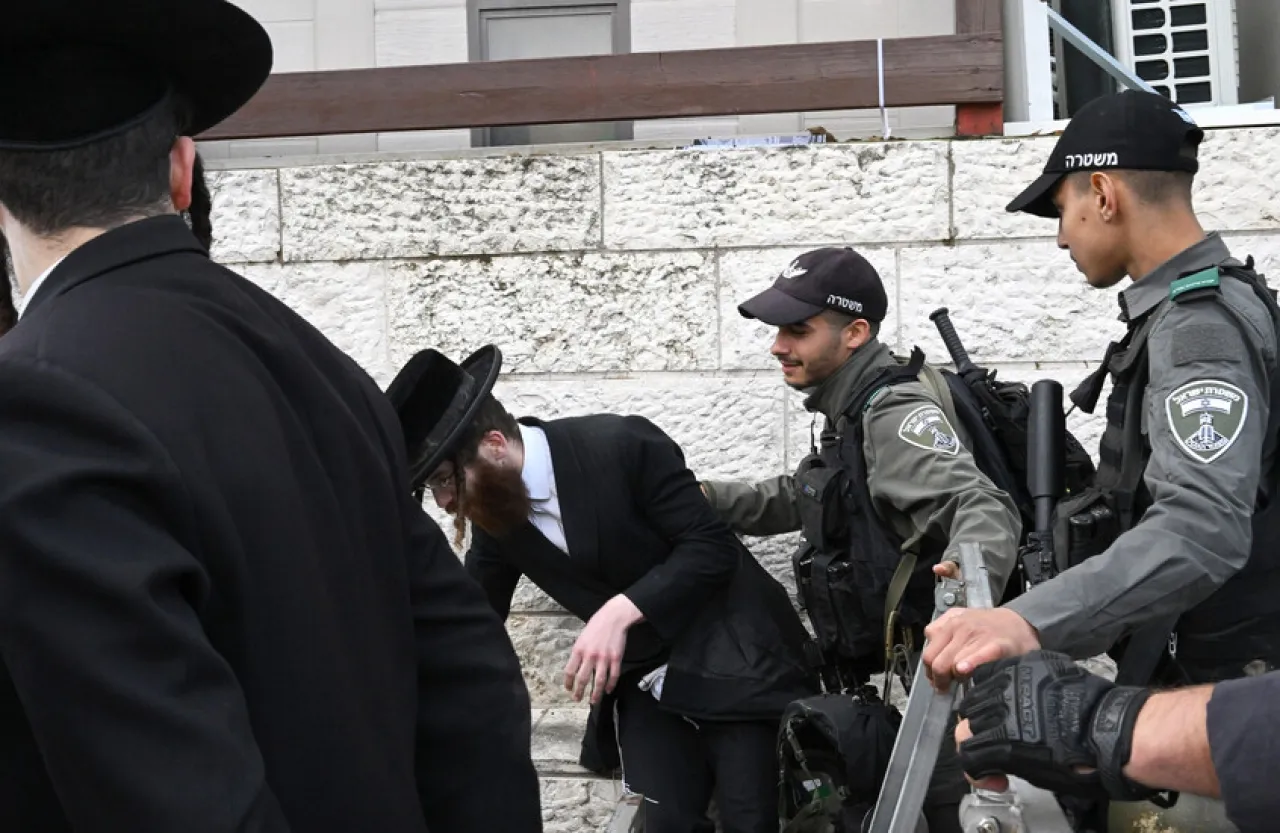
Last Tuesday evening, dozens of zealous Jews (Haredim), who expressed their protest against the renewal of the Israeli military's arrests of those fleeing military service, raided the yard of the military police commander (Brigadier) Yamin, and clashes ensued with police officers who arrived to evacuate them.
According to the site "Kikar Hashabat", the head of the "Grodna" religious school in Ashdod, Rabbi Moshe Shmida, instructed his pupils before the raid to "maintain a cover of secrecy" and to go out to Ashkelon (called Ashkelon by Israel) in "a demonstration of anger protesting the arrest of two students from religious schools". The police arrested 25 demonstrators, 13 of whom were released after a short investigation, and the rest, including 10 adults aged between 18 and 21 and two youths - ages 16 and 18, appeared in court.