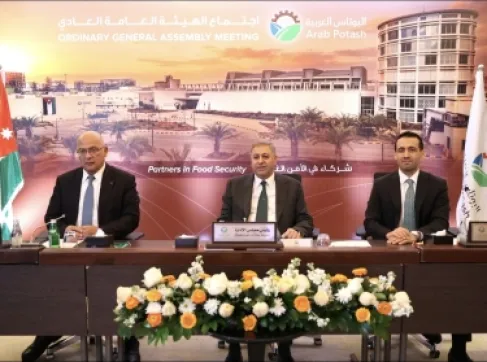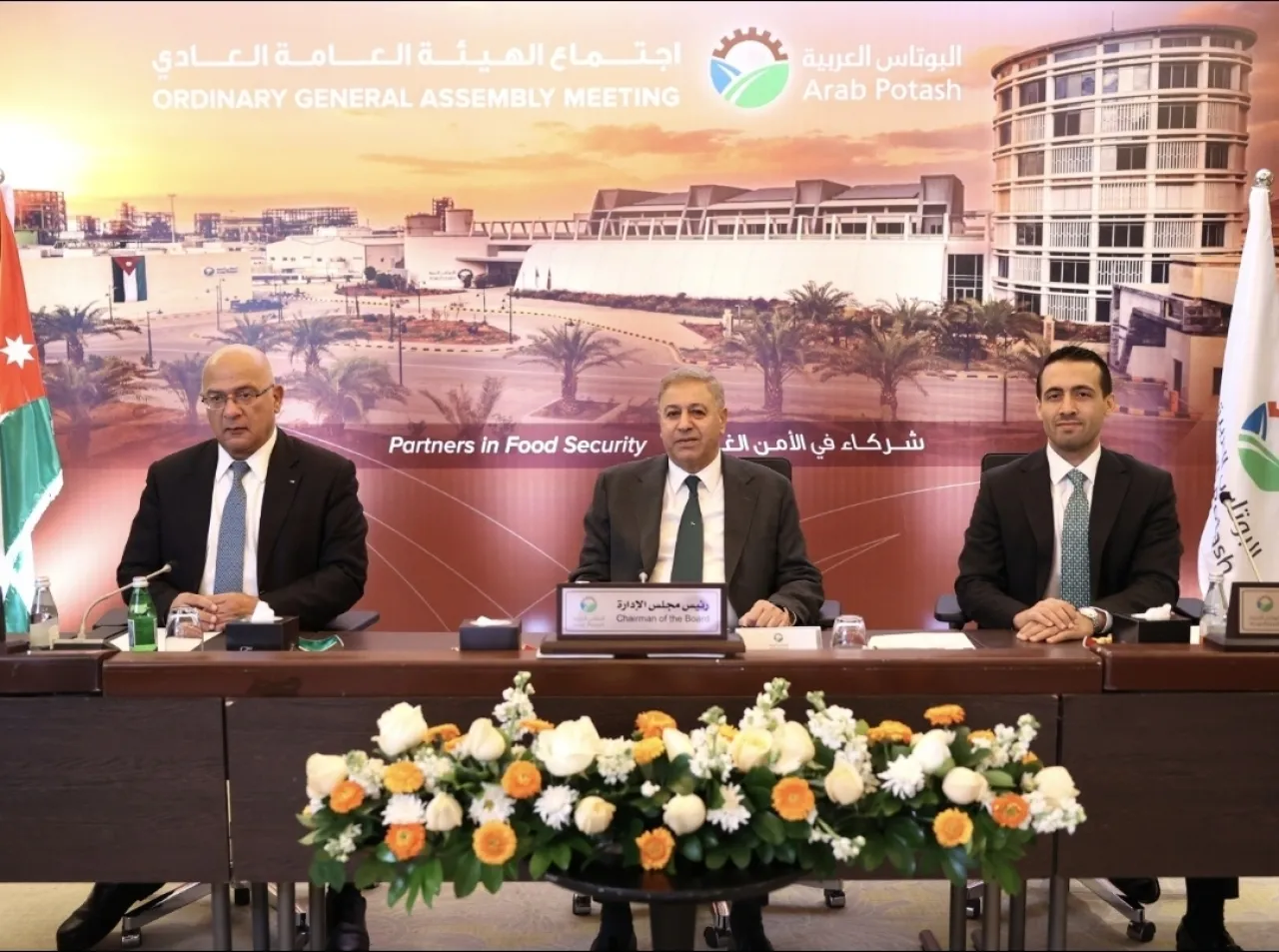
Khaberni - The General Assembly of the Arab Potash Company ratified during its ordinary annual meeting, which was held under the chairmanship of the Chairman of the Board of Directors, Engineer Shahada Abu Hudaib, and the presence of the board members and CEO Dr. Maen Al-Nsour, the board's recommendation to distribute approximately (100) million dinars as cash dividends to shareholders at a rate of 120% of the company's capital.
The General Assembly also approved during the meeting held today, Wednesday, with shareholders attending personally and by proxy, holding about 98.5% of the capital, and the General Companies Controller Dr. Wael Al Armouti, the report of the Board of Directors and the financial statements of the company for the year 2025, which showed strong financial and operational performance, supported by rising production and sales levels, and operational flexibility that enabled the company to efficiently deal with the challenges faced by the global fertilizer markets.
Engineer Abu Hudaib confirmed in his speech before the General Assembly that "Arab Potash" achieved during the year 2025 distinctive successes that represent an extension of an upward trajectory of achievements over the past years, reflected in achieving net profits of approximately (173) million dinars, as a result of continuous growth in production and sales.
Engineer Abu Hudaib pointed out that the company also succeeded in enhancing the position of the Jordanian product within the global supply chains, explaining that the company implements ambitious future plans targeting expanding its presence in the markets of Asia, Europe, and the Americas, through an integrated plan based on operational flexibility, marketing and logistical capabilities development, and leveraging digital technologies to enhance response speed to market requirements.
Engineer Abu Hudaib mentioned that the company is implementing an ambitious expansion plan that includes capital investments exceeding (3.4) billion dollars over the coming years, in addition to implementing strategic projects to increase production capacity, improve operational efficiency, and expand in value-added manufacturing industries.
Engineer Abu Hudaib outlined that the company is advancing in its major expansion projects, foremost of which is the Southern Expansion Project, which is the largest in its history and at the level of the Kingdom, aiming to increase production capacity to about (3.7) million tons annually, with investment costs estimated at about (1.1) billion dollars, expected to be completed by the end of 2029, pointing out that the company is working on implementing strategic projects in the fields of infrastructure and energy, including the railway project that will connect production sites with the Aqaba port, alongside renewable energy and water management projects, which enhance operational efficiency and reduce operating costs.
In terms of the company's contributions to supporting the national economy, Engineer Abu Hudaib emphasized that "Arab Potash" and its subsidiaries and affiliate companies contributed more than (1.37) billion dollars to the foreign currency reserves of the kingdom, in addition to playing a role in supporting national exports and enhancing the strength of Jordan's economy, pointing out that the company continues to carry out corporate social responsibility programs where the amounts allocated to these programs exceeded (43) million dinars over the past five years. Arab Potash Company has allocated an amount of (30) million dinars over (3) years to support the education and health sectors in the kingdom.
On his part, CEO of Arab Potash Company, Dr. Maen Al-Nsour, affirmed that the company adopted during the year 2025 a flexible operational approach that enabled it to maintain the efficiency of its operations and adapt to the rapidly changing global economy, including the fluctuations witnessed in the fertilizer sector, due to geopolitical changes, rising energy costs, and global supply chain disruptions.
Dr. Al-Nsour explained that the company achieved notable growth in production levels during the year 2025, where it recorded a record in production quantities reaching (2.9) million tons, with a growth rate of 19% compared to the year 2018, along with an increase in the number of high-quality potash varieties to nine varieties, compared to only three varieties previously, pointing out that the company focused last year on implementing plans and projects aimed at maximizing the use of national natural resources, expanding in value-added manufacturing industries, and enhancing its global competitiveness, in line with the objectives of the Economic Modernization Vision.
Dr. Al-Nsour added that the sales volume of the company reached about (2.88) million tons, supported by its expansion in new, high-return markets, which contributed to achieving a compound annual growth in sales revenue by 6.3% since the year 2018, in addition to a 30% increase in the average selling price per ton, which positively reflected on the profitability of the company and enhancing its competitiveness.
Dr. Al-Nsour noted that "Arab Potash" enhanced its presence in the global markets, including Asia, Europe, and the Americas, with a special focus on markets in East Asia and Southeast Asia, in addition to making significant progress in the European market through developing specialized products, establishing a commercial arm in Switzerland, and forming strategic partnerships with leading global companies, including "Yara" Group, indicating that the company continued to develop its logistical system, through adopting flexible shipping and distribution management solutions, establishing regional storage centers, and improving the efficiency of export operations through Aqaba port, ensuring continuity of supplies despite the challenges faced by global shipping routes, especially in the Red Sea.
Dr. Al-Nsour emphasized that the company focuses on achieving sustainable strategic growth by expanding its product portfolio to include specialized fertilizers and entering into quality global partnerships, enhancing its role as a key partner in the global food security system.