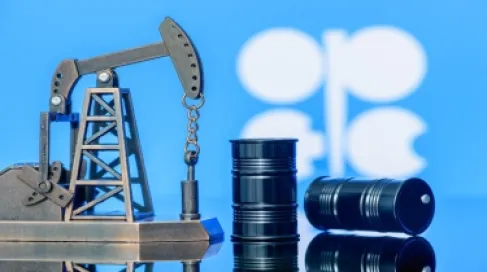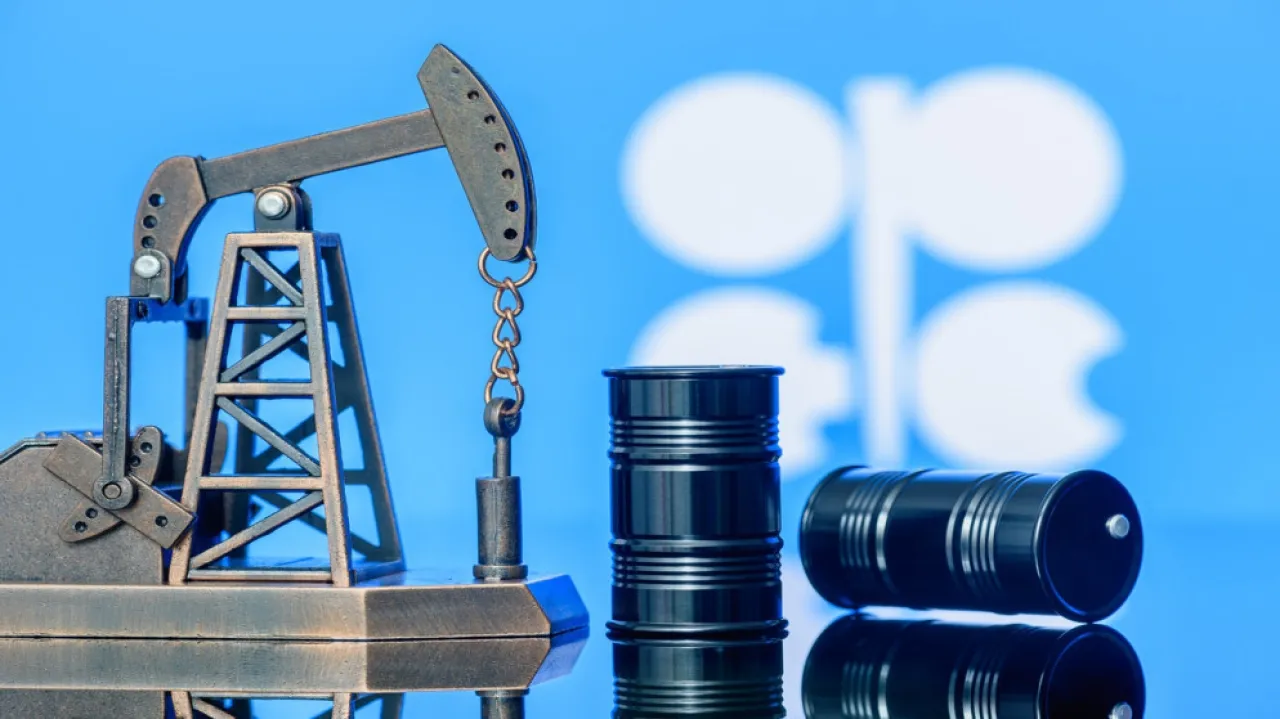
Khaberni - The UAE, one of the largest oil-producing countries in the OPEC+ alliance, announced on Tuesday that it will withdraw from the Organization of the Petroleum Exporting Countries (OPEC) and the OPEC+ alliance on the first of May.
OPEC and its allies, including Russia, collectively known as OPEC+, accounted for about 50% of the world's oil production and its derivatives last year, according to estimates from the International Energy Agency. The UAE is the fourth largest producer in the OPEC+ alliance.
The following are facts about the OPEC+ alliance and its role.
* What is OPEC and OPEC+?
OPEC was established in 1960 in Baghdad by Iraq, Iran, Kuwait, Venezuela, and Saudi Arabia with the aim of coordinating oil policies and ensuring fair and stable prices. The organization today includes 12 countries, mostly from the Middle East. The UAE joined the organization in 1967.
The UAE is the fourth producer to leave the group in the past few years and the largest ever. Angola, which joined OPEC in 2007, withdrew from the group at the beginning of 2024, citing disagreements over production levels. Ecuador also withdrew from OPEC in 2020 and Qatar in 2019.
According to calculations, the group produced more than half of the world’s crude oil in the seventies, before the emergence of supply sources from outside OPEC such as the North Sea.
In subsequent decades, OPEC's share ranged between 30% and 40%, but the record growth in production from competitors such as the United States steadily eroded that share.
OPEC sought to regain its influence in 2016 by forming an alliance with 10 non-member countries, including Russia, which it named the OPEC+ alliance.
According to the International Energy Agency, its market share rose to about 51.15 million barrels a day, or nearly 50% of global oil production and its liquids, in 2025. That share fell in March, a month after the outbreak of war with Iran, to about 44%.
* The war between the United States and Iran reduces UAE production
Before the outbreak of the war between the United States and Iran at the end of February, the UAE was producing 3.3 million barrels a day, with the capacity to produce up to 4.5 and five million barrels a day of crude oil and its liquids.
Its importance in OPEC has grown in the past given that it, along with Saudi Arabia, a prominent OPEC member, had surplus production capacity that could be added to the market if necessary.
This became theoretical since the unprecedented disruption in the oil market caused by the actual closure of the Strait of Hormuz since the war with Iran.
According to OPEC, crude oil production in the Gulf member states of the OPEC+ alliance dropped by about eight million barrels a day in March compared to February, as Saudi Arabia, the UAE, Kuwait, and Iraq all reduced their production.
This reduction was necessary; given the limited export capabilities of these countries, despite having some potential to bypass the Strait of Hormuz.
Saudi Arabia has a pipeline with a capacity of seven million barrels a day reaching the Red Sea, while the UAE can export between 1.5 and 1.8 million barrels a day through a pipeline reaching the port of Fujairah.
* OPEC and global oil prices
OPEC+ says it cuts and occasionally increases oil production to balance the markets.
Its critics say the group manipulates prices, which OPEC denies.
During the 1973 Arab-Israeli War, the Arab members of OPEC imposed a ban on the United States in response to its decision to resupply the Israeli military, as well as other countries that supported Israel. This ban included stopping oil exports to those countries.
The oil embargo pressured the already struggling US economy, which had increased its dependence on oil imports. Oil prices increased significantly, causing fuel costs for consumers to rise and shortages in supplies. The embargo also pushed the United States and other countries to the brink of a global recession.
US President Donald Trump accused the organization of "taking advantage of the rest of the world" by inflating oil prices. Trump also linked US military support for the Gulf to oil prices, saying that while the United States defends OPEC members, they "exploit it by imposing high oil prices."
However, Trump contributed to persuading the OPEC+ alliance to reduce production in 2020 during the COVID-19 pandemic, as crude oil prices fell and US oil producers suffered as a result.
According to data from the Kepler company, OPEC's crude oil exports in 2025 accounted for about 47% of global seaborne crude oil exports. The data added that this share decreased to 34.7% in March.
* What are the member countries of OPEC?
The current members of OPEC are Saudi Arabia, the UAE, Kuwait, Iraq, Iran, Algeria, Libya, Nigeria, Congo, Equatorial Guinea, Gabon, and Venezuela. The UAE announced that it would withdraw from the group on the first of May.
The OPEC+ alliance includes non-OPEC countries such as Russia, Azerbaijan, Kazakhstan, Bahrain, Brunei, Malaysia, Mexico, Oman, South Sudan, Sudan, and Brazil, which joined in early 2025.