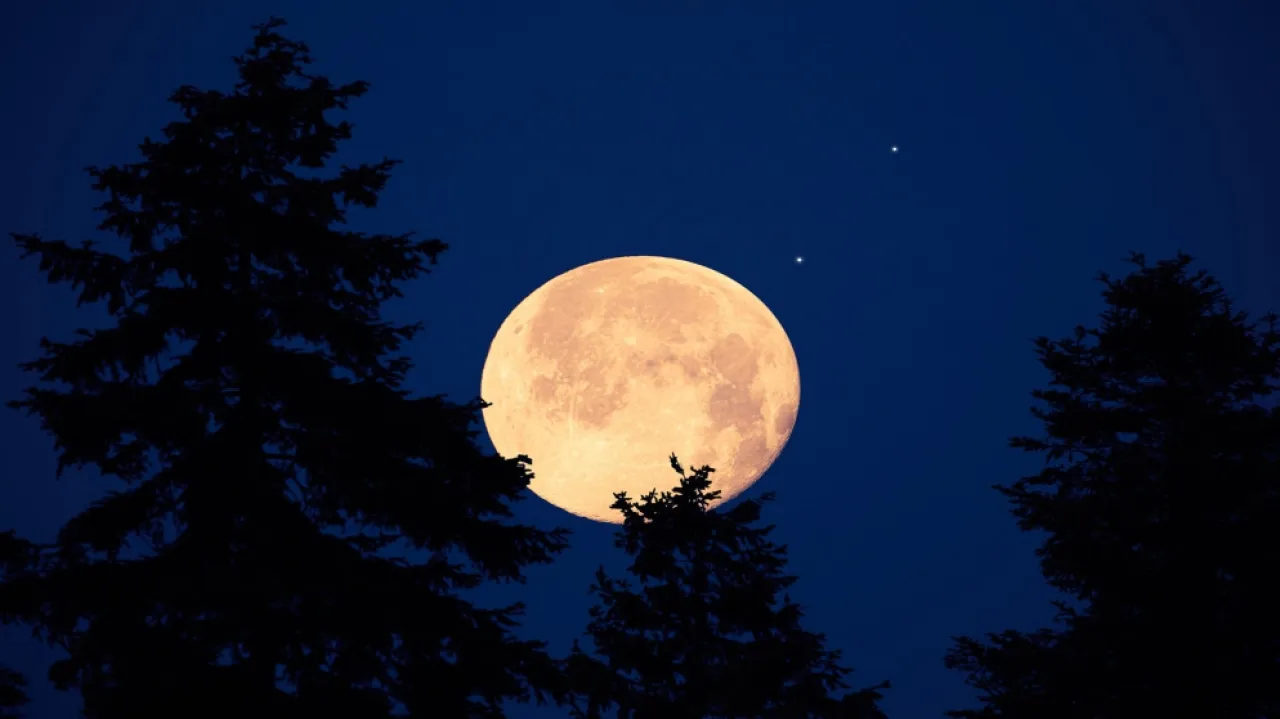
Khaberni - The residents of Jordan and the Arab region are anticipating a distinct astronomical event during the month of May NEXT, characterized by the occurrence of two full moons within the same calendar month, a phenomenon that occurs infrequently, giving this month a special significance for astronomy enthusiasts, according to Ammar Al-Sakaji, president of the Jordanian Astronomical Society.
He explained that the first full moon will complete on the evening of the first Friday of May at 8:26 PM Jordan time, marking the beginning of a fully illuminated lunar month, while the second full moon, known colloquially as the "Blue Moon," will complete on the morning of Sunday, May 31 at 11:49 AM.
Despite the common name, the “Blue Moon” is not related to the color of the moon; it is an astronomical term that is issued based on two common definitions; the first is the occurrence of two full moons in the same calendar month, which is the more common definition, and the second is that it is the third full moon out of four that occur within a single astronomical season, according to Al-Sakaji.
He pointed out that this phenomenon is considered relatively rare, as it occurs approximately every two and a half to three years due to the difference in length between the calendar month and the lunar month, i.e., the difference between the lunar cycle and the solar cycle, which sometimes allows two full moons to appear within the same month.
This phenomenon provides a unique opportunity for observation and photography, as the moon appears fully luminous, adding a unique visual scene to the spring sky in Jordan and the world, according to the Jordanian Astronomical Society.
The "Blue Moon" phenomenon may occur more than once during the same year; indeed, this occurred in 2018 when the months of January and March each experienced a “Blue Moon,” while February had no full moon. It is expected that this pattern will recur in 2037, with a "Blue Moon" recorded in both January and March as well.