Khaberni - A recent scientific study has revealed a mathematical explanation for a phenomenon that most drivers experience daily, characterized by their feeling that the slower cars eventually catch up with the faster cars, despite the clear speed difference between them.
The study was conducted by researcher Connor S. Bolland from Dublin City University in Ireland, who addressed this phenomenon in a scientific paper published in the journal Royal Society Open Science, naming it "Voorhees's Traffic Law".
Bolland was inspired for the name by the character Jason Voorhees, the famous villain in the "Friday the 13th" movie series, who always seems able to catch up with his victims despite moving slowly.
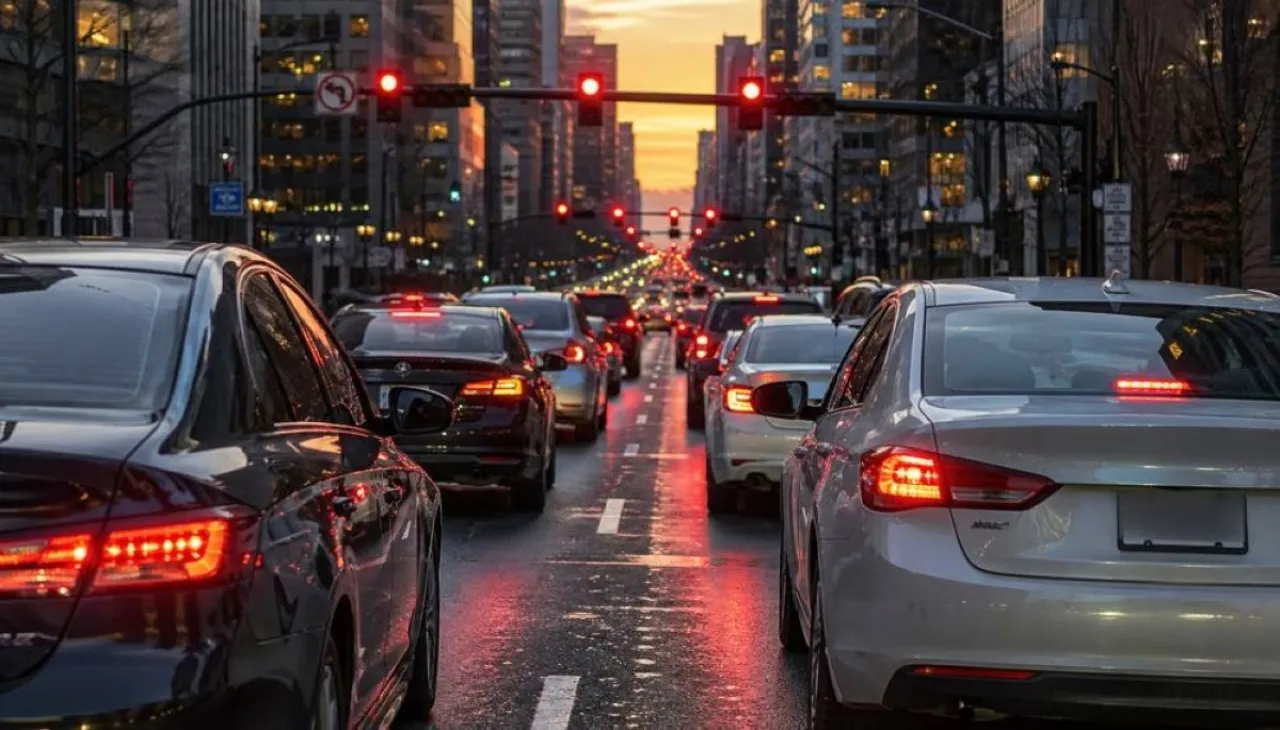
The study found that traffic signals play a crucial role in this phenomenon. After two cars with different speeds start from the same light signal, the difference in speed alone does not determine the distance between them. Instead, this distance is also affected by the pattern of traffic light operation, their timing, and the duration of each signal in its complete cycle. In some cases, these signals can completely eliminate the time difference between the two cars, significantly hindering the faster car's ability to progress.
According to the research findings, the chances of the slower car catching up to the faster one vary depending on the type of traffic signal system.
If the signals operate within synchronized cycles, also known as a "green wave," then the cars move at almost a uniform pace, where they approach and distance from each other without the leading car typically losing its position.
However, if the traffic lights are independent and unsynchronized, the probabilities clearly favor the slower car.
Mathematical calculations indicate that having one independent traffic light gives the slower car a 42% chance of catching up to the faster one, which increases to 78% after passing three signals, and exceeds 98% when crossing eight signals.
This phenomenon is more pronounced in urban environments, where intersections are closer and traffic lights are more frequent, compared to rural areas, which have fewer stop points, making urban drivers more prone to notice this repeated pattern during their daily commutes.
Although the study assumes that cars travel at constant speeds, which is rare in practice due to frequent stopping and starting at signals, its results provide a convincing scientific explanation for a common feeling among drivers, and help in understanding traffic dynamics more deeply. These results may contribute in the future to improving traffic light management systems and reducing congestion in cities.