Khaberni - The ice in the depths of Antarctica is not just a frozen mass, but a huge natural archive that preserves the history of the Earth itself. There, within layers that have accumulated over millions of years, scientists have been able to extract ancient air bubbles, which contain traces of the atmosphere as it was about 3 million years ago. What emerged from this ice was not just ordinary scientific data, but surprises that reopen old questions about what Earth's climate was like, how it changed over the ages, and whether the factors we know today are truly sufficient to explain what happened in the distant past.
The analyses showed that the atmosphere millions of years ago was more stable than previously thought, and that greenhouse gas levels remained within a narrow range for very long periods, despite clear changes in ocean temperatures and ice sheets.
What is even more exciting is that these results suggest that Earth’s climate is not governed by gases alone but is also affected by deeper and more complex factors such as ocean currents, the Earth's surface reflectivity of sunlight, and gradual changes in ice and continent distribution. These findings open a new door for scientists to rethink the laws that govern the climate system across the ages.
Ancient climate scientists have extracted a crucial climate record from the depths of the Antarctic ice, revealing secrets about Earth's atmosphere about 3 million years ago, in a discovery that raises new questions about our understanding of the climate history.
The results, which are part of research by the American COLDEX center, were based on air bubbles trapped inside the ice for millions of years, acting as time capsules preserving the composition of the ancient atmosphere. Through analysis of these bubbles, scientists discovered that carbon dioxide levels during that era were relatively stable, ranging around 250 parts per million, and never exceeding 300 parts per million for long periods, which is much lower than some previous estimates.
The big surprise is that this stability in gases did not coincide with climatic stability, as the second study showed that ocean temperatures fell significantly during the same period, by about 2 to 2.5 degrees Celsius, a substantial cooling that led to the formation and expansion of ice sheets in the northern hemisphere. This disparity between gas stability and temperature change prompted scientists to reconsider the factors that control Earth’s climate.
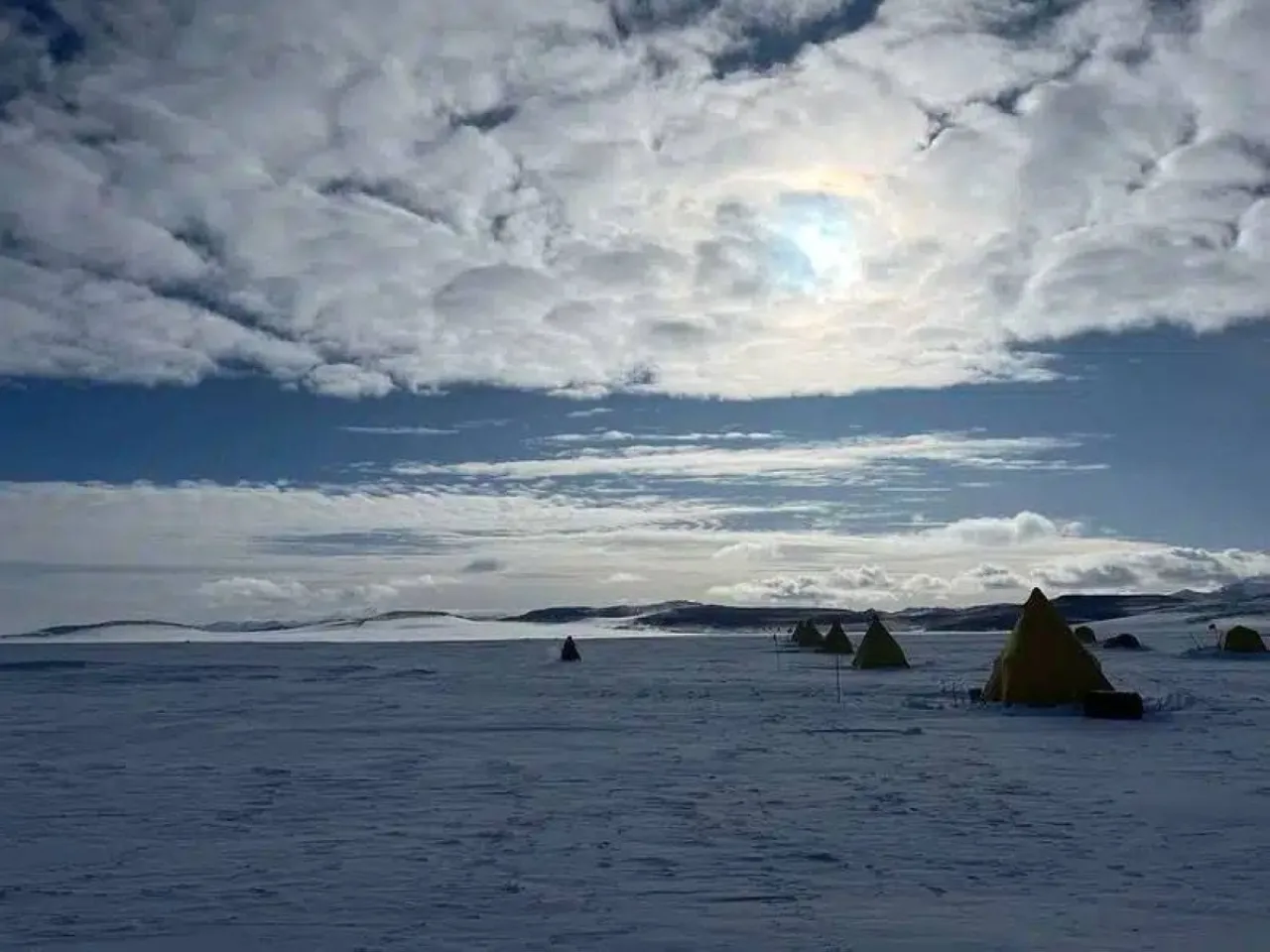
The researchers in this study relied on samples taken from an area known as "Allan Hills" in eastern Antarctica, a unique area where old ice layers are exposed due to the movement of the ice sheet and strong winds, allowing access to materials from very distant times.
Using the air bubbles trapped in the ice, the team was able to measure carbon dioxide and methane levels directly for the first time over a period of three million years. The results showed that methane levels remained relatively low, while greenhouse gases did not show significant increases as previously thought.
In a parallel study, researchers used inert gases like xenon and krypton, trapped inside the ice, to estimate global ocean temperatures. The results showed that ocean depths began to cool before the surface for a long period, and that this cooling continued for about a million years, while the decrease in surface ocean temperatures was delayed, suggesting a complex role for ocean movements in shaping global climate.
These findings suggest that past climate change was not linked only to greenhouse gas concentrations but was also influenced by other factors such as the reflectivity of the Earth's surface, changes in the distribution of continents and ice sheets, and the dynamics of oceans playing a fundamental role in redistributing heat around the planet, according to the "dailygalaxy" website.
While these discoveries do not lessen the seriousness of current climate change linked to human activities, they reveal that the Earth's system is more complex than previously thought, capable of entering long periods of cooling or warming due to the interaction of several natural factors.
Scientists are now continuing to work on older samples that may be up to 6 million years old, in an attempt to extend the climatic record into deeper ages of Earth's history, which may open the door to a more precise understanding of how the climate evolved over millions of years, and perhaps better predict its future.