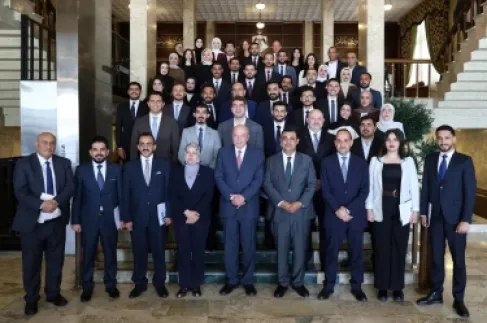
Khaberni - Speaker of the House Mazen Al-Qadi said on Monday that the Jordanian narrative represents a comprehensive national project for building and enhancing cohesive national awareness, through documenting the contributions of Jordanians in building their state at pivotal stations based on the values of loyalty, building, achievement, and giving.
Al-Qadi's remarks came during his meeting with the president and members of the committee "The Jordanian Narrative from the Great Arab Revolt until our present time".
Al-Qadi pointed out that the Jordanian narrative project, supported by His Majesty King Abdullah II, and closely followed by His Royal Highness Prince Hussein bin Abdullah II, the Crown Prince, demonstrates the royal commitment to the significance of reinforcing the national identity and preserving the historical memory of the state.
Al-Qadi said that His Majesty's directives and His Royal Highness the Crown Prince's guidance serve as a fundamental motivation to proceed with this project, enhancing Jordanians' confidence in their homeland and leadership.
He affirmed that the Jordanian narrative came as a sincere voice reflecting the deep identity of Jordan, extended between history and the present, and re-formulates the national story, representing a platform of inspiration and hope for generations in writing and documenting the history of the homeland.
On his part, the committee chairman Bassem Al-Batoush stated that the Jordanian narrative project represents an unprecedented scholarly and documentary effort, aiming to collect national narratives within a methodological framework that observes accuracy and objectivity, and is supported by reliable sources reflecting various stages of the development of the Jordanian state.
He added that the committee is working on providing content that reflects the social and cultural diversity in Jordan, and highlights the contributions of Jordanians in building their state, noting that the narrative includes various sections of society, enhancing the sense of participation and belonging for all community groups.
He explained that the project aims to employ modern tools in documenting and presenting, in a way that keeps up with the developments of the digital age, making the narrative accessible to young generations in a language familiar to them, without compromising its historical and intellectual depth.
In turn, the committee members emphasized that the narrative reflects the leadership's belief in the importance of establishing national identity and enhancing collective awareness, stressing that this project constitutes a fundamental pillar in the state's journey towards the future, and preserves its legacy for future generations.