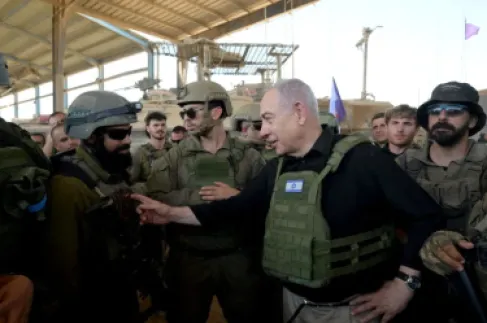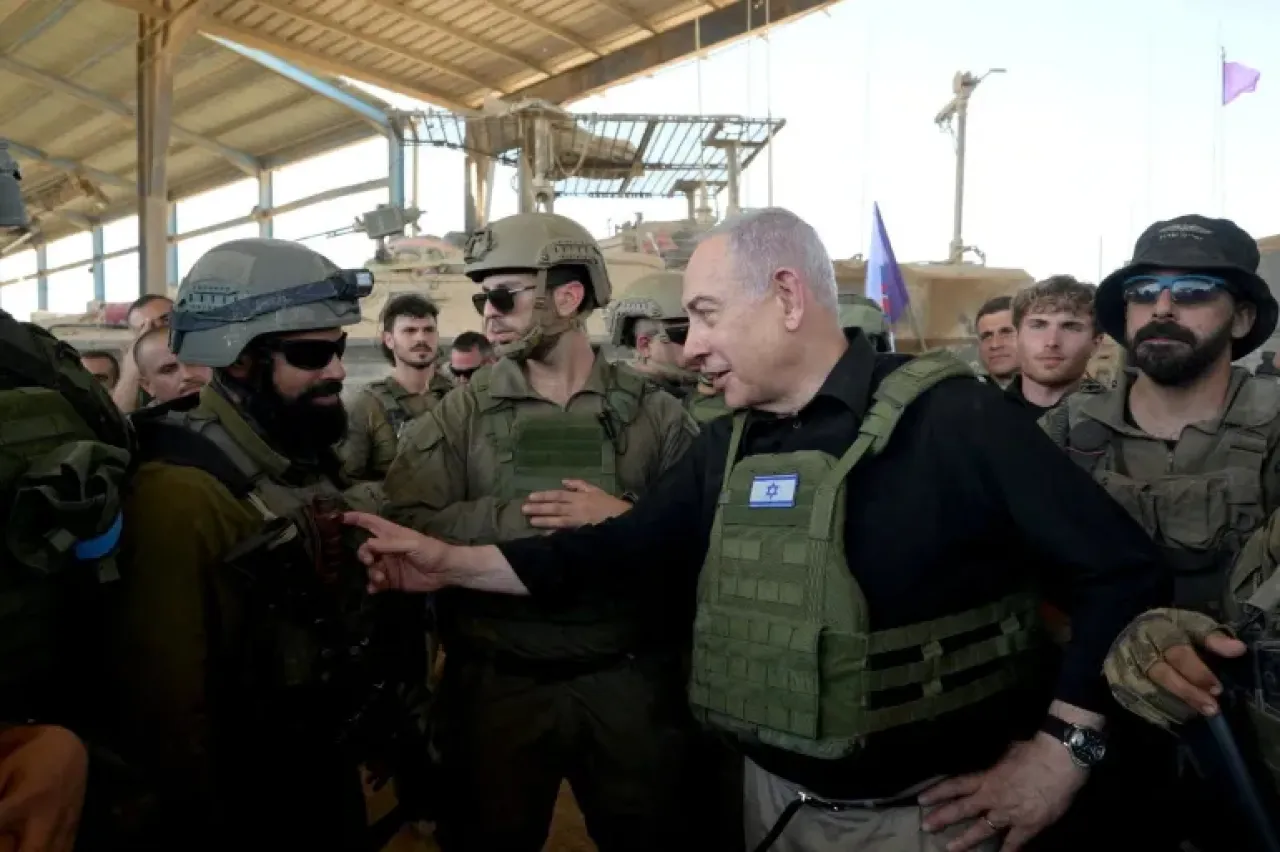
Khaberni - "Yisrael Hayom" newspaper said, quoting Israeli military officials, that Prime Minister Benjamin Netanyahu's announcement last Saturday ordering the military to respond forcefully to Hezbollah in Lebanon is a show of force intended to alleviate internal pressure, and an attempt by him to shift the responsibility onto the military under the pretext of not achieving the desired results.
The newspaper added that - two and a half hours after Netanyahu's announcement - the army spokesperson issued a statement indicating that the forces had attacked buildings used for military purposes by Hezbollah in areas of southern Lebanon, affirming the continuation of firm action to confront threats against Israelis and military forces, according to instructions from the political echelon.
High-ranking military officials clarified that Netanyahu's statement is merely a deceptive attempt aimed at alleviating public pressure, noting that there has been no actual change in military instructions — which remained as they were — in response to the events or in an attempt to prevent them.
The sources added that Netanyahu's statement was not random, but aimed at blaming the military for not achieving the desired results, confirming that the operations are carried out precisely according to instructions from the political echelon, and even according to directives dictated by US President Donald Trump, who announced a ceasefire in Lebanon for ten days, then extended it by an additional three weeks.
According to the newspaper, this is not the first time in recent weeks that a conflict has arisen between the military and the political echelon regarding military operations in Lebanon. At the beginning of the month, a high-ranking officer, in a briefing to journalists, stated that the operations in Lebanon are not aimed at disarming Hezbollah and will not achieve that.
The newspaper adds that these statements contradict the public statements of the political echelon, which has created a perception among the residents of northern Israel that this round will not end without decisive results.
According to "Yisrael Hayom," these conflicts are just the tip of the iceberg of a growing sense within the military and security establishment that Netanyahu is looking for a "scapegoat" to blame for the disappointing results in Lebanon and the partial results in Iran.
The newspaper added that the Iranian scene might see the foreign intelligence agency (Mossad) blamed, while the army is expected to be fully responsible for Lebanon, despite carrying out operations precisely according to instructions from the political echelon.
The field situation is becoming more complex
According to "Yisrael Hayom," as the frictions between the political and military echelons escalate, the field situation is becoming more complicated, noting that the Israeli military actually controls wide areas and various sites in southern Lebanon, but movement restrictions hinder its ability to provide full protection for northern towns and its forces deployed in the field.
The newspaper added that Hezbollah again exploited the ceasefire and what it described as the "defensive nature of the military activities," launching an attack on a force from the Golani Brigade in the town of Taybeh, resulting in the death of a soldier and injuries to others.
It noted that although the military declared it would respond, it moved this time also within the "allowed ranges" in southern Lebanon.
The newspaper mentioned that this deadlock in military activity is a confirmed recipe for more Israeli casualties and increasing frustration among the ranks of the military, pointing out that the current conditions are more complicated, given the number of forces, the nature of their presence in the field, movement restrictions, the quality of weapons available to the opposing side, and Hezbollah's motivation to fight.
The newspaper noted that public statements about the army's presence in Lebanon and the management of negotiations under fire represent a recipe for the continuation of this reality in the near future.
US President Donald Trump last Thursday announced a three-week extension of the ceasefire that began on April 17, following a new round of talks at the White House between the ambassadors of Lebanon and Israel.
Despite the truce being in effect, Israel continues to carry out airstrikes and artillery strikes in southern Lebanon, announcing the establishment of what it calls the Yellow Line and preventing residents from returning to dozens of villages within it.