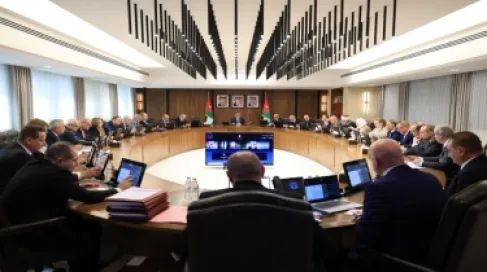
Khaberni - The Cabinet decided in its session held today, Sunday, chaired by Prime Minister Dr. Jaafar Hassan, to approve the disbursement of dues for 72 industrial establishments based on the value of their exports, which had accumulated over the years 2019, 2020, and 2021 and had not been paid at that time, with a total amount of approximately 15 million dinars, noting that the export support program had been halted after that period.
This decision is expected to enhance liquidity in the industrial sector, encourage exports, stimulate productivity, and strengthen investment and the competitiveness of the national economy.
The decision includes allowing eight industrial establishments, whose dues exceed 500,000 dinars, to obtain financing guaranteed and repaid in installments by the government, while the dues of other establishments whose dues are less than 500,000 dinars will be disbursed through the Ministry of Finance in coordination with the Ministry of Industry, Trade, and Supply.
This decision is an important step in alleviating the beneficiary establishments and increasing their competitiveness and growth locally and internationally through providing financial liquidity to them, enabling them to continue their activities more effectively, expand and increase production.
The decision is expected to support both large and small establishments, as this measure alleviates the financial burden on large companies helping them to meet their obligations, and allows small and medium-sized establishment owners to obtain their dues directly through the Ministry of Finance, enhancing the stability of these companies and contributing to their development.
As part of the steps related to implementing major projects, the Cabinet approved a set of incentives, exemptions, and benefits for the Jordanian company for Urban and Facility Development relating to priority projects of the first phase of the Amrah City Project, which include projects (Prince Hussein bin Abdullah II Stadium, the International Convention and Exhibition Center, the Entertainment City, King Abdullah II Ibn Al Hussein Sports City, the Omra City Master Plan, and Infrastructure Project beside the projects that will be added later).
In the context of supporting economic activities in the special economic zone of Aqaba, the Cabinet approved a decision by the board of commissioners of the Authority including launching a package of exemptions and reductions on building and land tax in Aqaba.
The decision continues the government’s efforts to support economic activities, stimulate investment, and enhance the competitiveness of the investment environment in the province.
The incentives include a 50% reduction on building and land tax for the years prior to 2026, provided that all dues are paid before the date of 31/7/2026, in addition to a 100% exemption from penalties due on building and land tax for taxpayers who pay the principal tax owed before the end of 2026.
These incentives are expected to alleviate the financial burdens on citizens and investors, rejuvenate economic and real estate activities, and enable taxpayers to regularize their financial statuses, supporting the sustainability of economic activity and providing a more flexible and attractive investment environment in Aqaba.
The incentives will be implemented starting from the date of this decision until 31/12/2026, according to the controls and procedures specified by the Authority.
In the context of decisions related to supporting the agricultural sector, the Cabinet approved the justifications for the draft amendment to the Wholesale Markets for Fruits and Vegetables Regulations for the year 2026.
The draft regulation aims to enhance the regulatory role of the Ministries of Local Administration and Agriculture over wholesale markets, and to organize the trading operations of horticultural products, ensuring the rights of both farmers and consumers, and achieving a balance in the prices of agricultural products.
The draft regulation allows municipalities to set up joint markets, ensuring the quality of agricultural services and improving the efficiency of marketing national products, in addition to granting the right for one or more municipalities to establish a wholesale market within the boundaries of one, specifying the management mechanism, contribution rate, financial resource shares, and collected fees in a formal agreement between the concerned municipalities.
These amendments are expected to ease the financial burdens and operational costs on municipalities, especially those unable to establish individual markets, which contributes to unifying efforts to serve the agricultural sector and providing an organized environment for selling products.
The decision also supports farmers by providing opportunities for them to promote their products within official markets, regulate random sales operations, in addition to creating new job opportunities and improving the financial resources of municipalities.
The new amendments will improve management mechanisms within central markets, in line with the targets of the economic modernization vision in the agricultural sector and achieving food security, developing market infrastructure, and enhancing the efficiency of marketing national agricultural products.
By virtue of the new amendments, modern control tools will be activated, and the work of operating entities within the markets organized; this contributes to limiting price distortions and ensuring transparency in commercial transactions within the wholesale markets across the various provinces of the Kingdom.
In the context of supporting and encouraging economic activities and relieving citizens, the Cabinet also decided to extend the work of the Tax Settlement and Reconciliation Committee; this allows companies, establishments, and taxpayers to submit settlement and reconciliation requests for accumulated tax claims during previous years, achieved up to the date of 31/12/2024, until the end of the business day on 30/6/2026.
The decision aims to enable companies, establishments, and taxpayers to settle their accumulated tax obligations on companies, establishments, and individuals from previous years and clear their tax liability, in addition to stimulating economic activities and ensuring their sustainability.
The decision also includes that the tax claims achieved from 1/1/2025 onwards are not included in the settlement and reconciliation requests.
In the context of economic partnerships with brotherly countries, the Cabinet approved the partnership agreement intended to be signed between the Social Security Corporation / Social Security Investment Fund and the Omani Investment Authority; the purpose is to establish a special joint-stock company equally between the Jordanian and Omani sides, to be based in the Hashemite Kingdom of Jordan, with a capital of $100 million.
This partnership will enable both the Social Security Investment Fund and the Omani Investment Authority to study and implement joint investments in a number of promising economic sectors, in addition to exchanging expertise and knowledge, with a focus on information and communication technology, agriculture, medical supplies, energy, mining, tourism, logistics, infrastructure, and accelerating the transition to sustainable energy.
This partnership reflects the depth of economic relations between the two brotherly countries and aims to enhance the prospects of investment cooperation between them, looking forward to expanding their presence and investment activities, diversifying investment portfolios through developing joint opportunities in priority sectors, contributing to achieving sustainable economic growth and providing quality job opportunities.
This partnership is part of the vision and strategy of the Social Security Investment Fund to expand and diversify its investments and contribute to major economic projects, in addition to enhancing the existing cooperation with foreign investment funds and building new strategic partnerships with similar investment funds in brotherly countries.
In another matter, the Cabinet approved the Independent Election Commission to manage the elections of the industrial and commercial chambers and the elections of representatives of the industrial and commercial sectors, and to supervise them.
This decision aims to ensure the highest standards of transparency and integrity in the election process for the industrial and commercial chambers representing the economic sectors in the Kingdom.
Under this decision, the Independent Election Commission will be responsible for organizing and managing the elections of representatives of the industrial and commercial sectors throughout the Kingdom, in addition to supervising all related procedures starting from the registration process to announcing the results, within the period that will be determined for these elections.
In the context of legislation related to supporting university students and enhancing social protection, the Cabinet approved the justifications for the draft amendment to the Student Support Fund System at public universities for the year 2026; the goal is to establish a new and clear mechanism for distributing partial scholarships and loans across all districts of the Kingdom, in a way that ensures fairness and equal opportunities among benefiting students, considering the population density of each district.
The amendment of the system is enforced following directions from Prime Minister Dr. Jaafar Hassan, to review the Student Support Fund System at public universities; taking into consideration the population numbers in densely populated districts, regarding the basis of providing scholarships and loans by the fund, in response to parliamentary remarks made in House of Representatives sessions.
The government had increased the allocations for the university student support fund to reach 40 million dinars this year; this contributed to increasing the opportunities for students to benefit from the scholarships and loans offered by the fund, reaching up to 60,000 students.
According to the proposed amendments, a total of 550 partial scholarships and loans will be allocated for each district of the Kingdom, distributed as 250 loans and 150 scholarships for bachelor’s degree students, and 150 partial scholarships for intermediate diploma students in vocational and applied specialties.
It is expected that this total of scholarships and loans will represent 50% of the total number of scholarships and loans annually offered by the student support fund, while the remaining 50% will be distributed across various districts that did not include all applicants, according to the population density and the number of students who met the conditions and were not nominated to receive scholarships or loans.
This mechanism is considered more fair for districts with high population density, as it will increase the number of students nominated for scholarships and loans in these districts, while reducing the points required for a student to qualify for a scholarship or loan, while maintaining the share of districts with smaller populations that will not be negatively affected by the implementation of the new mechanism.
In completion of steps to implement the school transportation project, the Cabinet approved the final operation agreement for the school transportation project in public schools, which will begin in the southern badia and Aqaba areas, between the Ministry of Education and a coalition of local and international companies with global expertise in this field.
The agreement will be signed in the coming days, signaling the start of the project, which is the first of its kind in the Kingdom and is expected to positively affect students and the educational process and address the transportation challenges they face.
The project will provide integrated and free school transportation for students in public schools, at no cost to the students, starting in the southern badia areas including 60 schools spread across the governorates of Karak, Tafilah, Ma'an, and Aqaba, and will gradually expand to include all governorates of the Kingdom, especially the central and northern badia areas. The Cabinet has also approved the system for the preparation and subsequent care of beneficiaries and graduates of shelters for the year 2026, based on the provisions of the Social Development Law No. 4 of 2024, in line with the government's commitment to achieving the goals of the economic modernization vision and the national strategy for social protection in the "Empowerment" sector. The system, which is introduced for the first time, aims to provide a comprehensive safety net for young men and women who are orphans or lack familial support; to ensure their safe transition towards independence and productivity, through mandatory "preparation" programs within shelters starting at the age of sixteen, followed by comprehensive "subsequent care" services continuing until the age of twenty-six.
This system represents a shift from the principle of "care" to "developmental investment", as it seeks to empower youth to become contributing members of the national economy rather than receiving support, and addresses the social and economic challenges faced by this category due to the absence of a legislative framework regulating their transition to independent life.
A national integrated information system will also be established to ensure the monitoring of the implementation of individual development plans for each graduate, with the confidentiality of their data guaranteed.
In terms of updating and developing the work of public sector institutions, the Cabinet has approved an amended system for the administrative organization of the Ministry of Health for the year 2026.
The system aims to establish a Directorate of Medical Committees concerned with managing data and monitoring the affairs of all medical committees, linked to the Secretary-General of the Ministry for Health Care and Epidemics, ensuring the achievement of work requirements.
The Council has also approved an amended system for the administrative organization of the Income and Sales Tax Department for the year 2026.
The amendments serve to develop tax administration procedures according to the best global practices and establish new directorates responsible for analysis, risk management, billing, electronic control, and others, in addition to restructuring the directorates in light of the reliance on electronic technologies and services.