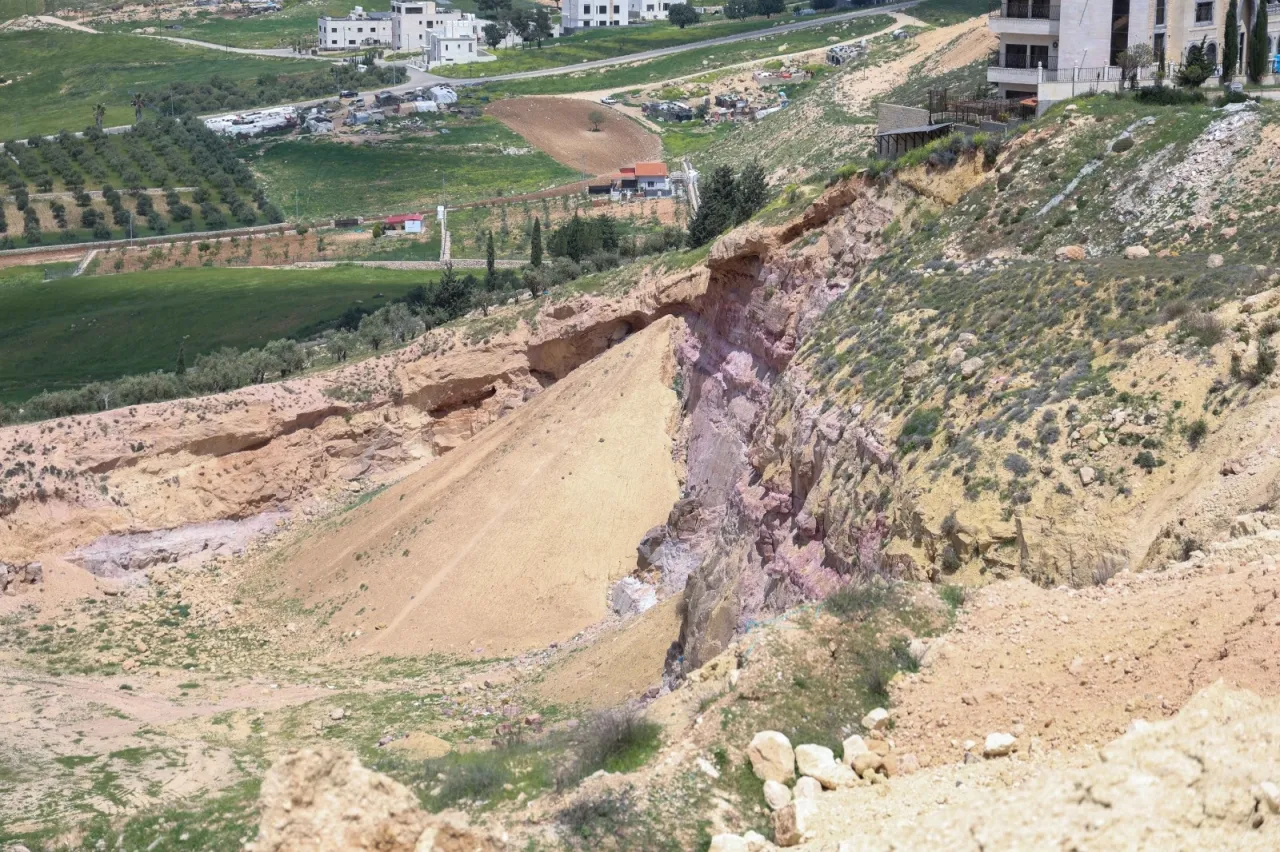
Khaberni - The Jordan Engineers Association issued, on Sunday, a detailed technical report on the landslide incident in the Safout area north of the capital, Amman, which caused widespread collapses that could extend to neighboring areas.
The report followed a field survey conducted by a specialized committee from the Mining and Geology Engineering and Petroleum division, with participation from a team from the engineering department of the association, where inspections indicated that the landslide was the result of a complex interplay of geological, geotechnical, and hydrological factors, leading to an almost complete failure of the soil system.
The report clarified that the soil in the area consists of highly expansive and weakly cohesive clay layers, along with geological variance between different rock formations, contributing to the formation of an active sliding surface, especially with the high saturation of the soil with water. It pointed out that the absence of surface and subsurface water drainage systems led to water accumulation and increased pore pressure, which reduced shear resistance to critical levels.
It noted that works on old, abandoned quarries beneath the slope caused sharp rock disruptions and the loss of sideways support for the soil, which are among the most significant causes of collapses according to engineering standards.
The report also attributed the acceleration of the landslide to climatic conditions in recent years, including heavy rainfall and sudden floods, which increased the soil’s saturation and weakened its mechanical properties and widened the earth cracks.
Structurally, the committee observed severe damage to the affected building, including partial collapse of the retaining wall, and the appearance of deep ground cracks with some measuring up to about 80 cm wide, indicating active ground movement and an imminent threat to public safety.
The association called for immediate measures, most notably the final evacuation of the building and prohibiting its use, evacuating areas below the slope, closing the site, and temporarily halting the issuance of construction permits until studies are completed.
It also recommended implementing urgent solutions for water drainage, stabilizing unstable rock masses, and conducting a comprehensive study to analyze slope stability and develop permanent engineering solutions.
The association emphasized the need for coordination with the relevant authorities, including the Ministry of Public Works and Housing, the Public Security Directorate, and the Crisis Management Administration, to monitor the site especially during the rainy season, to preserve public safety.