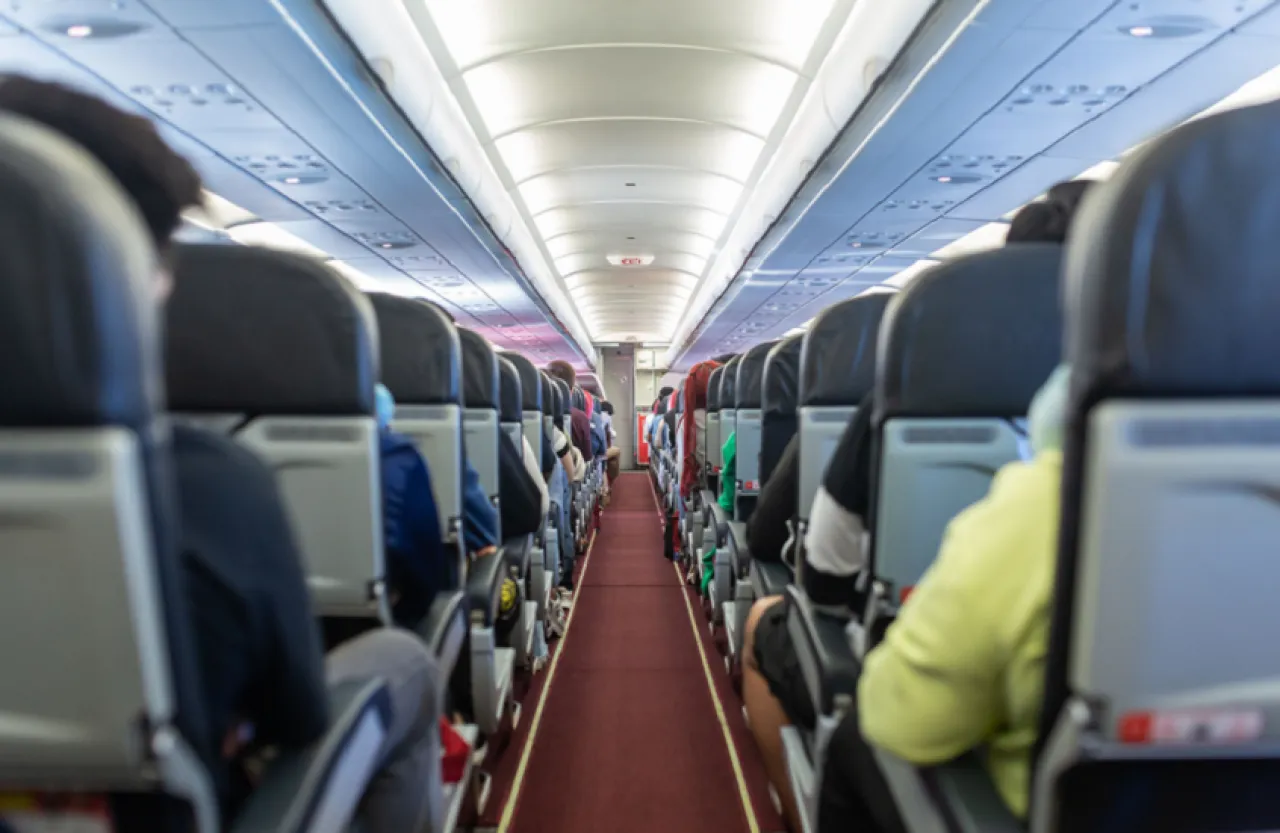
Khaberni - A recent study indicates that improving the safety of aircraft evacuations may not only rely on technological advancements but also on the distribution of passengers within the cabin, especially the elderly.
The study suggests that evenly distributing elderly passengers throughout the plane could accelerate evacuation processes in emergencies, thereby enhancing the chances of rescuing passengers during critical times.
This comes in the context of safety standards adopted by the Federal Aviation Administration (FAA), which require that the plane be completely evacuated within no more than 90 seconds in emergency situations. However, these standards are based on an ideal simulation that does not always reflect real-world conditions, such as panic or variations in passengers' physical and age capacities.
Data clarify that the elderly may face difficulties in mobility or cognition, which could affect the speed of their evacuation compared to other passengers. For this reason, the Emergency Cabin Evacuation Act (EVAC) was introduced in December 2022, calling for an update to evacuation procedures to take into account the actual conditions inside airplanes, such as narrow aisles, proximity of seats, and passenger diversity.
The importance of these updates increases with global demographic changes, as the average age of the global population is expected to rise from 31 to 36 by 2050, meaning an increase in the number of elderly passengers on flights in the future.
In this context, researchers conducted emergency simulations including a fire in the engines of an Airbus A320, a dangerous scenario that might prevent the use of wing emergency exits and force passengers to head to the front and rear exits.
The researchers tested three different seating arrangements accommodating up to 180 passengers, taking into account the distribution of age groups, including passengers over the age of sixty.
The results showed that the fastest evacuation was achieved in 141 seconds when the proportion of elderly was low (20%) and they were evenly distributed near the exits, while the longest evacuation time recorded was 218.5 seconds when the proportion of elderly increased, even though they were seated near the exits.
Although these results may seem predictable, their importance lies in reflecting potential future scenarios with an increasing number of elderly globally, which calls for rethinking passenger distribution strategies.
Researcher Chen Yang (Luca) Zhang, a specialist in human factors at the University of Calgary, confirms that these results can help airlines proactively reduce risks and improve emergency response without impacting operational efficiency.