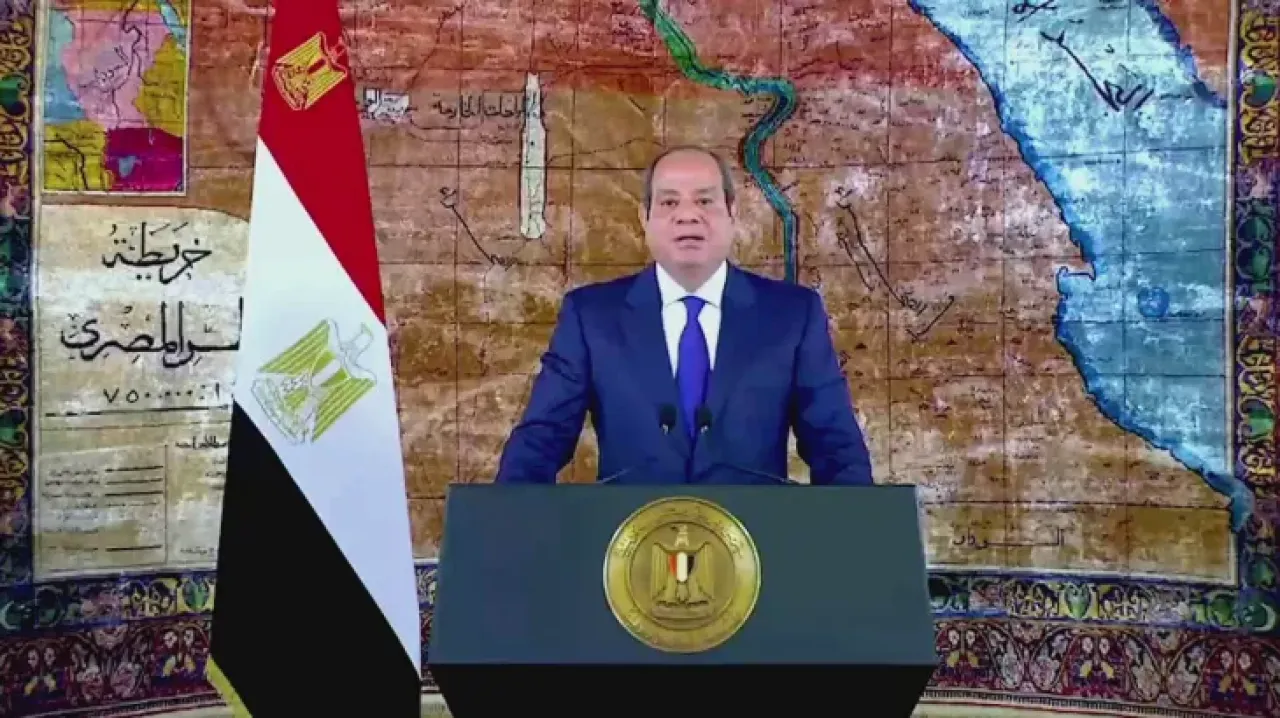
Khaberni - Egyptian President Abdel Fattah El-Sisi revealed the deep economic and security repercussions that his country faces due to the escalation of regional tensions, confirming that Egypt incurred losses estimated at around $10 billion in Suez Canal revenues.
He attributed this—in a speech on the occasion of the 44th anniversary of the liberation of Sinai—to attacks on ships in the Bab al-Mandab Strait, amid escalating regional crises, primarily the war on the Gaza Strip and the Iranian war.
International data and reports indicate that the Red Sea attacks targeting commercial ships near the Bab al-Mandab Strait have caused widespread disruption in global navigation, as many shipping companies have changed their routes to pass through the Cape of Good Hope instead of the Suez Canal.
According to data from the International Monetary Fund, traffic through the Suez Canal decreased by up to 35% during peak periods of the crisis, while revenues decreased by about 40% at the beginning of 2024 due to rerouting of ships away from the vital Egyptian corridor.
El-Sisi clarified that these challenges were accompanied by additional pressures, including hosting about 10 million newcomers from brotherly and friendly countries, alongside the global rise in food and energy prices.
In a related context, the Egyptian president warned of attempts to reshape the region, adding that the Middle East is undergoing "delicate and decisive" circumstances, and that it witnesses efforts to redraw its map under the guise of "extreme ideological" claims.
El-Sisi emphasized that "the optimal path for the future of this region does not lie in occupation, destruction, and bloodshed, but in cooperation, construction, and peace to achieve stability."
He affirmed Egypt's rejection of any infringement on the sovereignty of Arab states, emphasizing the necessity of respecting state sovereignty and territorial integrity, and halting attempts to divide and dismantle the countries of the region and seize their peoples' resources.
He pointed out that political solutions and negotiations remain the best way to spare the region further disasters, bloodshed, and destruction.
Emphasis on rejecting displacement
El-Sisi also discussed the developments in the Gaza Strip, stressing the necessity of fully implementing the second phase of the ceasefire agreement in the Gaza Strip."
He added that this includes the entry of humanitarian aid without obstacles, and the immediate start of the reconstruction process of the sector, contributing to the improvement of the conditions there.
Egypt staunchly reiterates its rejection of any attempts to displace Palestinians, asserting that this rejection is "firm and non-negotiable under any circumstances," also calling for a halt to the attacks in the West Bank.
He stressed that the option of peace will remain Egypt's strategic choice, explaining that it is "derived from strength and firm conviction, not from weakness, hesitation, or fear," at the same time affirming the readiness of the armed forces "to counter any threat to national security."
During the successive crises in Gaza, Egypt has repeatedly emphasized that any solutions involving resettlement of Palestinians outside the sector pose a direct threat to the Palestinian cause, emptying it of its political and rights content.
Egypt's positions in regional and international forums affirm that the solution lies in reconstruction within the Palestinian territories, preserving the residents' right to remain on their land, while Egypt rejects any projects for the displacement of Palestinians, considering them a threat to regional stability and the fundamentals of the Palestinian cause.