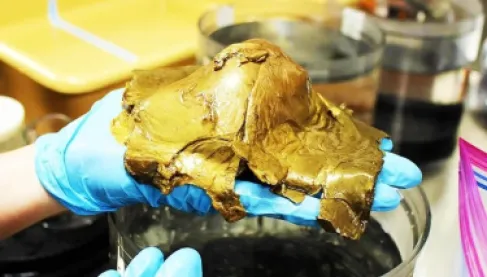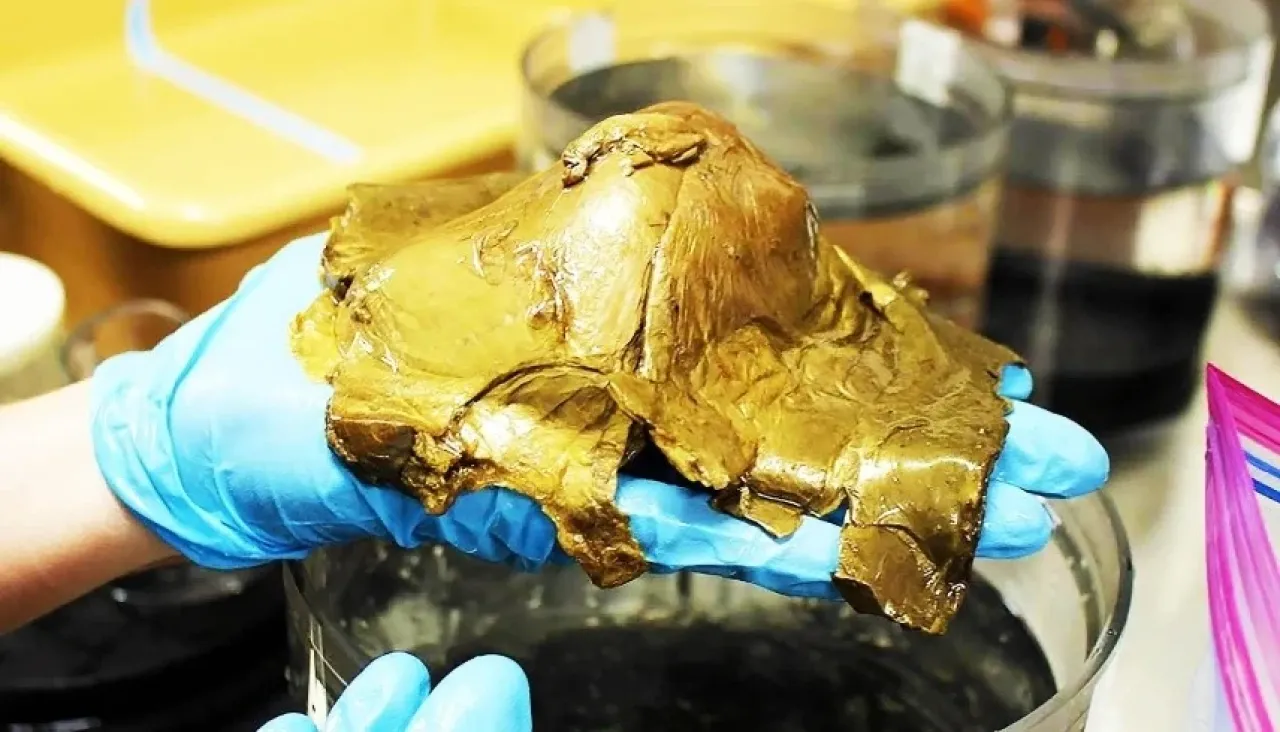
Khaberni - Scientists from the National Oceanic and Atmospheric Administration (NOAA) have solved the mystery of the "Golden Sphere" that was found at the bottom of the Pacific Ocean three years ago, confirming that it is not an egg of an alien creature as previously thought, but it is a part of a "skin" lost from a giant sea anemone.
The details of the incident date back to 2023, when the remotely operated vehicle "Deep Discoverer" discovered a glittering golden spherical mass attached to a rock at a depth of 3250 meters in the Gulf of Alaska.
The object, which has a diameter of 10 centimeters and contains a hole in one of its sides, astonished researchers, as speculations at the time varied between it being an egg of an unknown creature or remnants of a sea sponge, with one researcher describing the scene then as "resembling the beginning of a horror movie."
After three years of precise laboratory examinations and complex genetic analyses, scientists announced that this object is not an egg, but a part of skin or external tissue left behind by a marine creature called "sea anemone," a type of deep-sea jellyfish whose tentacles can grow over two meters long.
Animal scientist Allen Collins, from the NOAA Fisheries' National Systematics Laboratory, explained that solving this mystery required the concerted efforts of experts in genetics and bioinformatics, due to the complexity of the sample and contamination by other microscopic organisms.
The results showed that the "sphere" consists of fibrous "chitin," a strong material found in insect structures, which acts as a casing to protect the sea anemone, and it is likely that the creature sheds it while moving or as part of an incomplete asexual reproduction process.
Meanwhile, Captain William Moit, director of ocean exploration at NOAA, confirmed that this discovery underscores the importance of continuing to explore the depths, noting that these biological remains turn into a "hotspot" for microbial activity on the ocean floor, contributing to the nitrogen cycle and supporting the ecosystem in those harsh, high-pressure, pitch-dark environments.