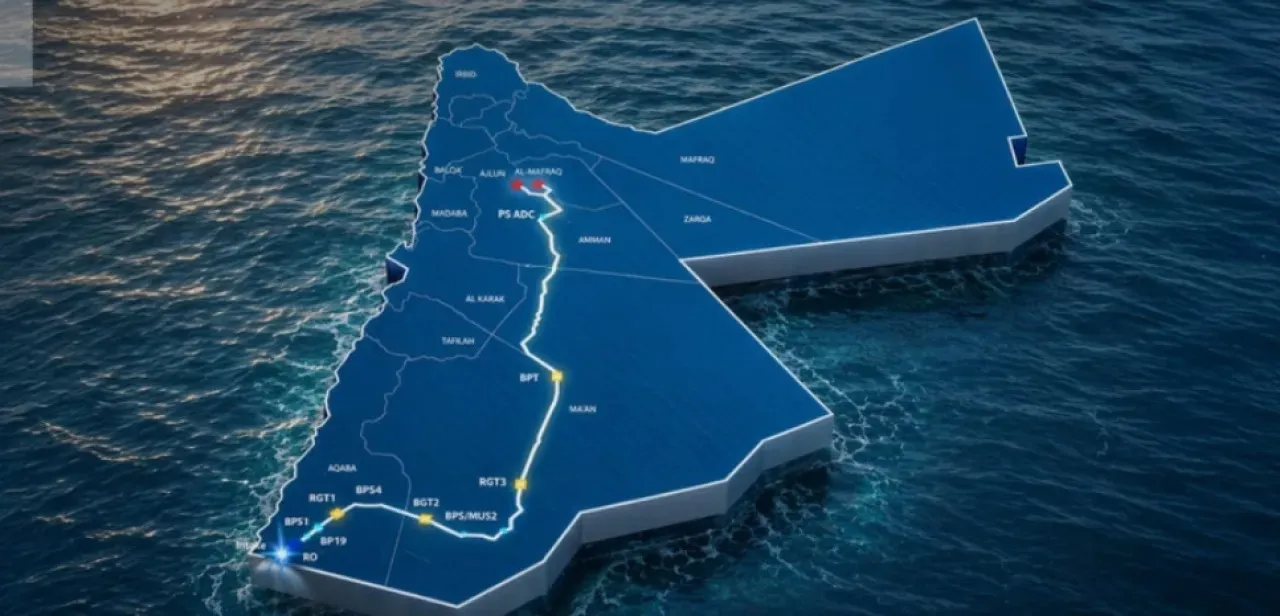
Khaberni - Matteo Patrone, Vice President of the European Bank for Reconstruction and Development for Banking Affairs, confirmed that the bank will be the "largest lender" for the Jordan Water Carrier project", after its board of directors approved a substantial initial loan of up to $475 million.
Patrone stated that the national carrier project represents a "very important" step to ensure water security for the Jordanians, deeming the signing of the final technical and legal agreement for the project between the Jordanian government and Meridiam, the implementing entity, as a major milestone in the execution of the project, according to Kingdom.
He mentioned that the bank is currently completing the necessary documentation with the implementing entities and development partners in preparation for signing the agreement in the coming weeks.
Patrone added that the project will be a "historic example" of cooperation between international financial institutions and commercial lenders to support a large transformative project in partnership with the government and private sector.
He confirmed to "Kingdom" that the European Bank for Reconstruction and Development is a long-term partner for the Jordanian government and private sector and will continue to support ensuring vital water supplies for Jordanians.
Regarding the repercussions of the recent war in the Middle East, Patrone expressed his sympathy for those affected and hoped for a permanent solution to the conflict, explaining that the bank is committed to supporting the economies it invests in and proactively responding to changing needs.
He referred to the launch of the bank's initiative to respond to the conflict in the Middle East to provide targeted support to economies and clients affected by the war, alongside economies facing broader regional implications.
He explained that his visit to Jordan was aimed at enhancing the bank's partnership with the Jordanian government and its private sector clients during what he described as a "particularly challenging" time for the region, noting that Jordan remains stable, but has faced economic pressures from regional conflicts affecting tourism, trade, and transportation.
Patrone pointed out that the bank has been working intensively to support the Jordanian economy, as it doubled the number of its investments in 2025 by implementing 10 projects exceeding 200 million euros, stating that the majority of these projects were in the private sector.
As part of the response to the conflict in the Middle East initiative, he added that the bank will provide Jordan with additional support in several sectors, including water and energy.
The bank's response to the conflict will focus on the economies directly affected, namely Iraq, Jordan, Lebanon, the West Bank, and Gaza Strip, in addition to an initial set of neighboring countries affected, including Egypt, Turkey, Armenia, and Azerbaijan.
He mentioned that this week he signed two memoranda of understanding with the Jordanian government and the National Electric Power Company regarding the water and energy sectors, in a step he said reflects the importance of these sectors and the bank's plans to proceed with their investment priorities.
Under the memoranda, the bank will support the preparation and implementation of tenders for renewable energy projects and battery storage systems, assist in implementing targeted reforms to improve the financial sustainability of the electricity sector, and support the necessary investments to modernize the electric transmission grid.
The bank will also provide technical support to assist Jordan's ambition to transform Aqaba into a regional hub for green hydrogen, with a study on the potential to finance future projects in this field, as the memorandum supports Jordan's goal for renewable energy to make up 50% of the total energy mix by 2033.
Patrone thanked Zaina Touqan, Minister of Planning and International Cooperation and Governor of Jordan at the European Bank for Reconstruction and Development, Raed Abu Saud, Minister of Water and Irrigation, Saleh Al-Kharabsheh, Minister of Energy and Mineral Resources, and Sofian Al-Batayneh, General Manager of the National Electricity Company, for their partnership with the bank.
He also revealed to "Kingdom" that during his visit he held roundtable discussions with clients from the private sector and startups that continue to work and plan despite uncertainties, and confirmed that supporting the private sector represents the core of the operations of the European Bank for Reconstruction and Development, adding that the bank prides itself on being a long-term partner of this sector.
He added that he held a productive meeting with the bank's teams in the region, during which they discussed activating the bank's tailored approach within the response to the conflict initiative in Jordan, Lebanon, Iraq, the West Bank, and, when conditions allow, in Gaza.
Since 2012, the bank has invested more than 2.2 billion euros in Jordan through 84 projects, 73% of which went to the private sector, including financial support to the banking sector through loans to micro, small, and medium enterprises, secondary debt instruments, and trade financing facilities.