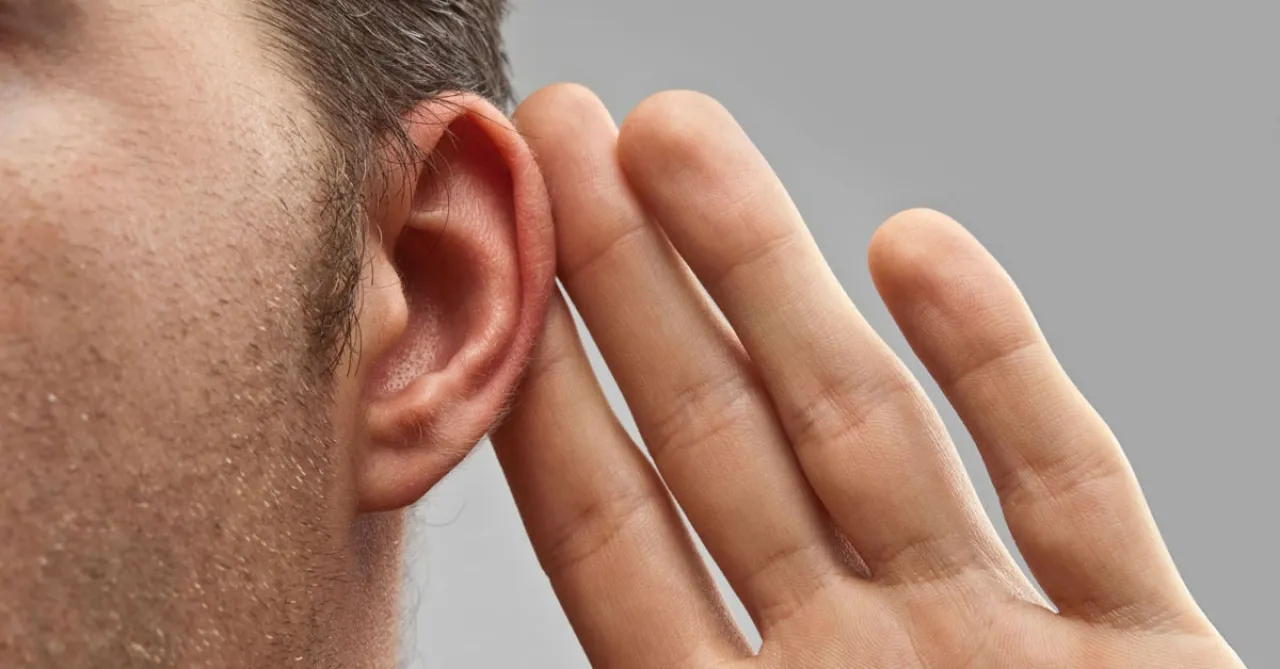
Khaberni - Contrary to the popular belief that closing the eyes helps "sharpen" other senses and reduce distractions, a new study conducted by researchers at Shanghai Jiao Tong University in China in April 2026, revealed that keeping the eyes open is the real key to improving the ability to hear clearly in noisy environments.
The researchers, led by engineer Yu Huang, subjected 25 volunteers to meticulous tests including attempts to detect "target sounds" like drum beats or bird singing amidst a background noise reaching 70 decibels.
Tests were conducted under four different visual conditions including closing the eyes, looking at a blank screen, viewing a still image related to the sound, and watching a dynamic video related to the sound source.
The results were surprising and counterintuitive; participants performed worst when closing their eyes, as they had to increase the volume by 1.32 decibels compared to the normal state to distinguish it. On the other hand, visual observation related to sound significantly increased auditory sensitivity, as participants could detect sounds approximately 3 decibels quieter when watching a video related to the sound source.
To explain this phenomenon, the team used electroencephalogram devices to monitor neural activity and discovered that closing the eyes stimulates the brain to filter out sounds in an exaggeratedly aggressive manner. While this process aims to block out distractions, it results in "over-filtering" that makes the brain block the desired signal along with the noise.
Conversely, visual interaction acts as a stabilizer for the auditory system in the external world, helping the brain to separate the target signal from the surrounding noise chaos.
Although the study does not deny the benefits of closing the eyes in completely quiet environments, it confirms that in our modern world filled with noise, integrating the senses is the most effective approach. The researchers plan to test in the future whether this improvement is due solely to keeping the eye open, or whether the brain requires an exact match between what we see and hear to achieve this heightened sensitivity.