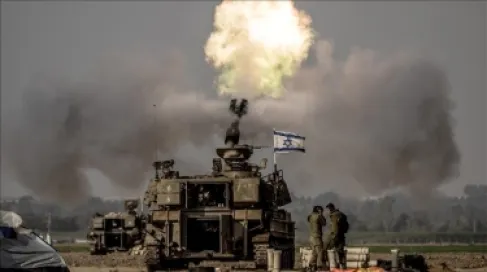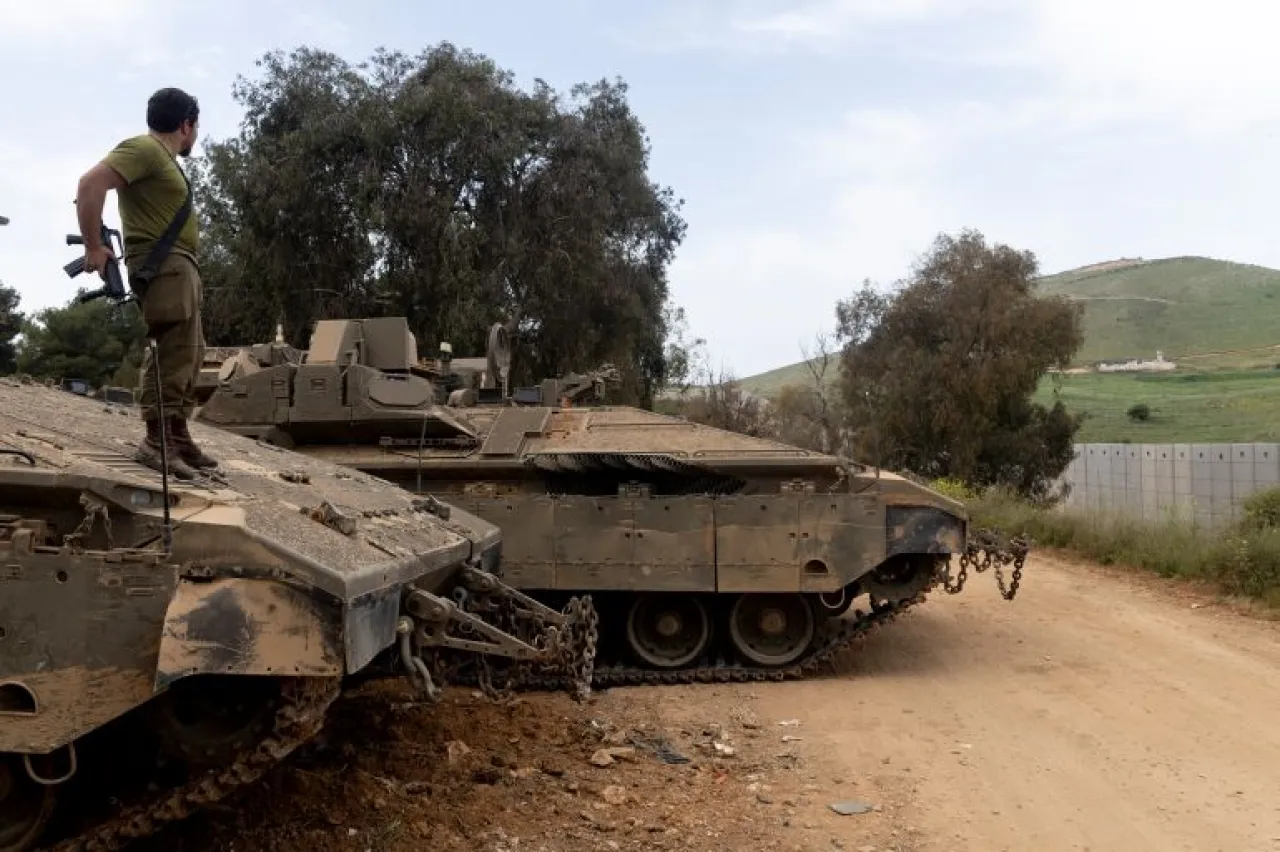
Khaberni - Hezbollah announced today, Monday, the destruction of 4 Israeli Merkava tanks in an explosion of explosive devices in southern Lebanon, while the occupation army warned residents of dozens of Lebanese villages against moving south of a specified line or approaching areas near the Litani River, despite a ceasefire in effect for the past 4 days.
Hezbollah stated in a statement on Monday that, while the occupation forces were committing a "new breach" and while an Israeli military convoy, consisting of 8 armored vehicles, was moving yesterday, Sunday, from the town of Taybeh towards the former Al-Salha site in the town of Deir Syrian, "it was hit by a linked explosion of explosive devices previously planted by Islamic Resistance jihadists at the site."
The statement added that the explosion resulted in "the destruction of 4 Merkava tanks and flames were seen erupting from them before the enemy proceeded to withdraw them from the scene."
Warning to the Residents of 80 Villages and Areas
Meanwhile, the Israeli occupation army warned the Lebanese from returning to about 80 villages and areas in the south of the country, asserting that its forces are still deployed in the area due to what it described as Hezbollah's ongoing activity.
The army said in a statement on Monday: "Until further notice you are required not to move south of the line of villages of Mezraa Beit Al-Sayyad, Majdal Zoun, Zibqin, Yatar, Sirbine, Hadatha, Beit Yahoun, Shukra, Majdal Salim, Kubrikha, Froun, Zawtar Al Gharbiyah, Yohmor Al Shaqif, Arnon, Deir Mimas, Marjayoun, Ibbel Al Saqi, Al Mari, Kfar Shouba, Ain Qana, and Ain Atta."
The occupation army also warned against approaching the area of Litani River, Al Salhani Valley, and Al Salouqi south of the country.
The Israeli army also warned Lebanese not to cross or return to numerous villages, towns, and areas including Al Bayyadah, Shama, Tair Harfa, Abu Shash, Al Jibayn, Al Naqoura, Zahira, Miyarin, Rawhin, Ramiya, Beit Life, Sulahana, Aita Al Shaab, Hanin, Al Tiri, Rashaf, Yaron, Maroun Al Ras, Bint Jbeil, Einata, Kunin, Aitroun, Bliida, Mahaybeb, Meiss El Jabal, Qalaat Daba.
On Friday, Israeli Defense Minister Israel Katz confirmed Tel Aviv's intent to continue controlling all the areas it occupied in southern Lebanon during the recent aggression.
Yesterday, Sunday, for the first time, the Israeli army published a map of its new deployment line inside Lebanon, which will lead to extending its control over dozens of Lebanese villages that are now mostly devoid of inhabitants.
The army did not specify the area of that region, but Katz stated that the area of intrusion extends to a depth of 10 kilometers inside Lebanon.
On Saturday, the Israeli army spoke of a "yellow line" in Lebanon, an imaginary line drawn south of the Litani River, extending according to Israeli media from the town of Naqoura to the town of Al Khiam northeast of the Metula settlement in northern Israel, passing through other Lebanese towns.
The Israeli forces destroyed Lebanese villages in the area, saying that their goal is to protect the cities in northern Israel from Hezbollah attacks.
In related news, the Lebanese National Media Agency reported today, Monday, that a "hostile" drone flew at a low altitude over Beirut and the southern suburbs. Israeli reconnaissance aircraft also flew at a low altitude over Tyre and its villages.
The agency noted that the occupation army exploded a number of residential buildings in the towns of Shama, Al Naqoura, and Al Bayadah in the Tyre District, from night until dawn today, Monday.
On Thursday evening, U.S. President Donald Trump announced a ceasefire in Lebanon for 10 days, following telephone discussions with his Lebanese counterpart Joseph Aoun and Israeli Prime Minister Benjamin Netanyahu.
However, Israel said that its army does not intend to withdraw from the areas it occupied, while it continued its operations in those areas during the ceasefire, including airstrikes and artillery shelling.
The war, lasting more than six weeks, resulted in the death of about 2300 people, and injured 7544 others, and displaced more than a million, especially from the suburbs of Beirut and from the south of the country, according to the latest official Lebanese data.