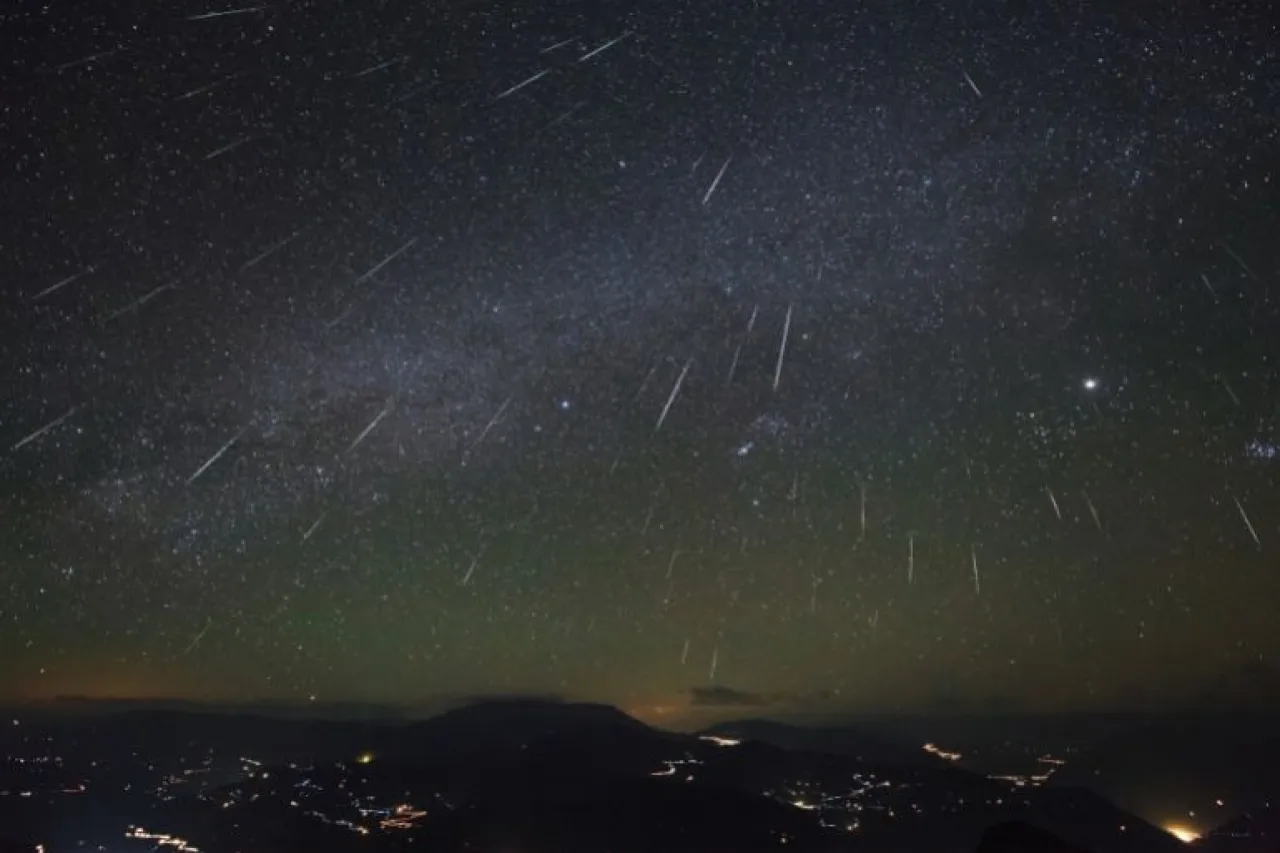
Khaberni - The skies of April shine with captivating astronomical sights that captivate the eyes of observers and awaken the enthusiasm of followers, where the precision of astronomical calculations is mixed with the beauty of natural phenomena; from a crescent moon that determines the timings of rituals and the start of months, to a comet that continues to appear in the dawn sky, to a celestial conjunction that announces the change of seasons, culminating in meteor showers that decorate the sky as a final farewell to winter and a welcome to a new season.
Dhul-Qa'dah.. crescent moon leads to the knowledge of Eid al-Adha
Astronomy enthusiasts in the Arab world observed the crescent moon of Dhul-Qa'dah 1447H on the past Saturday, 18 April, where it was seen in most Arab countries as a brilliant thin crescent, and they captured a number of beautiful and elegant photos.
And the crescent of Dhul-Qa'dah is what precedes the crescent of the Hajj month, which Muslims anticipate in all their countries because it determines the schedule of Hajj - its beginning and end - and it sets the date for Eid al-Adha, the days of Tashreeq, and the Day of Arafah.
After the crescent was born on Friday, 17 April at about 3 p.m. Mecca time, no one came forward with a testimony of its sighting that night in any of the Arab and Islamic countries, making Sunday, 19 April, the start of Dhul-Qa'dah 1447H.
Therefore, Monday, 18 May will be the start of the month of Dhul-Hijjah according to astronomical calculations and crescent sighting standards, and accordingly, Eid al-Adha will fall on Wednesday, 27 May 2026.
The comet is still in the sky
The comet "PanSTARRS" (C/2025 R3 PanSTARRS) still shines in the dawn sky, but it is gradually fading. It has been observed by many astronomy enthusiasts who photographed it and displayed its long tail through professional astronomical imaging.
However, other enthusiasts used less professional methods and achieved acceptable results in observing the comet's tail, which requires three things:
- Clear and pure skies.
- A map that pinpoints the location of the comet.
- A large binocular or telescope that allows you to see it.
If you want to photograph it without seeing it directly, you should use a professional camera mounted on a holder to capture dozens of images at the same moment and then stack them (adding their faint light together), to get a professional image of the comet with a beautiful and colorful tail.
The crescent and Pleiades.. friendship seasons of heat, cold, and rain
The poet says:
If Pleiades in the sky poses it is seen by the sharp eye as seven stars
On the chest of the mangy one as though a pearl brace was mounted above a wrist
The moon moves every night in the sky a known distance, traveling among the stars, and after 28 days it returns to the starting point, announcing that it has orbited the sky a sidereal month lasting 27.3 days.
But it will need two more days to complete one orbit around Earth, returning to a straight line with Earth and the Sun, and this is called the synodic month, which typically lasts 29.5 days.
In this lunar month (Dhul-Qa'dah 1447H), and on its third night (Sunday, 19 April 2026), the crescent will meet the famous Pleiades cluster, located in the constellation Taurus.
What's beautiful is that you can see that stellar cluster (Pleiades), as there is no more than the thickness of a pinkie finger between it and the moon, making it easy to see and recognize.
This meeting, or what is known among the Bedouin as "al-Qiran" (meaning conjunction or gathering), is the last meeting between the moon and Pleiades this season, as next month (May) they will meet at the Sun and will not be visible at all.
According to the number of the day when Pleiades meets with the moon, the Arabs name it, and all the names are singular, starting from:
- "Qiran 11" of the lunar month when it meets with Pleiades in December, and it is said: Qiran Hadi.. cold Badi, meaning the beginning of the cold.
- "Qiran 9" in January, and it is said: Qiran Tase'a.. biting cold, meaning the cold is intense.
- "Qiran 7" in February, and it is said: Qiran Sabi'a.. hungry and filled, meaning the grass is not enough for grazing.
- "Qiran 5" in March, and it is said: Qiran Khames Rib'i Tamis, meaning the grass is plentiful.
- "Qiran 3" in April, and the poet says: When the moon meets Pleiades.. for the third time winter has gone, and it is "the absence of Pleiades," as Pleiades will not be seen thereafter in the evening time.
Lyrids Meteor Shower.. the last meteor shower of winter
Every year on the night of 21-22 April, astronomy enthusiasts welcome a meteor shower known as the "Lyrids", named after the constellation Lyra or the Lute. The Arabs saw this constellation as an eagle with its wings folded and fallen, and it includes the famous bright star "Vega", a word derived from "al-Waqi'."
The Lyrids meteor shower is one of the weaker showers, as it does not exceed 5 meteors per hour on that night. If you want to observe these meteors, you only have to sit facing the east after 10 p.m., looking up to the sky. As time progresses, the probability of seeing meteors increases.
This number in any meteor shower - and there are more than 35 showers - is defined as the number of meteors that an alert observer under a clear sky free of clouds, without the moon and light pollution, sees, provided that the radiant point (the point where Earth meets the comet's tail) is at the zenith.
The meteors are dust grains left by comets after passing near Earth's orbit, where they remain floating in space until they meet Earth and enter our atmosphere as luminous threads of various colors depending on the meteor's material and the ionized gas in the air.
If a dust grain is larger than a lentil or chickpea when it enters the atmosphere, it noticeably and brightly glows, then it is called a "fireball."
If you are lucky, you will see one of these fireballs, and the condition of that luck is that your eyes be raised to the sky, for the meteor's appearance location and time cannot be predicted.