Approval of the valid reasons for the draft of an amended system for the regulation of the investment environment for the year 2026.
Approval of the valid reasons for the draft system for managing the passenger transport support fund for the year 2026.
Approval of the valid reasons for the draft law amending the cybersecurity law for the year 2026.
Approval of the valid reasons for the draft of an amended system for the Social Solidarity Fund system for employees of the Greater Amman Municipality for the year 2026.
Approval of the valid reasons for the draft of an amended system for the Housing Fund system for employees of the Greater Amman Municipality for the year 2026.
Approval of the valid reasons for the draft system of bonuses and savings fund for employees at Mutah University for the year 2026.
Approval of the valid reasons for the draft of an amended system for the administrative regulation system of the Telecommunications Regulatory Authority for the year 2026.
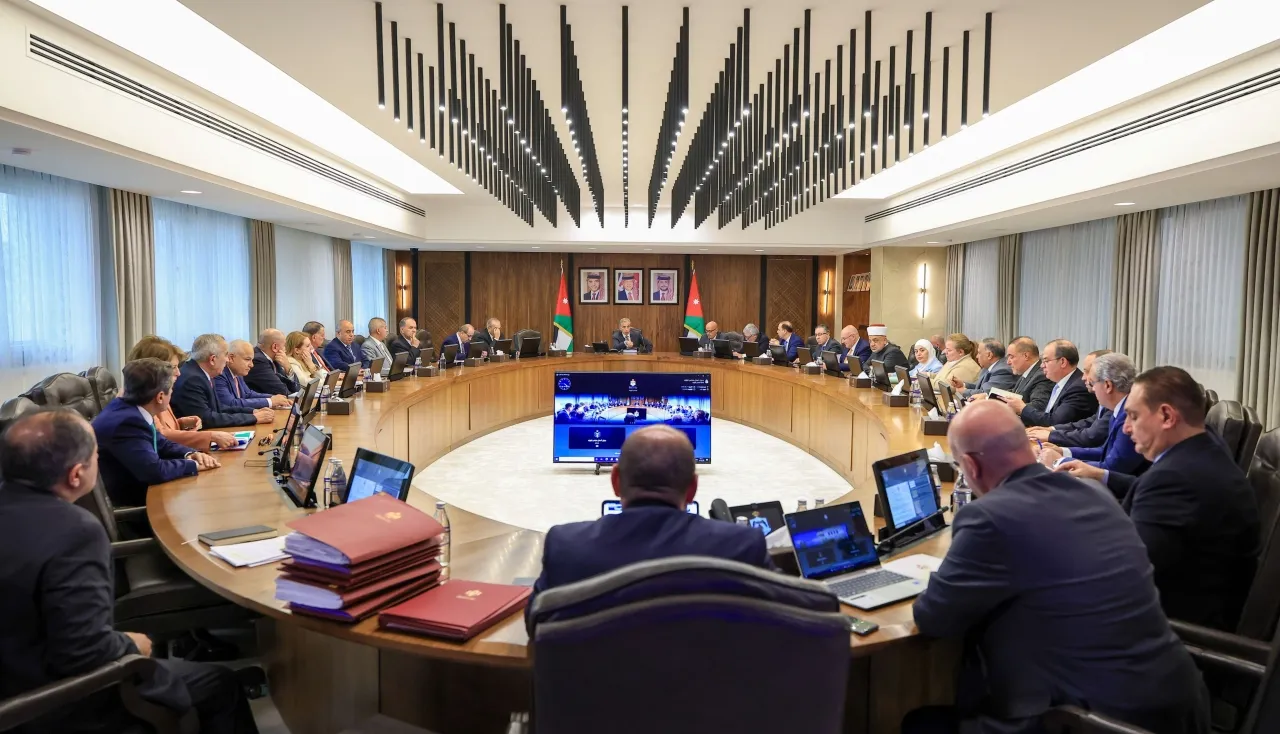
Khaberni - The Council of Ministers, in its session held today Sunday, chaired by Prime Minister Dr. Jaafar Hassan, approved the valid reasons for the draft of an amended system for the regulation of the investment environment for the year 2026, in preparation for its referral to the Legislation and Opinion Bureau to proceed with the issuance procedures according to proper regulations.
The amended system project is part of the executive program for the economic update vision and within a comprehensive governmental approach to modernize the legislative framework regulating investment, enhancing policy stability, and establishing trust in the business environment.
The amended system aims to enhance the attraction of investments, through resolving overlaps in some provisions and unifying regulatory concepts within the technical developments of the investment environment, supporting investment decision-making based on clear and scientifically technical standards.
The system includes clarity and simplification of procedures; aiming to encourage investors to make investment decisions and start implementing them; this reflects positively on development and the economy, shortening the time periods associated with issuing licenses and approvals, directly reducing costs on investors and improving the quality and efficiency of government services.
The facilities are likely to reduce time and effort on investors; helping to launch projects faster, at lower costs, and with greater efficiency.
The amended system project includes the introduction of the concept of "licensing as a condition for compliance" as a modern regulatory tool, allowing the granting of licenses in developmental areas, based on an investor's commitment to meeting requirements, with subsequent monitoring, achieving a balance between facilitating business and ensuring compliance contributing to the growth of new investments.
The amended system supports extending the scope of benefit from investment incentives, including expansion and development projects, enhancing flexibility in benefiting from them according to investors' needs, which provides employment opportunities, and ensures investment sustainability.
The amendment targets attracting quality investments with added value, particularly in nationally prioritized sectors, contributing to enhancing the kingdom's status as a comprehensive regional and international investment hub and reflecting on employment opportunities and growth.
The amended system enhances Jordan’s competitiveness in international indices related to ease of doing business and investment attractiveness, through improving the regulatory environment and reducing procedural complexities.
The system project follows extensive consultations with government bodies, the private sector, and investors, reflecting a national consensus on developing the investment environment according to best practices.
In terms of improving services provided to citizens, the Council of Ministers approved the valid reasons for the draft system for managing the passenger transport support fund for the year 2026; in preparation for sending it to the Legislation and Opinion Bureau for approval according to proper regulations.
The Council of Ministers had commissioned the Ministries of Transport and Finance to issue this system, which constitutes an important step in sustaining public transport projects recently launched by the government, such as the regular transport project between provinces, smart transport systems, in addition to expanding the fast bus project beyond the capital towards provinces of Madaba, Balqa, and Zarqa.
The system project aims to develop passenger transport facilities, support, and develop passenger transport services, and invest in these services.
The system project opens the way for obtaining funding provided through grants via the Ministry of Planning and International Cooperation in green policies and sustainability.
Under the system project, a trust account will be opened within the accounts of the Ministry of Transport, where revenues collected by the Land Transport Regulatory Authority under the provisions of the law, regulations, and instructions issued thereunder are deposited, for the purpose of providing the necessary funding to support licensed passenger transport providers.
The Passenger Transport Support Fund account, provided by the Passenger Transport Regulation Law for the year 2017, will be fed by amounts allocated by the government in the state's general budget and the investment fee for passenger transport services collected by the Authority or the relevant entity from the licensees, and from the fees collected under the provisions of the law and the regulations issued thereunder.
Additionally, the financial resources of the fund include donations and grants received; provided that approval from the Council of Ministers is obtained.
Regarding the legislations related to updating the public sector and developing institutional work, the Council of Ministers approved the valid reasons for the draft law amending the cybersecurity law for the year 2026.
The draft law aims to keep up with the rapid technical and digital developments, through updating the basic concepts related to security and cyberspace, and including definitions for newly introduced technologies.
It also aims to develop the tasks of the National Cybersecurity Center, enhance its capabilities in supporting scientific research and development, and establish the necessary controls and standards to regulate the use of newly introduced technologies and future technology within the cybersecurity framework; to ensure their security and minimize emerging risks.
The draft law works on developing mechanisms for detecting emerging cybersecurity threats, enhancing the role of the National Cybersecurity Council in following up the center's activities and monitoring its performance, identifying sectoral response teams and their operating mechanisms, and building national capacities in cybersecurity in partnership between the National Cybersecurity Center and the National Academy of Public Administration.
The draft law achieves higher efficiency in managing resources, as it enhances the protection of the digital economy, which increases investment and boosts private sector confidence.
It also contributes to the draft law amended in raising the level of protection of citizens' data and enhancing trust in digital government services, positively reflecting on the use of services and increasing trust in their use.
It supports clarity of authority and integration of roles between national entities, improving the efficiency of incident response, reducing duplication, enhancing national readiness to face cybersecurity threats, and improving the state’s capacity to protect critical infrastructure, in addition to keeping up with future technology by regulating the use of emerging technologies like artificial intelligence, ensuring their safe and effective employment.
Furthermore, the Council also approved the valid reasons for both: the draft of an amended system for the Social Solidarity Fund of Greater Amman Municipality employees for the year 2026, and the draft of an amended system for the Housing Fund for Greater Amman Municipality employees for the year 2026; in preparation for sending them to the Legislation and Opinion Bureau to complete the issuance procedures according to proper regulations.
The projects for both systems respond to a number of regulatory and administrative updates, fulfilling institutional development requirements, aiming to enhance legislative flexibility by granting the management committee the authority to decide on unregulated issues, ensuring proper application of the system provisions and handling new practical cases, and unifying the benefit umbrella of the Housing Fund, achieving fairness among the employees.
The draft system for the Housing Fund of the Municipality employees contributes to enhancing housing stability for employees in the public service, which directly impacts increasing work performance efficiency and ensuring sustainability in providing municipal services to citizens.
It also enables the Housing Fund to include the same categories covered by the Social Solidarity Fund, in harmony with the united social and economic purpose of both funds, while maintaining financial balance and continuity of their resources.
Regarding updating systems related to universities, the Council of Ministers approved the valid reasons for the draft system of bonuses and savings fund for employees at Mutah University for the year 2026; in preparation for sending it to the Legislation and Opinion Bureau to complete the issuance procedures according to proper regulations.
The system project aims to reduce financial burdens on the university, by limiting the university's commitment to paying its contribution in the savings fund for appointments after the provisions of the system project come into effect.
The system project is in line with the proposals from the Ministry of Higher Education and Scientific Research regarding the proposed amendments to the bonus and savings fund systems in official Jordanian universities.
Moreover, the Council of Ministers approved the valid reasons for the draft of an amended system for the administrative regulation of the Telecommunications Regulatory Authority for the year 2026; in preparation for sending it to the Legislation and Opinion Bureau to complete the issuance procedures according to proper regulations.
The system project aims to cover the volume and variety of tasks in light of the expanded scope of supervision of the senior management in the Telecommunications Regulatory Authority and to enable the authority to achieve greater effectiveness in providing and improving services, keeping up with technological development, digital transformation, responding to modern threats to networks.
On another note, the Council of Ministers decided to appoint Dr. Mustafa Hammarna as the president of the Jordanian Academy of Public Administration, and transfer Engineer Siham Al-Khawaldeh from the role of Director General of the Public Administration Institute to occupy the position of Secretary General of the Academy.
The Council of Ministers also decided to appoint members to the Board of Trustees of the Jordanian Academy of Public Administration, including: Nasreen Barakat, Saad Nabil Al-Mashaer, Dr. Abla Mohammad Amawi, the president of the German Jordanian University, the president of the Digital Skills Association, and the chairman of the Board of Directors of the Information Technology and Communications Companies Association.
The Board of Trustees is chaired by the Prime Minister according to the Academy’s system issued last week, while the minister concerned with the public sector occupies the position of vice president, in addition to membership of the Minister of Digital Economy and Entrepreneurship, and membership of six members from academic institutions or the private sector with expertise and specialization appointed by the Council of Ministers as mentioned above.
The Council of Ministers also decided to appoint Raafat Musa Al-Sawafin as the General Director of the Vocational Training Corporation, after he scored the highest marks according to the competition held under the government leadership system.
Furthermore, the Council decided to appoint Khaldun Ahmed Al-Khalidi as the General Director of the Department of Lands and Survey, and transfer the Secretary General of the Ministry of Tourism and Antiquities, Yazan Mohammad Al-Khudair, as an advisor at the Ministry of Culture.