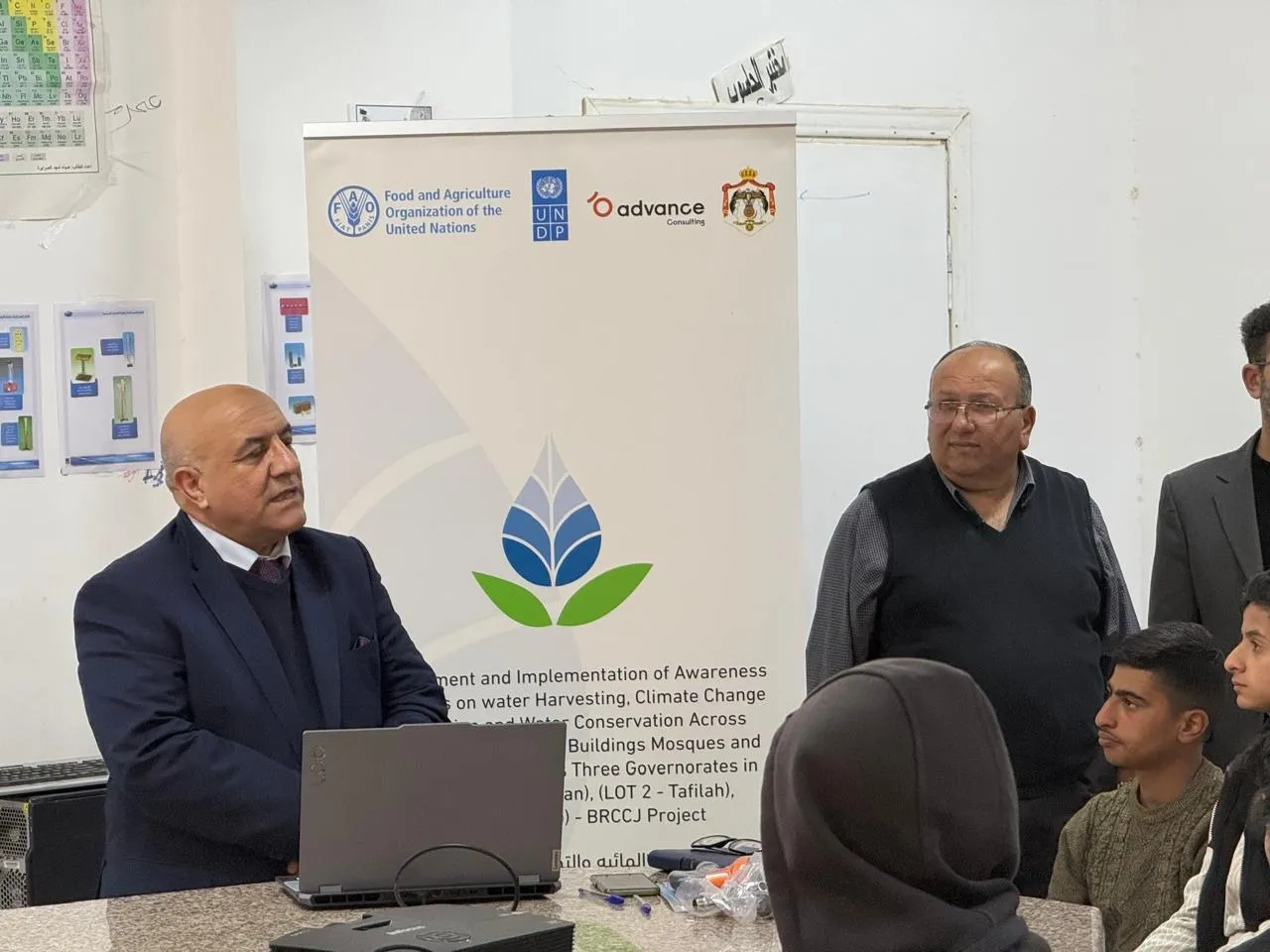
Khaberni - The United Nations Food and Agriculture Organization (FAO), in coordination with the Ministry of Education, launched an awareness program about rainwater harvesting and water consumption rationalization in the governorates of Karak, Tafilah, and Ma'an, as part of the project "Building Adaptation Capacity to Climate Change through Improved Water Use Efficiency in the Agriculture Sector (BRCCJ)," funded by the Green Climate Fund.
The implementation of the program, through a local consulting firm, is part of the first phase of an awareness program aimed at enhancing students' awareness of the importance of harvesting rainwater from building rooftops and rationalizing its use.
This program is part of the first component of the project, which focuses on developing water systems capable of adapting to climate change, thereby enhancing water security in Jordan. It also aims to raise awareness among local communities about the importance of preserving water resources and managing them sustainably, by targeting students in public schools, mosque imams, and public sector employees.
The program focuses on educating participants about the water challenges facing Jordan, highlighting home technologies that contribute to improving water use efficiency, such as rainwater harvesting systems and the installation of water-saving devices and parts, in addition to explaining the impact of climate change and national policies on water resources.
The program has been designed in an interactive style that suits various community segments, focusing on presenting practical solutions that can be implemented in daily life.
The program targets 150 public schools selected for the installation of water harvesting units—rainwater collection tanks—at a rate of 50 schools in each governorate, distributed among male and female schools. It also includes 150 government buildings, including mosques and health centers, in the three governorates.
In its second phase, the program will expand to include mosque imams and public sector employees in buildings where rainwater harvesting units will be installed.
The program is based on five main pillars, including: water scarcity in Jordan, concepts of adapting to climate change, rainwater harvesting technologies, efficient water use, and the installation of water-saving devices.
It is noted that the project "Building Adaptation Capacity to Climate Change in Jordan through Improved Water Use Efficiency in the Agriculture Sector (BRCCJ)," implemented by the United Nations Food and Agriculture Organization (FAO) with funding from the Green Climate Fund, in partnership with the Ministries of Water and Irrigation, Agriculture, Environment, and the United Nations Development Programme, spans seven years, aiming to enhance sustainable development resilient to climate change in the kingdom, and increase the capacity of water management systems and the agricultural sector to adapt to climate challenges.