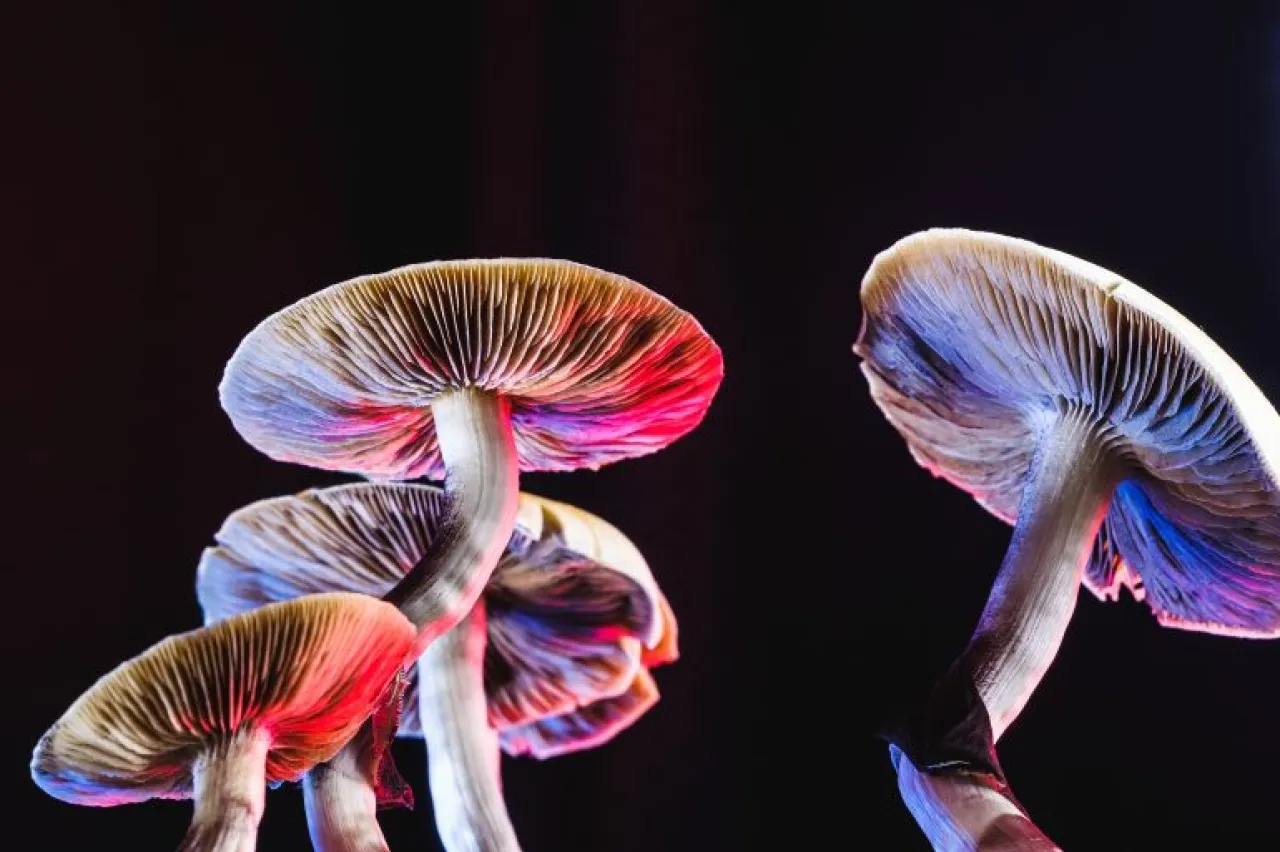
Khaberni - For years, scientists assumed that the most famous and widely cultivated magic mushroom globally, Psilocybe cubensis, was accidentally brought to America with the importation of cattle from Africa and Europe during the 16th century. However, the discovery of a new type of mushroom in South Africa may resolve the longstanding scientific controversy regarding its origin.
In a new study published in the journal "Proceedings of the Royal Society B", an international team of researchers from Africa and the United States identified a new type of hallucinogenic mushroom, which is the closest known wild relative of Psilocybe cubensis. This suggests that its history is much older and more complex than previously thought.
The Hidden Relative
Bretten van der Merwe, a mycologist and a PhD student in Chemical Engineering at Stellenbosch University in South Africa and one of the study's participants, explains that "magic mushrooms mostly belong to the genus Psilocybe and produce a psychoactive compound known as psilocybin".
He adds, in his conversation with Al Jazeera Net, "scientifically, these mushrooms are increasingly important in fields studying neuropharmacology and psychotherapy, as evidence of their potential role in treating disorders such as depression, anxiety, ADHD, and PTSD is growing".
The newly discovered species, known as "Psilocybe ocreascentrata", derives its name from the ochre-yellow center of its cap. It was found growing on cattle dung in pastures in South Africa and Zimbabwe. This feature is shared with Psilocybe cubensis; both species rely on animal dung—whether from cows, bison, goats, or horses, among others—to spread their spores.
Even though this domesticated species, known in Africa and Asia, is the most widely cultivated type of hallucinogenic mushroom, its origins and how it acquired its psychoactive properties remain largely a mystery.
This species is known by various names around the world, such as "magic mushroom", "shrooms", and "golden caps", and is famous for its hallucinogenic effects on the human brain. It was first described in Cuba in 1906, before becoming popular among cultivators because of its potency and ease of cultivation. However, until this study, it was not known that it represented a completely independent species from the traditional magic mushroom.
The researchers revealed that Psilocybe ocreascentrata has been circulated and cultivated around the world for years under names like Natal Super Strength (NSS) and Transkei, but its genetic differences from the magic mushroom were only apparent in this study.
Despite their similar outward appearances and shared dung-dependent growth environment, and production of psilocybin, they differ in their genetic, environmental, and chemical properties.
Van der Merwe notes that the differences between the species include a clear genetic separation, microscopically distinct characteristics (such as spore shapes), and while Psilocybe ocreascentrata is a species native to Africa, Psilocybe cubensis has a global distribution and is partially domesticated and cultivated.
Tracing the Path
To determine the relationship between the two species, the team analyzed DNA samples from this new species collected across South Africa, along with older reference samples preserved in museums and scientific collections.
Dr. Cathy Sharp from the Natural History Museum in Zimbabwe, a participant in the study, found some of the earliest samples in Zimbabwe in 2013. Yet, Africa's hidden fungal diversity remains largely unexplored.
According to van der Merwe, the researchers utilized a range of advanced scientific tools, including multi-site genetic analysis and Bayesian molecular dating models to estimate when the two species diverged. They also used species distribution models and ecological range modeling to understand the environments where these mushrooms appeared and spread.
The findings suggest that Psilocybe ocreascentrata diverged from Psilocybe cubensis about 1.5 million years ago, long before the global spread of domesticated cattle, directly challenging the long-held view on how the magic mushroom spread globally.
New Insights
This discovery holds the potential to reshape scientific understanding of how hallucinogenic mushrooms spread across continents. It suggests that the history of Psilocybe cubensis may be linked to much older environmental changes, instead of its recent appearance due to human agricultural activity.
In the study, researchers presented several scenarios that could explain how and when these two species diverged millions of years ago. During that period, pastures were expanding and diversifying across parts of the world, while herbivorous animals—providing a nourishing environment for these mushrooms—were migrating from Africa to Europe and Asia.
One potential scenario suggested by van der Merwe is that the origin may have occurred in Africa, before Psilocybe cubensis later spread to other areas through a rare dispersal event, followed by geographical isolation that contributed to its differentiation.
The team also does not rule out the possibility that their ancestors may have crossed the Atlantic Ocean, possibly via natural vectors like air currents or insects, in limited but impactful dispersal events. In contrast, the scenario of migration via the Bering Land Bridge is considered, though less likely compared to other hypotheses that still require further research.
The researchers believe that these major environmental and animal changes provided suitable conditions that contributed to the emergence and spread of separate hallucinogenic mushroom species. The current distribution patterns suggest that the spread and differentiation of these species were influenced by several factors, including the presence of large animals, climate changes, and rare dispersal events that played a significant role in shaping their geographic distribution.
The study indicates that psilocybin-producing mushrooms can spread long distances across continents. It is likely that adaptation to dung-rich environments appeared early in their history, paving the way for later specializations such as growth on cattle dung. However, it does not provide a definitive answer on how Psilocybe cubensis arrived in America.
Expanding Research Horizons
In addition to clarifying the wild origins of Psilocybe cubensis, this discovery opens new avenues for scientific research by providing new genetic resources that can support deeper study of hallucinogenic mushrooms, as van der Merwe mentions.
He adds that "it also highlights the spread of classification errors and biases resulting from a lack of sample collection and field studies, contributing to improved scientific classification accuracy, which is crucial in clinical research and pharmacological studies, as it helps avoid identification errors that could impact scientific outcomes and therapeutic applications."
Research on psilocybin-producing mushrooms has increased in recent years, with a focus on studying their chemical properties and exploring their potential medical uses.
Scientists aim to understand how hallucinogenic compounds have changed over time and how these mushrooms have adapted to diverse environments, through discovering new species and mapping their historical relationships.