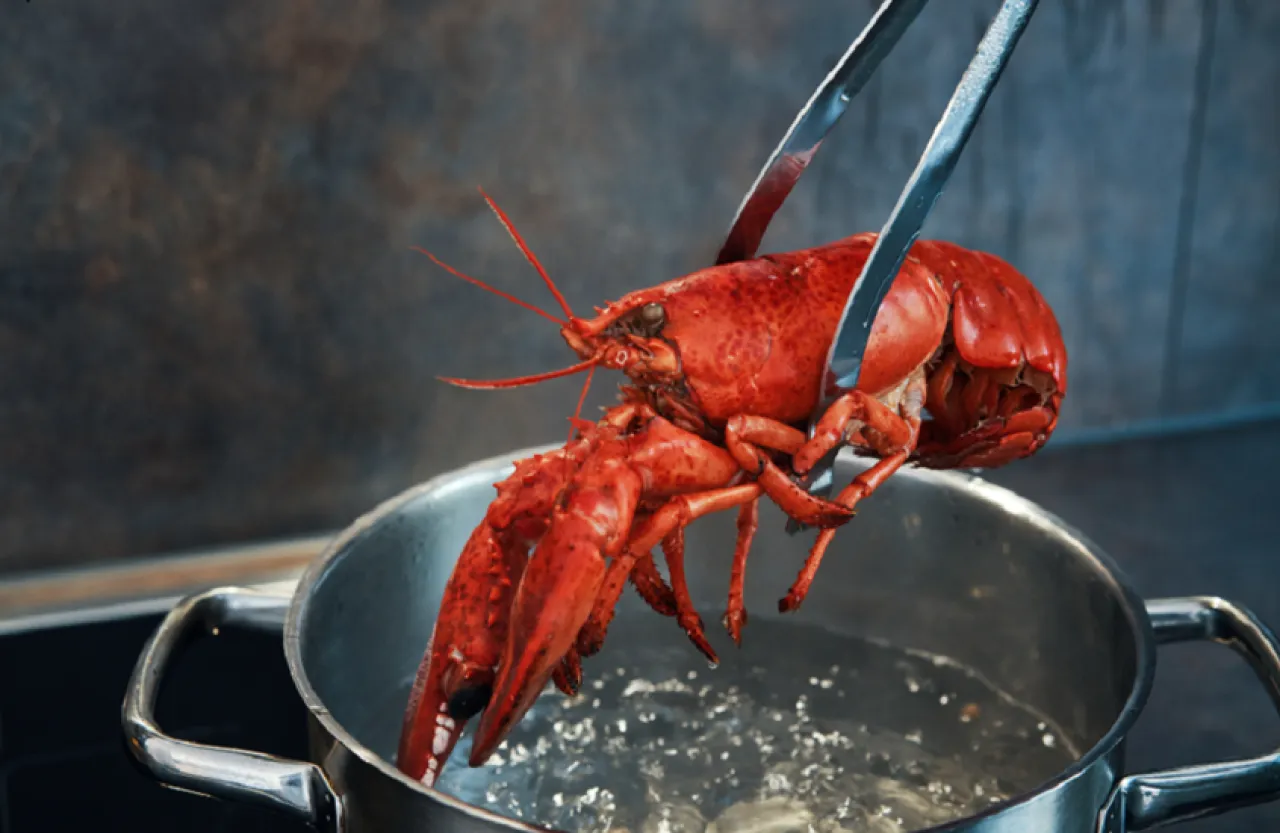
Khaberni - A recent study has found that the method of boiling lobsters alive can cause them severe pain, reigniting the debate over the necessity of banning this practice in the United Kingdom and other countries.
Researchers concluded that the Norwegian lobster displays behavioral and biological responses that may indicate its ability to feel pain more similarly to what was previously thought in crustaceans.
Experiments showed that crustaceans react to painkillers such as "lidocaine" and "aspirin", as these substances reduced their response to harmful electrical shocks, which researchers considered a potential indicator of a nervous system linked to the sensation of pain.
The scientific team believes that these findings not only suggest simple reflex actions but could reflect an actual experience of pain when the animal is harmed.
This controversy comes at a time when the practice of boiling live crustaceans is already banned in several countries, including Norway, New Zealand, Austria, and some Australian states.
Professor Lynn Sneddon, an expert in animal behavior at the University of Gothenburg and one of the study participants, said that the scientific evidence makes the practice of boiling live crustaceans inhumane, and emphasizes the need to end the lives of animals in more merciful ways, similar to what is applied to mammals and birds.
Studies on crustacean behavior indicate that they interact with harmful stimuli in their environment, and they avoid high temperatures, which opens the door to questioning whether these responses are merely reflex actions or evidence of the sensation of pain.
Researchers distinguish between "pain" as an experiential feeling associated with suffering, and "sensation of pain" as an automatic nervous response to damage, and this distinction explains part of the ongoing scientific debate concerning crustaceans.
In the study, researchers observed that lobsters attempted to escape when exposed to electrical shocks, while this behavior significantly decreased when they were given pain relievers, reinforcing the hypothesis that they possess more complex neurological mechanisms than previously thought.
The lead researcher in the study, Eleftherios Kassouras, said that the crustaceans' response to painkillers during painful experiments indicates that what occurs goes beyond merely involuntary reactions, suggesting that they are indeed capable of feeling pain.
In the same context, entities concerned with animal welfare consider that boiling live crustaceans causes unnecessary suffering, calling for the adoption of more merciful methods of killing such as rapid cutting or electrical stunning.
However, some researchers believe that imposing a complete ban may not be practical in all cases, as Professor Henrik Loreidsen notes that killing large crustaceans can be easily and humanely regulated, while it may be difficult to apply the same for smaller species such as shrimp in home environments or during recreational fishing.
This scientific and ethical debate leads to an open question about how much suffering society can accept in its dealings with marine organisms.