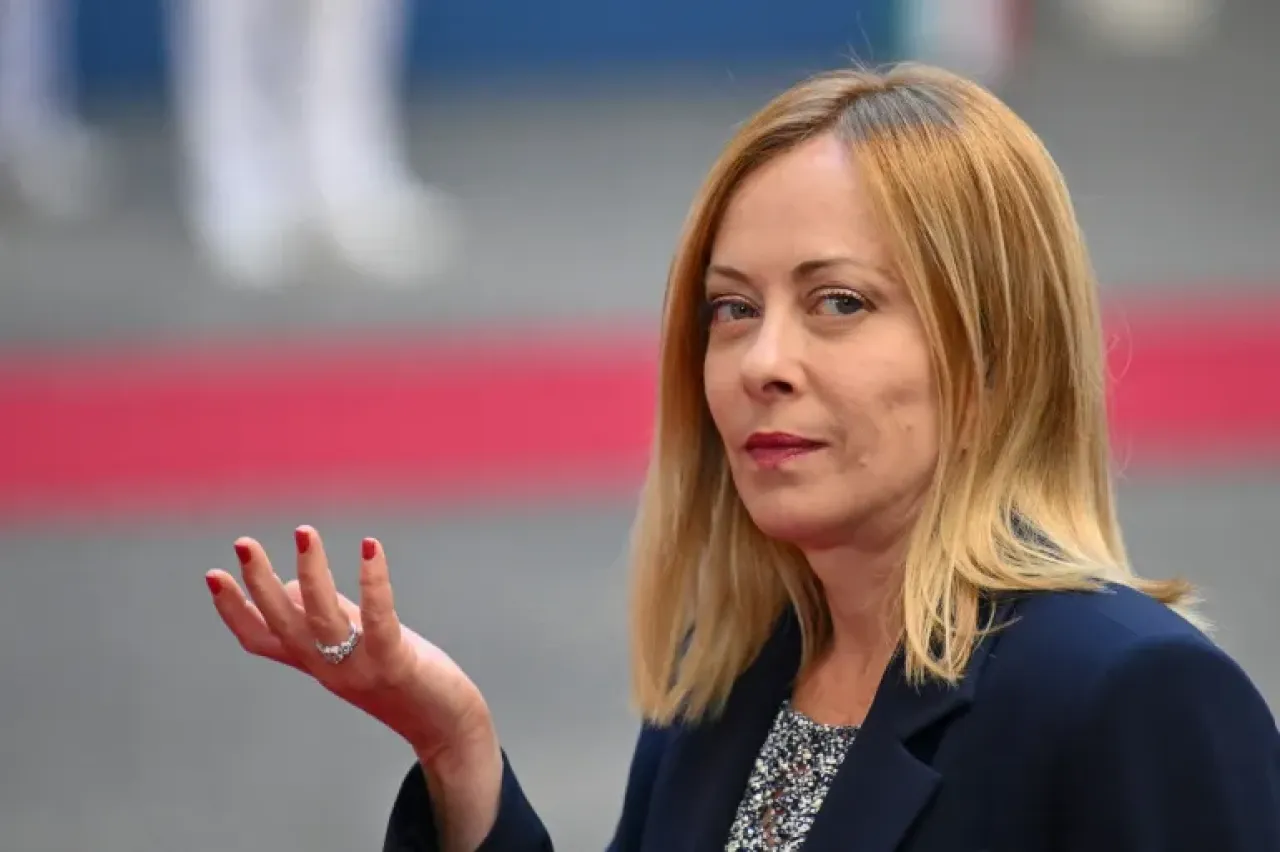
Khaberni - On the sidelines of a wine exhibition in the city of Verona, northern Italy, and with brief words, Italian Prime Minister Giorgia Meloni announced the suspension of the automatic renewal of the defense cooperation agreement with Israel.
The step taken by a right-wing government, which has long been considered one of Tel Aviv's closest allies in Europe, did not come out of nowhere, but was the culmination of accumulated field and political tensions, and a change in the balance of internal and external pressure.
What is the nature of this cooperation and its magnitude? What does Israel actually lose from the Italian stance? And could Rome's step spark a widening of the arms embargo in other countries?
The recent tension
The Italian stance was not impromptu, but followed a direct escalation involving the Italian forces. The Italian military announced that Israeli forces had fired "warning shots" at a convoy of Italian peacekeepers under the United Nations in Lebanon, resulting in damage to at least one vehicle without injuries.
This incident prompted Rome to summon the Israeli ambassador to protest, followed by a visit from Antonio Tajani, Deputy Prime Minister and Minister of Foreign Affairs of Italy, to Beirut, where he explicitly stated, "I came to Beirut to express Italy's solidarity following the unacceptable attacks by Israel against civilian populations." This statement was met with the summoning of the Italian ambassador in Tel Aviv by Benjamin Netanyahu's government.
The nature of the agreement and the scale of military cooperation
The roots of the defense memorandum date back to 2003, ratified later to become effective, stipulating automatic renewal every 5 years. It includes import, export, and transit of military equipment, joint training, and defense research.
Nevertheless, the quantitative scale of the cooperation remains limited. According to data from the Stockholm International Peace Research Institute reported by the "Washington Post," the United States and Germany together account for about 99% of Israel's "major conventional weapons". Italy comes in a distant third, contributing only about 1%.
Italian supplies have recently focused on naval cannons (76 millimeters) and "Koala AW 119" helicopters
Despite the existence of an Italian law since 1990 prohibiting the export of arms to countries in a state of war, an analysis by the Italian site "Ultra Economia," used by "Deutsche Welle," revealed that Rome exported weapons worth 5.2 million euros to Israel last year, in a context of military cooperation that today’s decision to suspend the agreement places under a strict legal and political microscope, casting significant doubt on the continuation of such shipments.
The internal pressure: the law, the streets, and the opposition
Milioni's decision did not come “from above” alone but resulted from significant internal pressure. Italian opposition parties have long been demanding the suspension of the agreement with Israel.
Ily Schlain, the leader of the left-central Democratic Party, said, "We have been demanding this for some time, alongside other progressive forces," adding that Italy should also support the suspension of the partnership agreement between the European Union and Israel.
In June last year, 10 professors of constitutional and international law challenged the legitimacy of renewing the memorandum, referring to decisions by the International Court of Justice concerning genocide and occupation, and arrest warrants issued by the International Criminal Court against Netanyahu and his former defense minister, Yoav Galant.
The pressure was not limited to the political and legal elite but was based on widespread popular movement, as decision-makers in Rome were not isolated from the voices of the Italian streets, which over the past two years, have seen massive and ongoing demonstrations.
These protests traversed major Italian cities and squares, rejecting Israeli military practices and violations in the Gaza Strip, and their extending destructive operations to Lebanon.
What did Israel lose?
Officially, Tel Aviv tried to downplay the Italian decision, with the Israeli Foreign Ministry issuing a statement saying, "We do not have a security agreement with Italy. We have a memorandum of understanding from many years ago that never included substantive content at any time, and this will not affect Israel's security," the same position echoed by Foreign Minister Gideon Saar through social media.
However, Israel faces strategic losses beyond the material aspect:
Loss of a reliable political ally: The Meloni government, once a partner to Israel, turned into a fierce critic, also preventing the use of the "Sigonella" base for transferring American weapons to the Middle East, with increasing critical voices against Israel within the government.
Undermining the legitimacy of European cooperation: The decision to suspend the agreement by a prominent G7 country may encourage parliaments and civil society organizations in other European countries to target their military deals with Israel on grounds of violating international law.
Reputational damage before UNIFIL forces: The suspension followed an Israeli targeting of an Italian peacekeeping force in Lebanon, sending a message from Rome about their readiness to take stances to protect their forces, a path Tel Aviv fears other countries might follow.
Could the "domino" effect spread?
Rome's decision does not occur in a vacuum but is part of an escalating wave of restrictions on arms exports to Israel, some old and some new. The "Washington Post" detailed this in a previous report:
Spain: In October last year, the Spanish parliament passed a law imposing a ban on weapons to and from Israel.
United Kingdom: Previously suspended 30 export licenses (8% of licenses for Israel) including drone parts, except for "F-35" aircraft parts that do not go directly to Israel.
Belgium: A court prohibited the "transit" of military equipment headed for Israel through its ports.
Netherlands: Halted direct arms exports to Israel, while continuing to supply parts for the "F-35" program, and excluded Israeli companies from the largest Dutch military exhibition, while Slovenia and Ireland took early steps to ban.
Germany: Despite Berlin providing about a third of Israel's imports, Chancellor Friedrich Merz told "WDR" network that he "no longer understands" Israel's objectives in Gaza, considering its actions unjustifiable.
Despite the exclusion of a comprehensive German ban due to its security commitments to Israel, "Politico" magazine pointed to an actual freeze on some weapons, reflecting tension between Germany's historical legacy and the field reality.
Ultimately, while Rome's decision to suspend its defense agreement does not directly drop heavy weapons from Israel's hands, as most come from Washington and Berlin, it unquestionably drops an essential card from the legitimacy of this weaponry on the European continent.