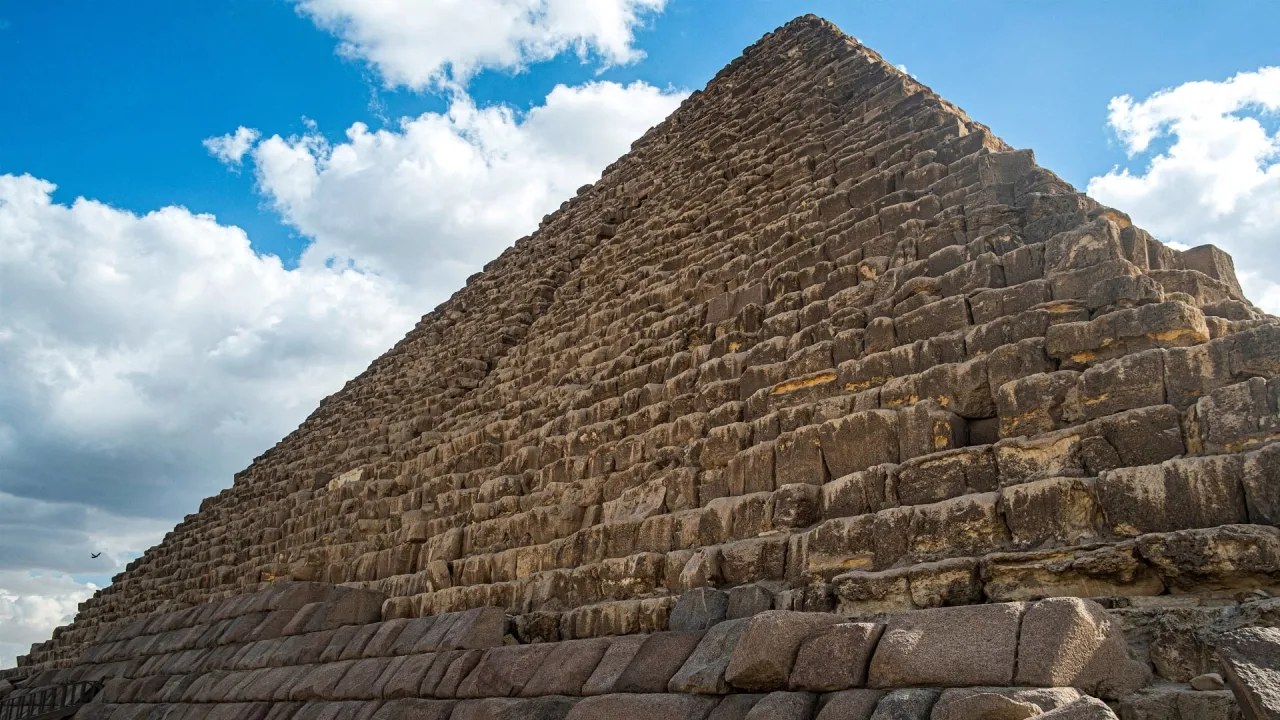
Khaberni - Recent scientific research has uncovered a new perspective that contributes to solving one of the most complex engineering puzzles in history, which is how the Great Pyramid was built at Giza during the reign of Pharaoh Khufu.
For decades, scientists and historians have been puzzled by this tremendous achievement, where approximately 2.3 million stone blocks, some weighing up to 15 tons, were used without the presence of modern techniques or written records to explain how it was done.
Spiral ramp
The new study, published in the journal NPJ Heritage Science, suggests that ancient Egyptian workers relied on an innovative system involving a spiral ramp hidden within the pyramid itself, instead of using large external ramps as previous theories had assumed. This proposition is led by Spanish computer scientist Vincente Luis Rosell Roig, who presented a comprehensive computer model to simulate the construction process.
According to this theory, an inclined pathway was created along the outer edges of the pyramid, known as the "flank ramp".
This path was used to gradually transport the stone blocks upwards, layer by layer. As construction progressed, parts of this ramp would be covered with new stones, eventually disappearing completely inside the final structure, explaining the absence of any clear evidence of its existence today.
This model is notable for its ability to explain several aspects that were previously obscure. On one hand, it provides a practical method for transporting stones without the need to create massive ramps requiring vast amounts of material. On the other hand, it is consistent with recent discoveries of unexplained internal voids within the pyramid, potentially remnants of this internal system.
The Element of Time
The study also focused on the element of time, where simulations showed that a stone block could be placed every four to six minutes regularly. Based on this rate, the construction of the pyramid could be completed within a period ranging from 14 to 21 years, while the estimate rises to 20–27 years when accounting for the stone extraction processes, transporting them across the Nile and rest periods for the workers. These figures remarkably align with current historical estimates.
Additionally, the research addressed the issue of structural stability, using finite element analysis to simulate the impact of loads during construction. The results showed that the stresses on the limestone remained within safe limits throughout the building stages, indicating that the design was carefully considered to ensure the structure's stability.
One of the strongest points of this theory is that it is testable. The researcher identified a set of physical indicators that archaeologists can look for, such as infill edges or wear patterns caused by the workers' movement on the ramp. If these clues are found, they could strongly support this hypothesis.
This study presents a comprehensive model that combines engineering, logistics, and scientific analysis. If proven correct, it could change our understanding of how the Great Pyramid was built, not merely as an achievement based on human strength, but as a result of smart planning and amazing engineering precision that allowed for a construction method that disappears within the work itself.
Engineering Genius
The Great Pyramid remains the greatest monument of ancient Egyptian civilization, and it is the only one still existing from the seven wonders of the world to this day. Built as a tomb for Pharaoh Khufu from the Fourth Dynasty, it reflects a staggering level of planning and engineering precision that still amazes scientists in the modern era.
The pyramid is known for its huge dimensions, where its original height was about 146.6 meters before it decreased to about 138 meters due to the loss of its apex. Each side of its base measures about 230 meters, with an inclination angle close to 51.5 degrees. This monument remained the tallest building in the world for over 3,800 years, reflecting the greatness of the architectural achievement accomplished by the ancient Egyptians.
Various materials were used in its construction, primarily limestone which constituted the bulk of the structure, while granite was used in the inner chambers, especially the King's Chamber. Evidence shows that some of these stones were transported from distant areas across the Nile, indicating the existence of an advanced transport and logistics system at that time.
The pyramid exhibits exceptional engineering precision, as it was almost perfectly aligned with the original four cardinal directions (north, south, east, west), with a very slight deviation that is negligible. This precision, achieved without the use of modern tools, reflects an advanced level of astronomical and engineering knowledge possessed by the ancient Egyptians.
Inside, the pyramid contains a complex network of passages and chambers, such as the descending and ascending passages, the Grand Gallery, and the King's Chamber which contains a granite sarcophagus, in addition to the Queen's Chamber which still has an unconfirmed function. Interestingly, these chambers are not centered within the pyramid, but are unevenly distributed, adding to the mystery of its design.
Recent studies, such as the ScanPyramids project, have revealed large internal voids of unknown function, which supports some modern theories suggesting the existence of internal passageways or ramps used during construction. Evidence also indicates that the workers were not slaves, but skilled laborers living in organized communities and working in precisely coordinated teams.