- "Arab Potash" is moving towards forming an integrated industrial conglomerate to maximize the added value of the mineral wealth
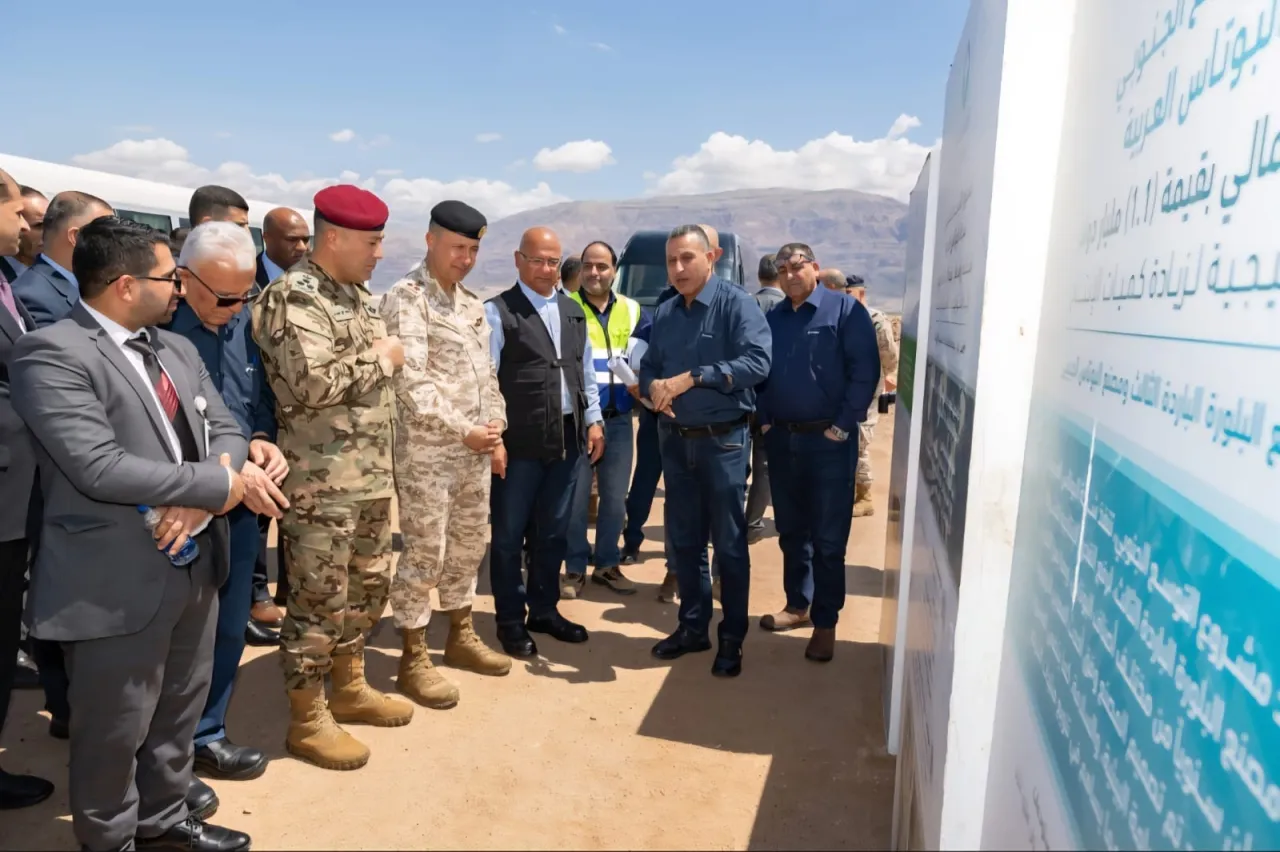
Khaberni – Dr. Maen Al-Nasour, the CEO of the Arab Potash Company, confirmed that the company is implementing an integrated industrial transformation strategy aimed at maximizing the added value of national mineral wealth, enhancing its contribution to supporting the national economy and consolidating the pillars of economic security. This was stated during the company's reception of a delegation from the participants in the National Defense Course (23/2026) at the Royal Jordanian National Defense College headed by the college commander Brigadier General Rizq Al-Rawashdeh, with the participation of the chief of guidance Brigadier General Mohammad Al-Muheiddat and other guidance members, during a field visit to the company’s factories in Ghor Al-Safi area, to learn about the company’s experience and its role in supporting the pillars of economic security and enhancing the industrial sector’s contribution to the national economy.
During the visit, Dr. Al-Nasour delivered a lecture titled: "Industrial Policy and Its Role in National Development: Insights from the Arab Potash Company Experience," in which he reviewed the qualitative transformation that the company has witnessed in recent years, transitioning from traditional production to an integrated industrial conglomerate based on maximizing added value and developing derivative industries.
Dr. Al-Nasour noted that the company recorded a historical record in potash production in 2025, reaching about (2.9) million tons with a growth exceeding 21%, while consolidated net revenues amounted to about (726) million dinars, and consolidated net profits were about (173) million dinars, reflecting the solidity of operational and financial performance.
Dr. Al-Nasour added that in recent years, the company succeeded in enhancing its presence in global markets through the development of new potash products and opening additional export markets in Europe, Brazil, and a number of Asian markets, which contributed to meeting the increasing demand for fertilizers in the international markets and enhancing Jordan’s position within the global supply chains.
Dr. Al-Nasour further explained that the company’s strategic vision extended to 2034 not only aims at increasing the production capacity to about (3.7) million tons but also extending to opening new industrial pathways and expanding the portfolio of high value-added specialized products, which enhances Jordan’s position within global value chains and supports global food security.
Dr. Al-Nasour also mentioned that the company’s investment plans include capital projects estimated to cost about (3.4) billion dollars, targeting the development of the production system and expansion in the chemical industries and derived materials, aligned with the targets of the economic modernization vision.
Dr. Al-Nasour affirmed that Arab Potash Company is today one of the main locomotives of economic development in the country through its contribution to raising the level of national exports, supporting the state budget, and providing employment opportunities for Jordanians.
Dr. Al-Nasour clarified that the relationship between a country's economic performance and its stability is closely linked, reflecting a deep interaction between development data and indicators of social and political security. He noted that as the economy grows stronger and more diverse, and sustainable growth rates are achieved, this positively reflects on the standard of living of individuals, reducing social disparities and enhancing trust between the citizen and state institutions.
Dr. Al-Nasour also pointed out that strong economic performance contributes to empowering the state to defend its interests on the global political stage, as it grants it multiple tools of influence beyond traditional power. A state with a strong economy possesses greater capability to influence international decisions, whether through investment, strategic partnerships, and this enhances its status and gives it higher negotiating weight. Moreover, financial stability supports the development of defense and technological capabilities, earning the state the trust of allies and respect of adversaries, thereby cementing its active presence and enabling it to protect its interests and achieve its goals in the international system, indicating that investing in the economy and adopting wise developmental policies is not just a financial option but a fundamental pillar for ensuring overall stability and consolidating the foundations of national security.
On his part, the commander of the Royal Jordanian National Defense College, Brigadier General Rizq Al-Rawashdeh, appreciated the pioneering role of the Arab Potash Company as one of the pillars of the national economy, affirming that knowledge about successful national industrial experiences contributes to enhancing the strategic understanding among participants, especially regarding the concept of economic security and its role in supporting comprehensive national security.
Brigadier General Al-Rawashdeh noted that the experience of Arab Potash Company in transforming natural resources into an industrial and export force capable of global competition represents an important model in building a more robust and sustainable national economy.
At the end of the visit, the delegation undertook a field tour where the participants were introduced to modern operational technologies and mechanisms for producing potash and specialized products aimed at global markets.