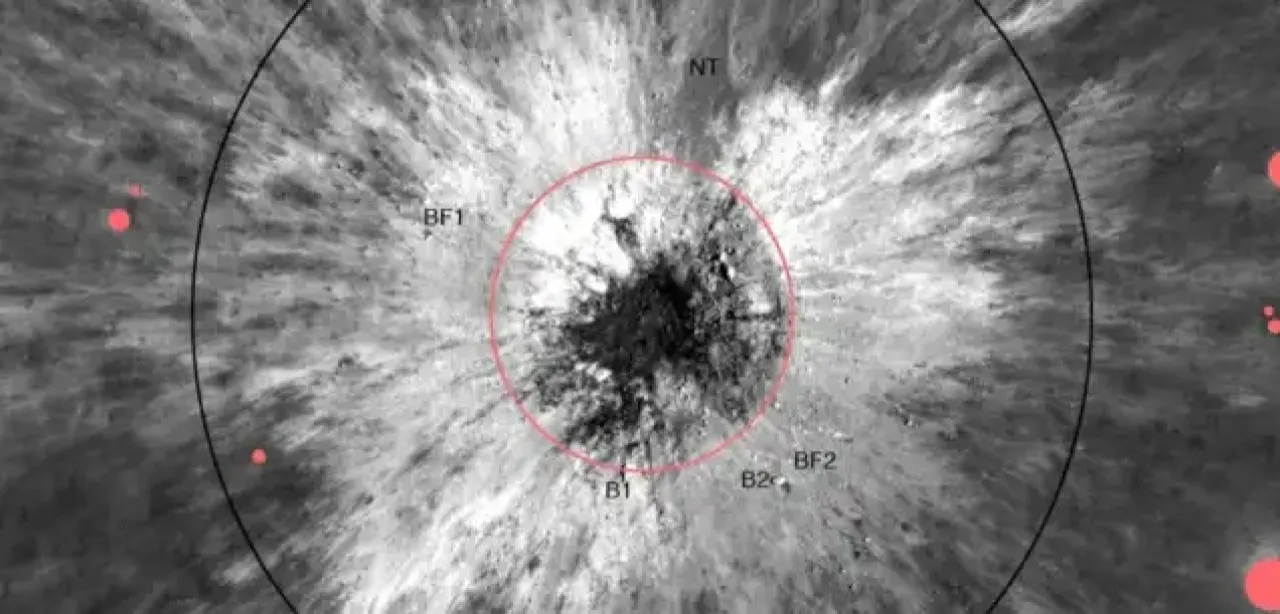
Khaberni - Space scientists have announced the discovery of a new, massive impact crater on the lunar surface, representing the largest impact event recorded since the launch of NASA's Lunar Reconnaissance Orbiter mission.
In a study presented at the 57th Moon and Planets Science Conference, researchers revealed that a space rock collided with the lunar surface in late spring 2024, resulting in a crater 225 meters wide, roughly the size of two football fields.
Experts describe this discovery as a once-in-a-century event, with statistical models indicating that an impact of this magnitude typically occurs only once every 139 years.
Prior to this discovery, the largest recent crater documented by the Lunar Reconnaissance Orbiter was only 70 meters in diameter, making the new crater three times larger than its predecessors.
The discovered crater is characterized by a funnel shape with a depth of 43 meters, and the impact resulted in the ejection of large rocks around its rim, with the largest reaching 13 meters in width.
By analyzing the pattern of the scattered debris, scientists concluded that the celestial body came from the southwest, causing the ejected material to be sprayed towards the north.
The team also found dark glass rocks inside the crater, which are lunar materials that melted due to the tremendous heat generated by the collision and then instantly solidified, remaining as evidence of the unimaginable impact energy.
The great scientific value of this discovery lies in the availability of high-resolution images of the site before and immediately after the collision. For the first time, researchers have precise imaging data that allows them to test and develop models used to understand how craters form, not just on the Moon but across the entire solar system.
Unlike Earth, where wind and water erase the traces of impacts, the Moon lacks erosive agents, making this new crater a precisely preserved record of this massive cosmic collision.