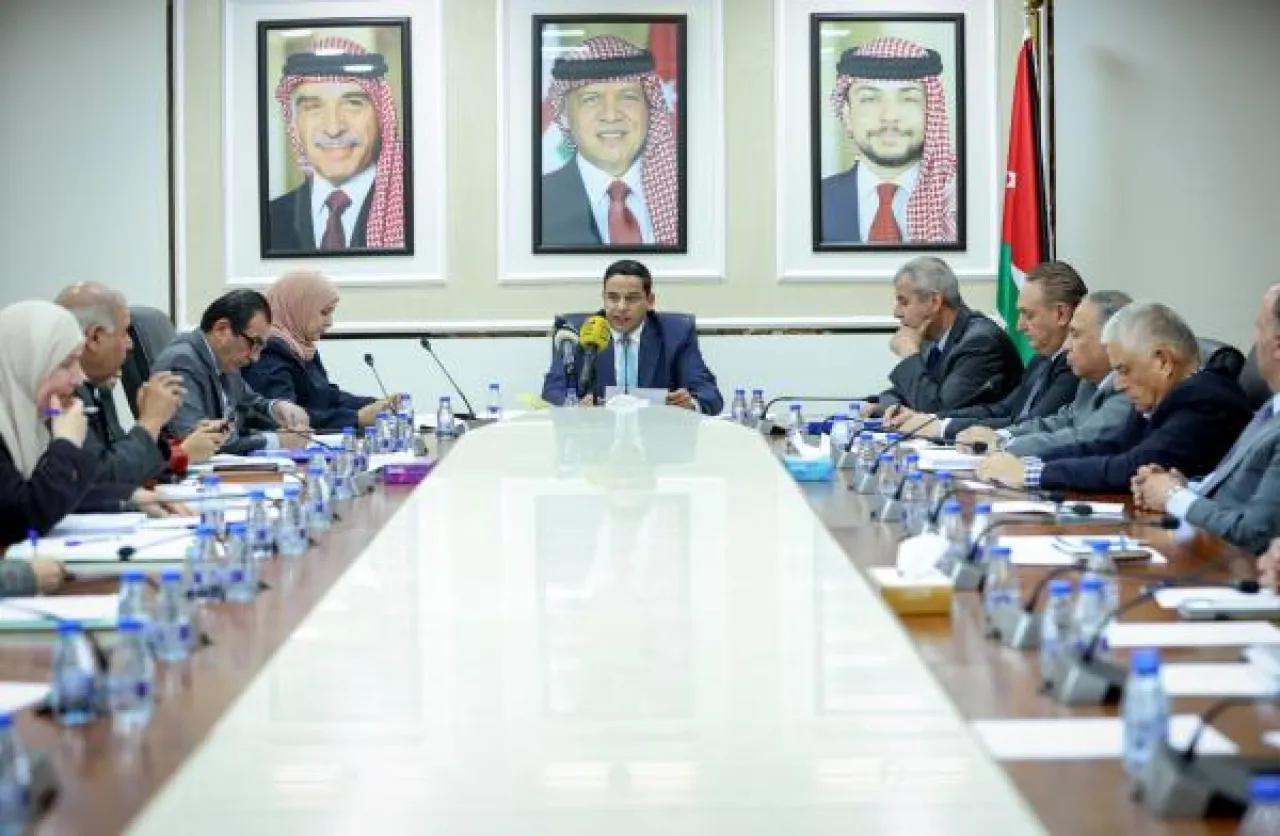
Khaberni - The parliamentary Energy and Mineral Wealth Committee, chaired by MP Dr. Ayman Abu Henia, continued its meetings to discuss the copper mining agreement in the Abu Khashiba area, attended by the Ministers of Energy and Mineral Wealth Saleh Al-Kharabsheh, the State for Legal Affairs Fayad Al-Quda, the Environment Ayman Suleiman, and the Chairman of the Board of Social Security Investment Fund Omar Malhas and Chairman of the Board of Commissioners of the Energy and Minerals Regulatory Commission Ziad Al-Saadeh.
Abu Henia emphasized that the committee views this agreement as having a direct impact on a vital sector that affects the national economy and is linked to the management of state resources, noting that the ongoing debate raises legitimate questions about feasibility, guarantees, and implementation mechanisms.
He clarified that the committee's role is not to promote or obstruct, but to achieve a balance between encouraging investment and protecting national interest, and between utilizing natural resources and ensuring their sustainability, along with achieving a balance between flexibility in agreements and clarity in obligations.
He added that the committee handled the agreement with national responsibility, studying its clauses and hearing from relevant parties, and raised a series of inquiries aimed at removing any ambiguity and ensuring clarity of rights and duties, and shielding the agreement from any future issues.
He stated that the discussion should focus on fundamental principles, foremost among them the extent to which the agreement benefits the state, fairness in the distribution of returns and risks, and ensuring compliance with national legislation and environmental standards.
Abu Henia highlighted the importance of full transparency, providing all technical and legal justifications and data, enabling the House of Representatives to make a decision based on a solid foundation.
He emphasized that the committee will remain committed to its supervisory and legislative role, presenting a balanced summary to the House of Representatives that reflects its dedication to protecting the nation's assets, without neglecting development opportunities.
The MPs, including Ra'kin Abu Henia, Khader Bani Khalid, Islam Al-Azzam, Qasim Al-Quba'i, Naseem Al-Abbadi, Talal Al-Nassour, Mai Al-Harahsheh, Saleh Abu Tayeh, Rania Khalifat, and Aref Al-Saadeh, affirmed that the House of Representatives supports any projects and agreements that serve the supreme interests of the state and support the national economy, noting that their concern stems from national responsibility and avoiding any harm that may affect the state's wealth and public money, with the necessity of clarifying the facts to the public.
The MPs inquired about the duration of the agreement, the methodology of its display procedures, registration mechanisms, and its termination or modification, and the conditions of adopted arbitration, questioning the judicial or arbitral authority competent in case of a dispute, and the extent of protection these mechanisms offer to the state's legislative and financial sovereignty.
The MPs also focused their inquiries on the economic feasibility studies upon which the project is based, the realism and accuracy of these studies, demanding access to the assumptions used in calculating reserves, costs, and returns, and emphasizing the need to ensure that the expected return to the treasury is proportional to the size of the wealth invested and the nature of the risks.
The MPs also inquired about accompanying minerals and their processing mechanisms, the financial and technical efficiency of the Wadi Araba Minerals Company, its previous experience in similar projects, its ability to execute the project according to the highest technical and environmental standards, as well as its actual contribution percentage, financial structure, and guarantees of commitment to executing the project within the specified timelines.
Regarding environmental impact, the MPs emphasized that protecting the environment and local communities is a priority no less important than economic feasibility, demanding clear and executable guarantees concerning water management, waste treatment, ongoing environmental monitoring, and not imposing any future burdens on the state resulting from environmental damages.
Minister Al-Kharabsheh affirmed that the agreement comes within the government's commitment to the provisions of the Constitution and the effective legislation, in line with the economic modernization vision that places the mining sector among high-added-value industries, emphasizing the government's dedication to protecting public money and maximizing national return.
He explained that the main objective of the agreement is to serve the national economy by attracting quality investments based on clear and transparent foundations, contributing to job creation, building real success stories in the mining sector, and enhancing investors' confidence, and raising local added value.
Al-Kharabsheh also reviewed various clauses of the agreement, affirming that the ministry's work is governed by clear laws and regulations, and that any company is required to prove its financial solvency and technical efficiency, noting that the developing company possesses a specialized technical arm.
Regarding the return, he clarified that the agreement relies on a variable return considered among the highest levels, pointing out that the agreement stipulates a royalty to the government ranging between 3% and 10% of total revenue depending on the global copper price, plus a progressive tax on unexpected profits that may reach up to 50% if the profit margin after tax exceeds 40%, in addition to collecting other taxes in accordance with the enacted legislations.
Minister Al-Quda asserted that the agreements undergo constitutional processes through the Cabinet and then are presented to the House of Representatives for ratification, pointing to the legal aspects of the agreement and affirming that Jordanian law is the law to be applied.
He provided comprehensive explanations about the arbitration procedures and its different pathways, in addition to the status of the developer, noting that it must transform into a public shareholding company, with 49% of its shares offered for public subscription.
Minister Suleiman emphasized the importance of complying with environmental conditions at all stages of the project's execution; no mining activity can begin before preparing a comprehensive environmental impact assessment study, emphasizing that this study must cover all project stages, from preparation through mining operations to rehabilitation, ensuring the protection of natural resources, the environment, and local communities according to adopted legislations and standards.
He mentioned that the ministry follows these projects within clear regulatory frameworks, to ensure full compliance with environmental legislations and application of best practices.
Melhas stated that the Social Security Investment Fund acts as a financial investor, with its investment policy built on bases prominently featuring economic feasibility, noting that the Fund's investment in the energy and mining sectors amounts to about 2.3 billion.
In response to the MPs' questions, he indicated that the Fund does not have experts in every field, but it includes financial experts, noting that when investing in any sector, technical experts specialized in that sector are consulted for their opinions.
Al-Saadeh affirmed that the Authority plays its regulatory and supervisory role over the mining sector according to the enacted legislations, ensuring compliance with technical and environmental standards and public safety requirements.
He explained that the Authority uses best global practices in the licensing of mining activities, where the license is issued through the Board of Commissioners of the Authority under specified conditions and if the licensee violates or exceeds any condition, they are held accountable according to applicable laws.
He noted that the Authority follows the stages of mining projects to ensure that companies comply with operational conditions, achieving a balance between exploiting natural resources and protecting them, and enhancing confidence in Jordan's mining sector.