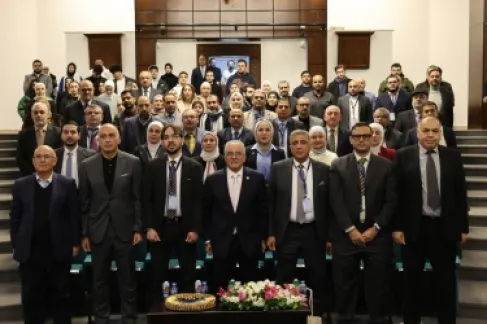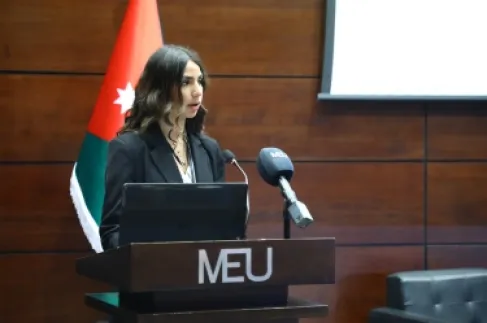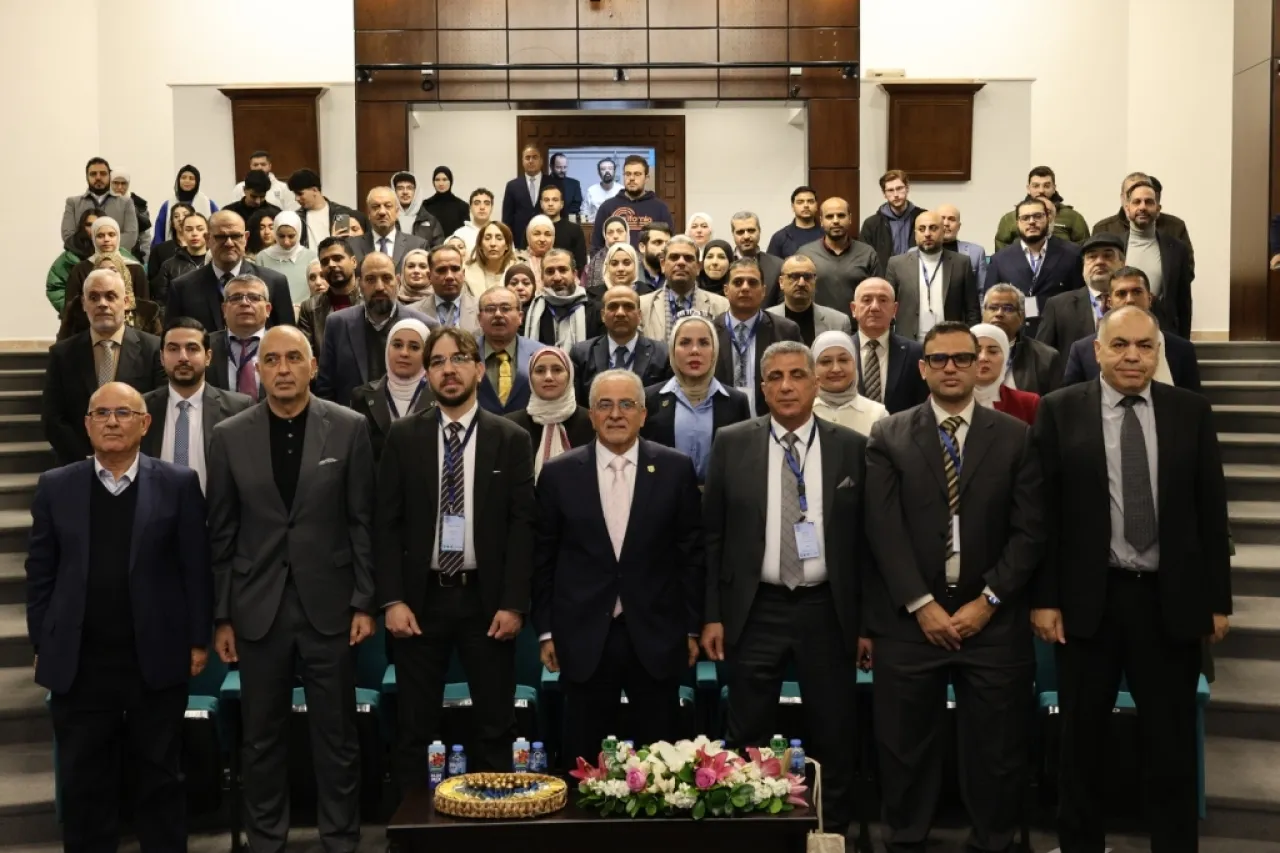
Khaberni - The Faculty of Information Technology at Amman Ahliya University organized its first international conference on emerging technologies and engineering systems, in cooperation with the Association of Arab Universities and IEEE Jordan, with wide participation from researchers, academics, and experts in the fields of information technology. The event was attended by the university president, Professor Dr. Sari Hamdan, the Vice President for Academic Affairs/Dean of the Faculty of Dentistry, Professor Dr. Ahmad Hamdan, and the Dean of the Faculty of Information Technology, Professor Dr. Mohammad Al-Qatawneh, along with Dr. Eyad Shaaban, the Assistant President for Accreditation, Quality and Planning/Director of Human Resources and Institutional Development Unit, beside the deans of faculties and a number of faculty and administrative staff members.
The conference, organized in cooperation with IEEE Jordan, aims to enhance scientific research and expand the horizons of academic and technical cooperation, keeping pace with the latest developments in the fields of technology and innovation.
In his speech during the conference, the university president, Professor Dr. Sari Hamdan, expressed his pride in the successful proceedings of the conference, pointing out that the participation of elite researchers with valuable scientific papers contributed to enriching scientific discussion and opening new avenues for development and innovation. He added that the conference's occurrence, despite the challenges faced by the region, reflects the determination of academic institutions to continue performing their scientific and educational roles.
The conference covered a number of specialized scientific topics, notably cybersecurity and privacy, artificial intelligence and data science, the Internet of Things and smart systems, innovation technologies, communication technologies and networks, software engineering, and engineering applications and smart technologies.
The conference witnessed a wide turnout from researchers around the world, with a total of 218 research papers submitted, of which 76 were accepted, reflecting a high level of selection and scientific quality. Additionally, a total of 496 scientific reviews were conducted by 103 reviewers.
The accepted papers were divided according to the topics, with the field of artificial intelligence and data science leading with 26 papers, followed by engineering applications with 17 papers, cybersecurity and privacy with 14 papers, innovation technologies with 8 papers, communication technologies and networks with 5 papers, software engineering with 3 papers, and the Internet of Things with 3 papers. Geographically, researchers from 17 countries participated in the conference, including Jordan, Palestine, England, Turkey, India, Malaysia, Indonesia, Bangladesh, Pakistan, Iraq, UAE, Saudi Arabia, Qatar, Algeria, Morocco, Syria, and Lebanon.
At the end of the conference, participants came up with a set of recommendations that focused on enhancing international research cooperation between Arab and international universities, particularly in the fields of artificial intelligence and cybersecurity, and the creation of platforms for exchanging ideas and implementing joint research projects.
The recommendations also emphasized the importance of developing research skills among young people through organizing specialized workshops in research writing and publishing, in addition to issuing a special issue in a indexed scientific journal for the best research papers presented at the conference.
Participants also stressed the need to link scientific research to the needs of the industrial and service sectors, encourage researchers to direct their studies towards solving real-world problems, and invest in building high-quality Arab databases that support the development of artificial intelligence models that reflect the region's specificity.
They recommended organizing the conference on an annual basis and expanding the scope of participation.
At the end of the conference, the university president expressed his hope that the outputs of the conference, in terms of scientific papers and recommendations, would contribute to the development of the information technology sector, enhance the technology and artificial intelligence industry, and serve the development journey in Jordan, further enhancing the university's position as a leading academic institution in supporting innovation and scientific research.