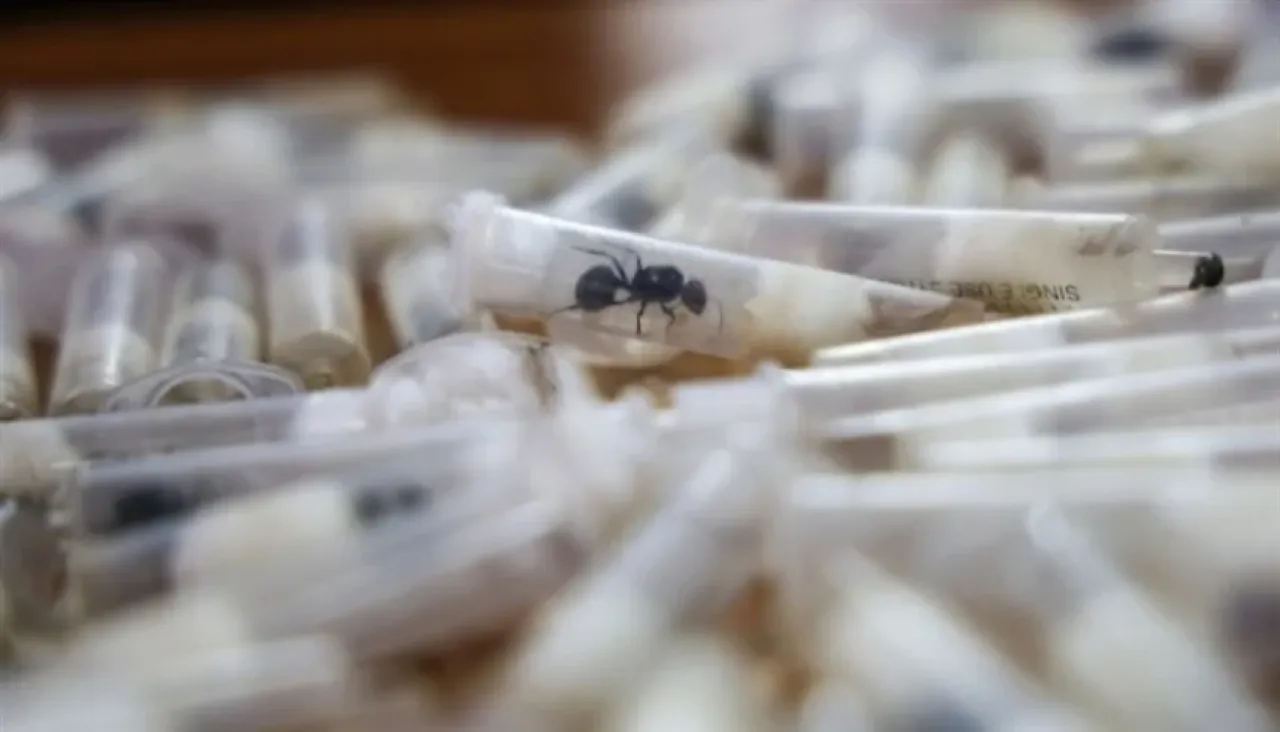
Khaberni - Last year, wildlife protection authorities in Kenya warned of an increasing demand for garden ants in Europe and Asia.
The issue resurfaced after an attempted smuggling of 2000 ants was thwarted at Nairobi International Airport earlier this year.
In 2025, a Kenyan court sentenced 4 people convicted of attempting to smuggle more than 5,000 ants. The accused admitted to possessing live wild species for illegal trade, a crime punishable under Kenya's 2013 Wildlife Protection Law, and the court imposed a fine of $7700 or imprisonment for 12 months.
The scope of crimes involving the smuggling of invertebrates and rare species
Elliot Dornbos, a criminology expert at Britain's Nottingham Trent University, explains that wildlife trafficking is no longer limited to large sizes such as elephant tusks and rhinoceros horns but has extended to include invertebrates like ants, spiders, and scorpions.
Despite the difficulty of estimating the size of this trade globally due to data scarcity and law enforcement challenges, estimates suggest that the legitimate trade in insects could reach $17.9 billion by 2033, reflecting the growing demand for them.
Motives for smuggling and international black market networks
Dornbos pointed out in an article on "The Conversation" website that thwarting smuggling operations in Kenya reveals the existence of foreign markets linked to organized criminal networks.
The legitimate purposes of ant trade vary between scientific research, as pets, or for human consumption, and these are the same reasons that drive the black market focused on rare species.
Investigations revealed that the ants smuggled from Kenya were intended for sale as pets, a motive repeated in attempts to smuggle rhinoceros beetles to Japan and the "praying mantis" to Italy.
Camouflage methods and legal complexities in crime fighting
The methods of smuggling insects are similar to those used for smuggling birds and reptiles, where a smuggler was caught wrapping plastic bags containing "bullet ants" and "tarantulas" around his body, while others hid insect eggs inside children’s toys or food packages.
Smugglers resort to shipping large quantities to compensate for the loss resulting from the death of some insects during transit.
The authorities face legal complexities due to the mixing of prohibited species with those allowed to be traded to mislead supervision, in addition to the difficulty of customs officials in distinguishing between different species.
Dornbos emphasized that the lack of clarity in international controls and the scarcity of security resources dedicated to wildlife protection represent a fundamental obstacle, stressing that increasing media awareness could contribute to creating popular support for stricter measures and protecting these species from depletion.