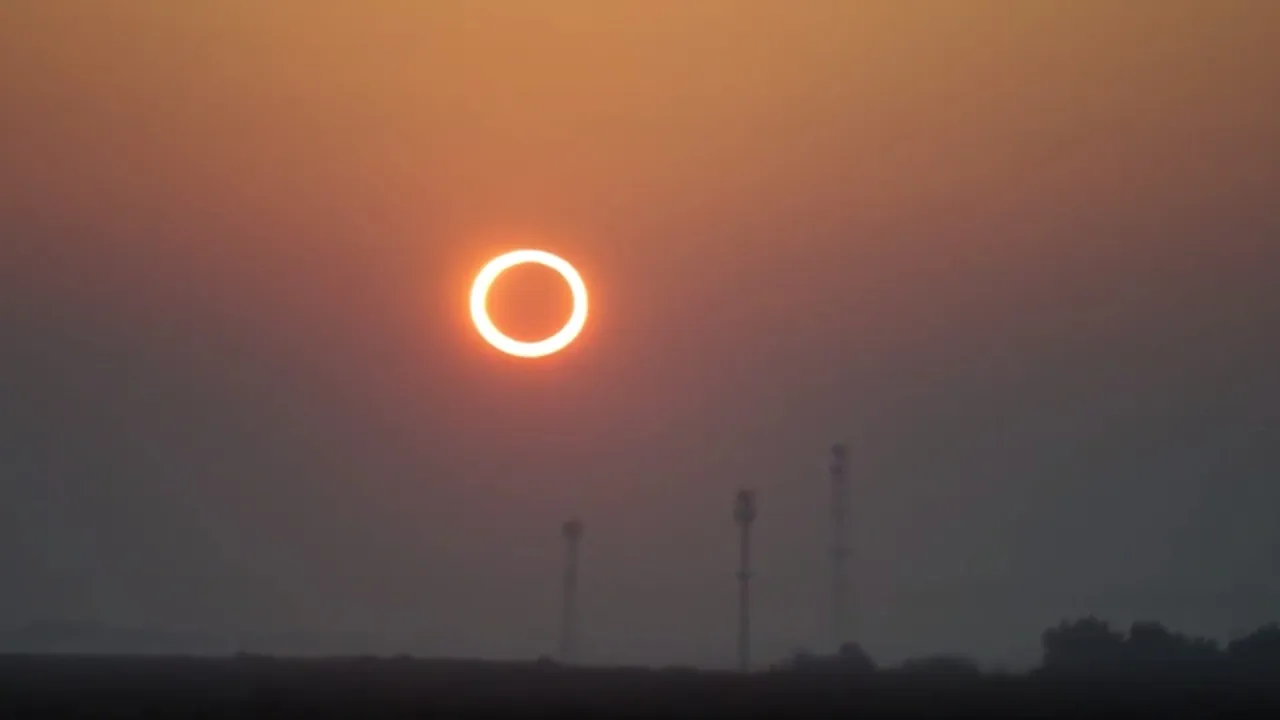
Khaberni - On August 12, 2026, the world is preparing for a rare astronomical event that will turn a mid-summer noon in the Northern Hemisphere into sudden darkness, during a total solar eclipse described among the most significant in the current decade.
According to NASA's data and interactive eclipse maps, the maximum duration of the total eclipse will be about two minutes and 18 seconds, a relatively short period, but sufficient to create a stunning visual transformation, as the sunlight disappears completely for a few moments and what resembles a temporary night appears in broad daylight. This event is part of an astronomical series known as "Saros 126," a regular cycle of eclipses that repeats approximately every 18 years and 11 days, controlling the recurrence of these phenomena over time.
What makes the 2026 eclipse particularly noteworthy is that it represents the peak duration in this specific series, where astronomical calculations indicate that it is the longest within the Saros 126 cycle, and will not repeat with the same characteristics for about 157 years within the same cyclical context. Despite this, scientists confirm that this number does not mean it is the longest in the history of global eclipses, as there are other eclipses that might last more than 7 minutes under different tropical conditions.
The total eclipse path will span from remote areas in northern Russia, across the Arctic Ocean, then through Greenland and Iceland, before reaching parts of northern Spain, where cities like Bilbao, Santander, and Burgos will experience rare moments of daytime darkness. In these areas, the eclipse will be very low on the horizon, making its viewing both a visual and logistical challenge at the same time.
Outside this narrow path, large areas of Europe, North Africa, and parts of North America will experience a partial eclipse, where a part of the sun's disk is obscured without reaching full darkness. Major cities such as London, Paris, and Berlin will witness clear partial scenes in the afternoon hours, adding a visually distinctive character to this event.
The solar eclipse will be visible in several Arab and African countries, but only partially and not in totality. For example, in the Arab world, regions like Northwest Africa (Morocco, Algeria, Tunisia, and Libya) will experience a relatively clearer partial eclipse compared to other countries, while the impact will be less in the Levant and the Gulf, where there is limited obscuring of part of the sun's disk.
In Egypt, the eclipse will only be partial and not total. The event will manifest as a partial obscuring of the sun's disk, with the percentage varying by location within the country, being somewhat clearer in the northern areas such as Alexandria and other northern coastal cities compared to Cairo and Southern Egypt. During the eclipse, residents may notice a slight decrease in lighting intensity without complete darkness, as the path of the total eclipse will pass far north in areas like Iceland and northern Spain.
Although the total eclipse will only be visible in remote areas such as Iceland, northern Spain, and Greenland, this event remains a special opportunity to observe a rare astronomical phenomenon that extends its effects to include broad parts of the Northern Hemisphere, according to the website "eclipsewise".
Experts confirm that observing such phenomena requires strict safety measures, as direct viewing of the sun without special filters can lead to permanent eye damage. Scientific bodies therefore recommend the use of eclipse glasses that meet international standards.
As scientists and enthusiasts anticipate this event, the August 2026 eclipse is seen as a rare opportunity to witness a precise interaction between the Earth, Moon, and Sun, where science meets cosmic beauty in a splendid scene reflecting the magnificence of the cosmic order and its extreme precision. This amazing harmony among celestial bodies reminds humanity of the Creator's greatness and power in creating this perfectly engineered universe, where celestial bodies move in precisely calculated paths that make these phenomena moments of contemplation and admiration before the majesty of the Creator, glorified be He.