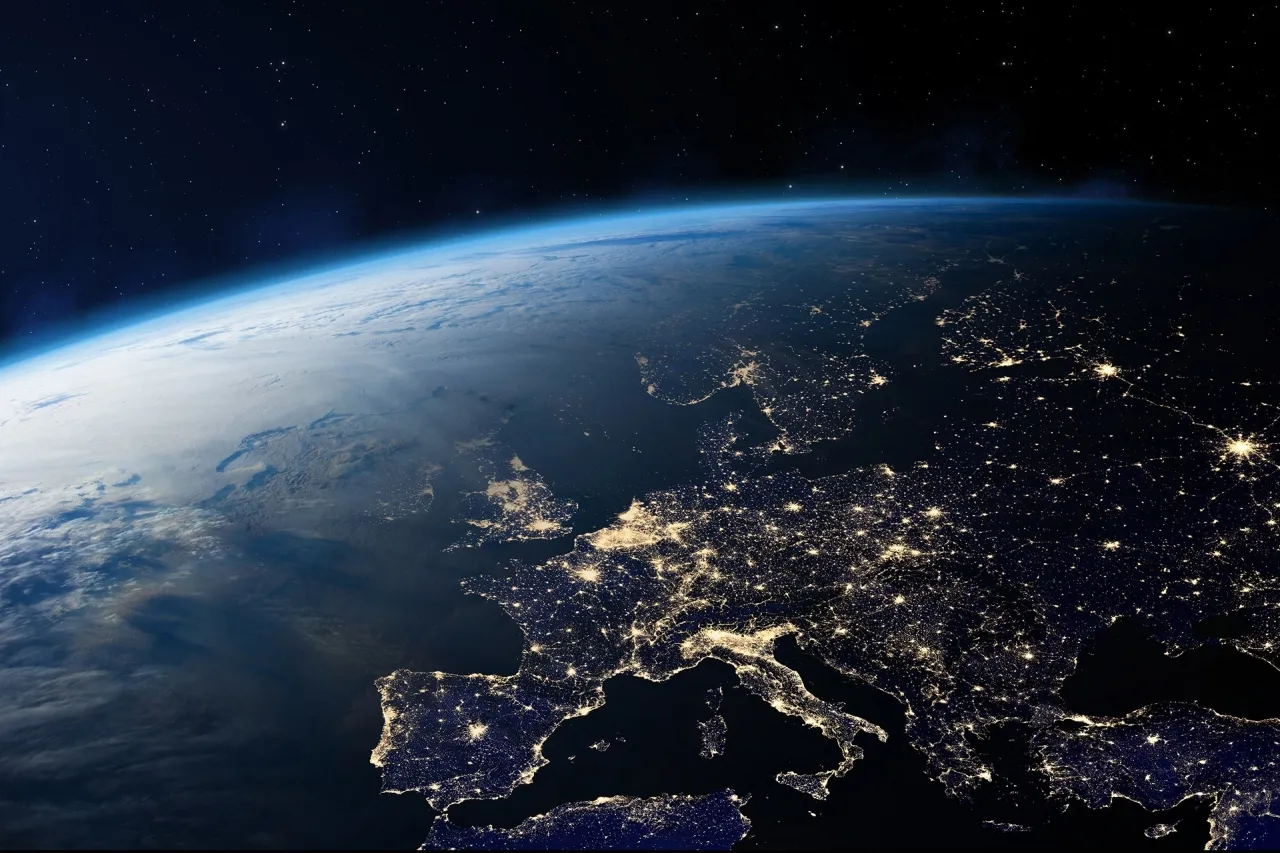
Khaberni - A recent study showed that the Earth's night lights, which scientists have relied on for years as a simple indicator of human activity, are not on a constant upward trend as was believed, but are constantly and quickly changing, directly reflecting economic, political, and environmental transformations around the world.
This idea primarily relies on satellite images that monitor lighting at night from space, where brighter areas are seen as more active in terms of population, economy, and infrastructure. However, the new study published on April 8 in the journal "Nature," shows that this indicator is more complex than it appears.
Through analyzing daily images taken between 2014 and 2022, researchers found that night lighting doesn't just change gradually but also experiences frequent increases and decreases, which can occur in the same place within short periods, something that yearly collected data does not reveal.
Light does not always increase, but fluctuates
The lead author of the study, Chi Chu, an associate professor of physical geography in the Department of Natural Resources and Environment at the University of Connecticut, explains that the findings showed that each region experienced an average of about 6.6 changes in lighting during nine years, a figure that reflects a high degree of instability in this indicator.
In other words, a place that appears brighter in a given year might experience a decrease the following year and then increase again.
Chu adds in statements to Al Jazeera Net, that the area of regions that experienced changes in lighting is more than 21 million square kilometers worldwide.
Of this area, sudden changes occurred in about two million square kilometers, like sudden power outages or disasters, while about 19 million square kilometers experienced gradual changes, such as urban expansion or improved infrastructure.
Although the total global lighting increased by a net rate of about 16% compared to 2014, this increase does not mean that all areas have become brighter. The overall picture hides a complex balance, as lighting in some areas increased by as much as 34%, while it decreased in others by about 18%, reducing the overall increase.
According to the researchers, this means that the world does not light up evenly, but experiences a state of ebb and flow in human activity, clearly shown when looking at daily data instead of annual averages.
Why do night lights change?
These changes are linked to several factors that directly reflect what is happening on earth, according to the study's lead author, who points out that increased lighting is often the result of urban expansion, building of new roads and structures, or power reaching previously unserved areas.
Conversely, decreases in lighting are linked to various events, such as economic crises leading to reduced activity, policies aimed at rationalizing energy usage, or even armed conflicts that may destroy infrastructure and cut off electricity to large areas.
These patterns are clearly visible when comparing different regions, as Asia and Africa recorded noticeable increases in lighting, driven by urban growth and economic expansion, while Europe experienced a relative decrease, resulting from policies aimed at reducing energy usage and using more efficient lighting systems.
At the national level, some cases provide clear examples of these changes. For instance, in Venezuela, lighting decreased significantly due to severe economic crises. In the United States, the situation is more complex, with lighting increasing in some areas while decreasing in others, reflecting different economic and social conditions within the same country.