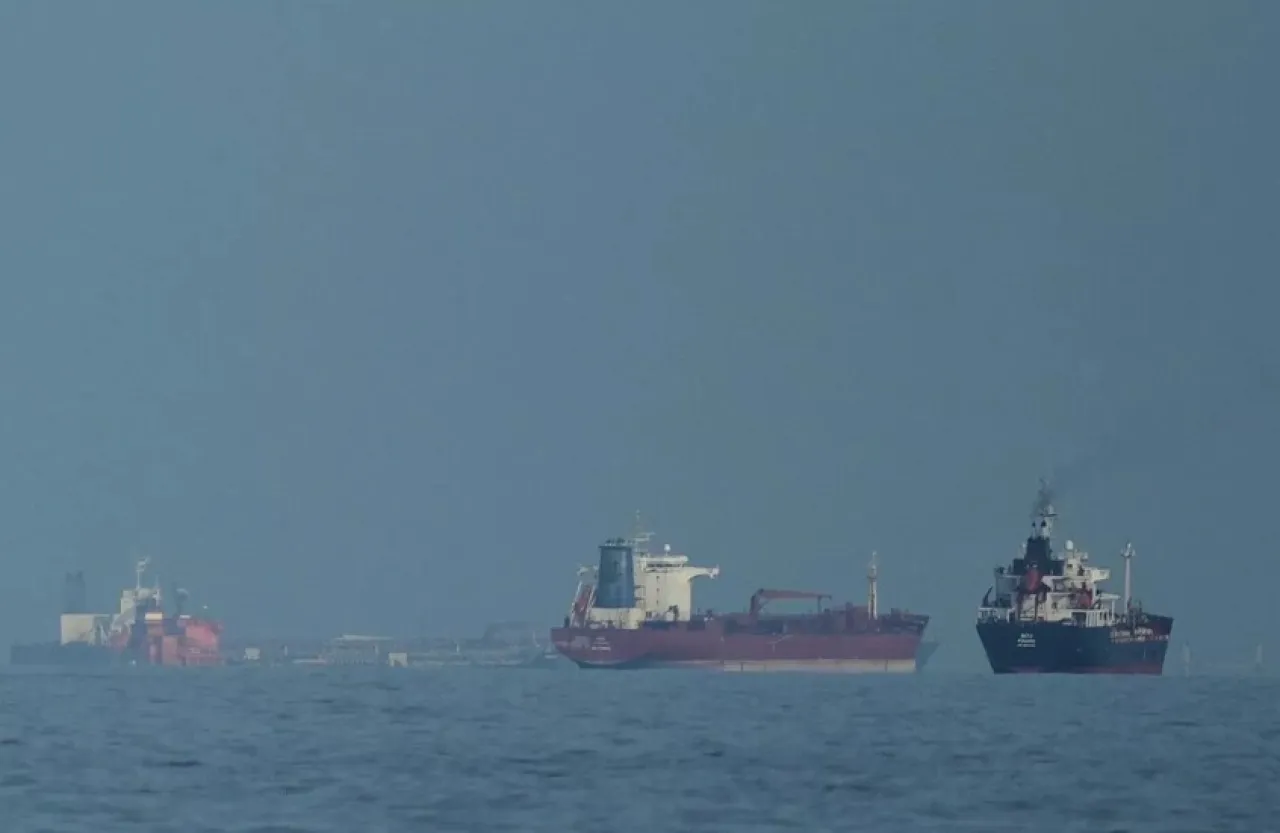
Khaberni - The "New York Times" mentioned that Iran could not open the Strait of Hormuz to broader maritime movement due to its inability to determine the locations of mines it planted in the waterway and its lack of the necessary capabilities to remove them.
The newspaper quoted American officials saying that this development is one of the reasons that prevented Tehran's swift response to the demands of US President Donald Trump's administration to allow more ships to pass through the Strait. This issue also represents an additional complex factor ahead of the anticipated peace negotiations today, Saturday, in Pakistan between Iranian negotiators and a US delegation led by Vice President J.D. Vance.
Officials stated that Iran used small boats last month to plant mines in the Strait of Hormuz, shortly after the outbreak of the war launched by the United States and Israel against it. The mine laying, coupled with the threat of Iranian attacks with drones and missiles, has greatly reduced the number of oil tankers and other ships passing through the Strait, causing a hike in energy prices and providing Tehran with a significant pressure tool during the war.
Officials noted that Iran kept one of the lanes open in the Strait, allowing ships that pay fees to cross.
The Iranian Revolutionary Guard issued warnings of the possibility of ships colliding with sea mines, while semi-official media outlets published maps showing the available safe routes.
American officials said that these routes remain very limited because Iran randomly planted the mines, adding that it is unclear whether the Iranian authorities have documented the locations of all the mines they placed. Even in cases where their locations have been recorded, some of the mines were planted in a way that makes them prone to drift or move from their original locations.
They explained that removing sea mines, as with land mines, is much more difficult than planting them.
Officials noted that the US military itself does not have significant mine removal capabilities, relying primarily on littoral combat ships equipped with mine sweeping capabilities. Meanwhile, Iran also does not possess the capability to quickly remove mines, even those it planted itself.
President Donald Trump stated in a social media post on Tuesday that a two-week ceasefire in the US-Israeli war with Iran is conditioned on the "complete, immediate, and safe" opening of the Strait of Hormuz.
In contrast, Iranian Foreign Minister Abbas Araghchi stated on Wednesday that the Strait would be open to navigation considering the technical restrictions." American officials mentioned that Araghchi's reference to "technical restrictions" reflects Iran's inability to quickly locate or remove the mines.
It is expected that the Iranian and American delegations will meet in Islamabad today, Saturday, where the issue of quickly re-securing safe passage through the Strait is likely to be one of the main topics of discussion.
The US military had sought to destroy Iran's naval capabilities by sinking ships and targeting naval bases, but Iran still possesses hundreds of small boats that can be used to harass ships or lay new mines, while it has been practically impossible to eliminate all these boats, according to the newspaper.
Even before Iran began laying the mines, threats made by its leaders had quickly disrupted global shipping movements and driven up oil prices. On March 2, a senior official in the Revolutionary Guard announced the closure of the Strait, threatening, according to official Iranian media, to set fire to ships if they entered the waterway.
In the days following that threat, Iran began laying mines in the Strait, despite the United States intensifying its strikes against Iranian naval assets. At that time, American officials stated that Iran was not planting the mines quickly or efficiently.
The officials concluded by noting that the United States is still uncertain of the exact number of mines that Iran has deployed in the Strait or their locations, given the difficulty in tracking the small boats that planted them.