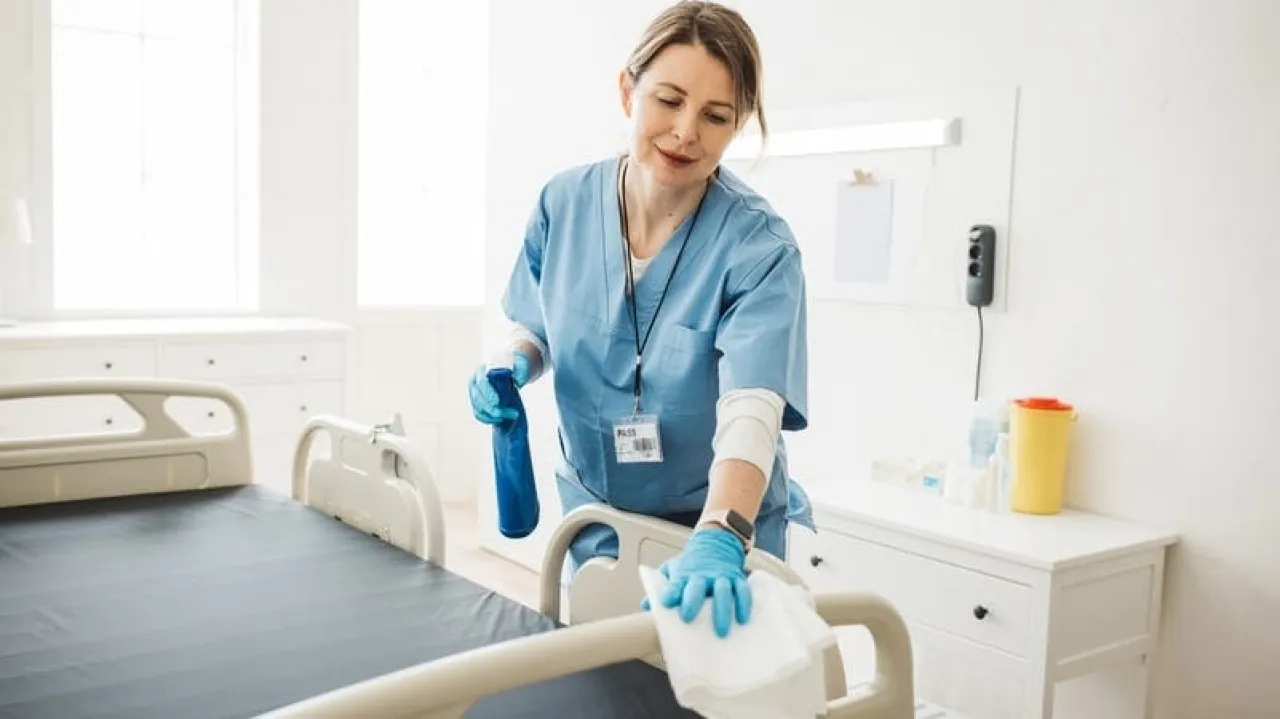
Khaberni - A recent study revealed that the disinfectants used daily in hospitals do not remain confined to their place of use, but spread within the surrounding environment and may affect bacterial behavior. According to a report published in Environmental Science & Technology, the common substance “chlorhexidine” leaves residues that persist for more than 24 hours on surfaces.
The study, conducted by researchers from Northwestern University, attempted to understand how these materials interact with microbes inside intensive care units, where infection poses a real risk to patients.
Laboratory experiments showed that residues of chlorhexidine remain on surfaces such as plastic and metals even after being cleaned with other substances. Although these quantities do not kill bacteria, they place them under modest chemical stress.
The study indicates that this type of exposure may allow some bacteria to survive and adapt, which increases the likelihood of them developing a form of “tolerance” to the disinfectants, a first step towards broader resistance.
In tests involving known bacteria such as Escherichia coli, these organisms were able to survive even after long periods of exposure to the substance. When analyzing about 200 samples from an intensive care unit environment, researchers found more than 1400 bacterial species, with about 36% of them showing a degree of tolerance to the disinfectant.
Washbasins (water basins) were found to have the highest concentration of bacteria, compared to dry surfaces. Researchers assume that the continuous moisture makes it an ideal environment for microbial growth, in addition to the potential transfer via water spray.
The surprise did not stop at the surfaces. Resistant bacteria were detected on the edges of doors, areas that are rarely touched. Here, the researchers point to the possibility of microbes being transmitted through the air, carried on fine particles such as skin cells or dust, which means that the movement of people inside the room may contribute to their spread.
This discovery highlights the role of air flow inside enclosed spaces, not just direct contact, in the transmission of bacteria.
Despite these findings, researchers affirm that chlorhexidine remains a fundamental tool in protecting patients, especially in high-risk environments like intensive care. However, the study warns against the excessive use of antimicrobial substances outside these environments. It suggests that cleaning with water and soap in homes and offices is usually sufficient, without the need for intense sanitization that may carry unexpected consequences.
In light of these findings, it seems that the battle against infection is not only about eliminating bacteria, but also understanding how they adapt to our changing environment.