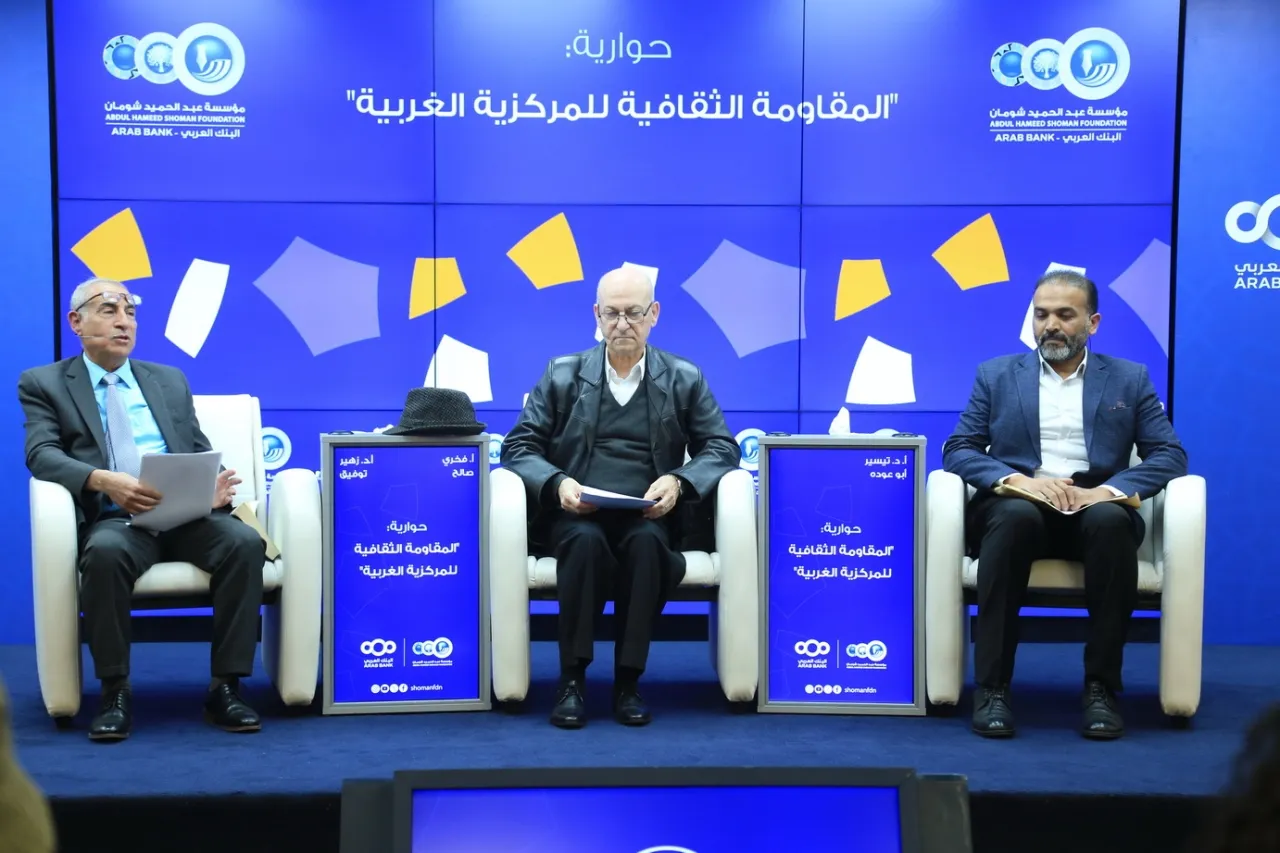
Khaberni - The lecture held by the Cultural Forum at the Abdul Hameed Shoman Foundation, yesterday evening, discussed ways to produce new alternative knowledge, based on understanding oneself and proposing concepts for redefining cultural identity through conscious translation that relocates knowledge instead of merely transferring it letter by letter, and developing cultural institutions as spaces of production not mere consumption platforms, in addition to building intellectual models that contribute to human civilization.
The lecture titled "Cultural Resistance to Western Centrality" was presented by researcher Fakhri Saleh, Dr. Tayseer Abu Odeh, and moderated by Dr. Zuhair Tawfiq, addressed the problem of Western dominance over patterns of thinking and knowledge production in the Arab world, and some countries around the world.
Researcher Fakhri Saleh pointed out that "Eurocentrism, or Western centrality, was based on an antagonistic dichotomy of the center/periphery as a means of extending domination over the global South and the East, with its peoples, cultures, and ancient civilizations that were the center of the world at one time. This gave rise to sciences, knowledge, administrative systems and forms of control, and securing expansion to provide dominance for this triumphant centrality during the eighteenth, nineteenth, and twentieth centuries. Hence, anthropology, linguistics, ethnology, Orientalism, the science of history, or historical recording, and even geography were founded to reflect this Western centrality and to establish a hierarchical civilization, culture, knowledge, and conceptual framework.
He added that "the world today is at a crossroads, with deep changes and transformations affecting everything: economics, geography, state formation, concepts, laws, rights, mental perceptions, knowledge, sciences, and more; and we need to reconsider our relationship with the world, and our position in it. The fortunate nations and peoples are those who sense the stirrings of change and quickly seize the opportunity to keep pace with this change.
Dr. Abu Odeh confirmed that it is not possible to understand Eurocentrism without understanding the nature of Western modernity and its extents or tributaries that reach all parts of the world, indicating that modernity originated from the roots of the Renaissance, the Enlightenment, the Industrial and Scientific Revolution.
He indicated that research studies written in Arabic on the relationship between social class and the learning, teaching, and politicization of the English language are shallow, and do not correspond with the geopolitical momentum and previous literature written in English, noting that many public and private universities are concerned with the frenzy of competing for global university rankings, but are not concerned with studying the anthropological, social, and educational nature of learning and teaching English, and educating generations in more than one language, with a focus on the mother tongue as the primary well of Jordanians' culture and identity, and considering English and other languages as an important cultural bridge between human civilizations, and a central means to deepen values of coexistence between civilizations, understanding the dynamics of power and language, knowledge, and language policies, and social class.
He also emphasized the necessity of keeping pace with artificial intelligence through the development of new educational tools for the phenomenon of linguistic and cultural immersion in English, activating English clubs, and networking with global institutions to update the level of English education in Jordan at the school and university level, and revising English language policies in Jordanian universities; the modern view of English departments should take into account Arab culture, comparative literature, world literature, the ongoing debate in the context of cultural studies, anthropology, sociology, philosophy, and move away from the centrality of teaching English away from the Arab cultural component, and its ability to reframe the pedagogy of the English language in Jordan.