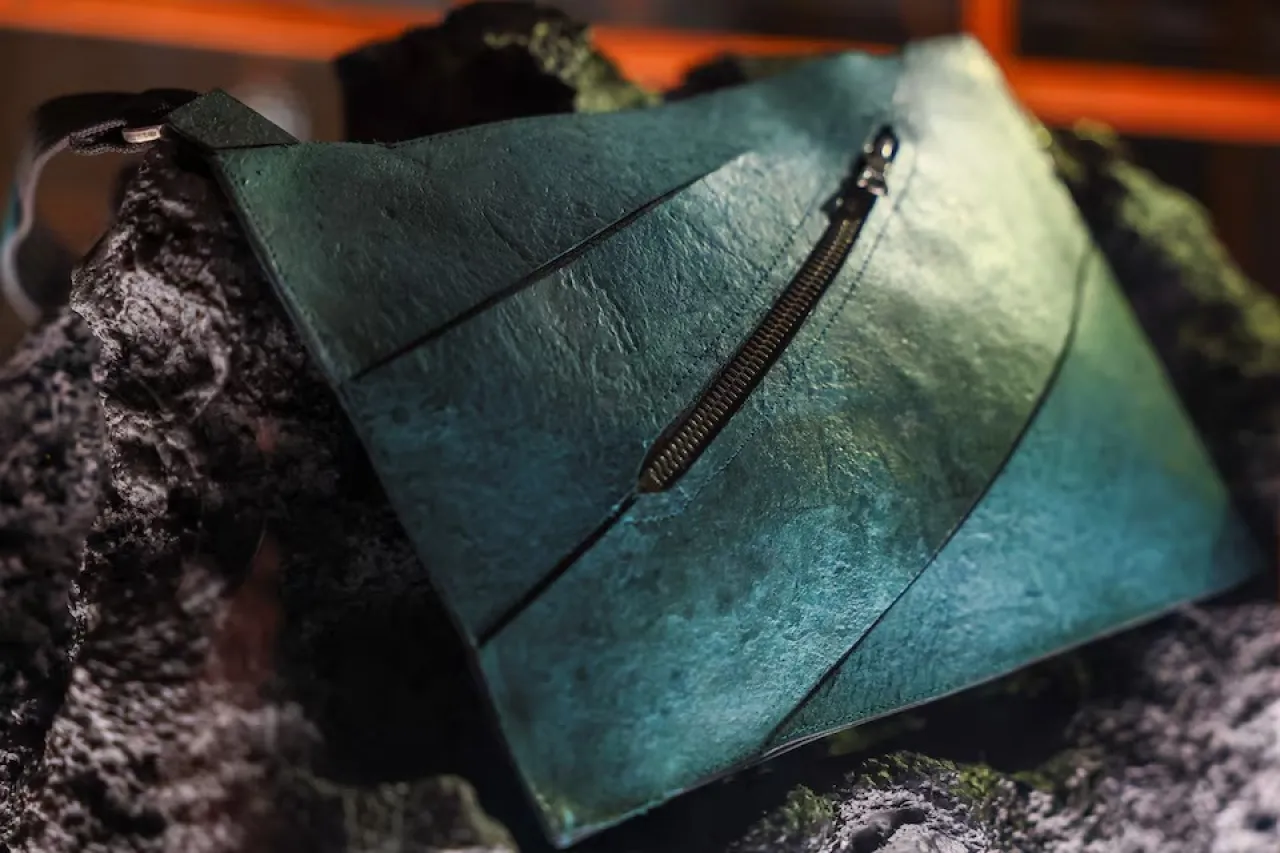
Khaberni - The announcement of the production of a dinosaur leather bag has revived a scientific controversy that has lasted 9 years about the possibility of recovering proteins from fossils of the extinct organism.
Scientists and designers announced the production of a handbag made from "collagen" extracted from dinosaur fossils. According to Reuters, this bag, now displayed in a special cage under a large dinosaur model at the "Art Zoo" in Amsterdam until May 11, will be auctioned later at a starting price of half a million dollars.
Not long after this news was revealed, the same debate that emerged in 2017 resurfaced when researchers from the National Central University in Taiwan found evidence suggesting that proteins existed within a 195-million-year-old dinosaur fossil. They announced this achievement in the journal "Nature Communications".
Advanced Imaging
The study focused on a rib bone of a dinosaur from the "Sauropodomorph" group. Scientists stated that they managed to detect preserved organic remains inside the vascular channels, which were the microscopic paths that the blood vessels and nerves used to pass through in the organism.
Using advanced imaging techniques based on synchrotron radiation and infrared analysis, they clarified that their results revealed distinct chemical fingerprints of collagen proteins, a fundamental component of living tissues.
They said these fingerprints appeared in the form of absorption bands known scientifically as "Amide A" and "B," and 1, 2, 3, which are strong indicators of the presence of preserved protein structures.
"Amide," a type of chemical bond that connects amino acids within proteins, whereas the numbers are scientific labels for different types of spectral signals that appear when analyzing these bonds, helping scientists identify the presence of proteins and their structure.
Severe Criticisms
At that time, this study was considered an unprecedented scientific achievement, but it wasn't long before it faced severe criticisms published in the "Proceedings of the Royal Society.".
This study, prepared by researchers at the University of Manchester, UK, questioned the accuracy of what the Taiwanese scientists announced, suggesting that the protein sequences discovered in the dinosaur fossil might be due to recent contamination.
Researchers at the University of Manchester tested this hypothesis by extracting collagen from the bones of a modern bird (the ostrich), and using a precise technique known as "Tandem mass spectrometry," compared the protein sequences of recent ostrich samples to those previously attributed to dinosaurs. The result was surprising; there was a match suggesting that distinguishing between ancient and modern proteins is not straightforward, especially given the possibility of cross-contamination during analysis.
The Debate Resurfaces
In a much simpler approach than the previous studies, the debate arose again after announcing the bag which has a greenish-blue color inspired by the "Tyrannosaurus Rex." The project's managers confirmed that the material used in its manufacture was developed through extracting protein molecules from dinosaur remains, then incorporating them into animal cells to produce collagen, which was later converted into leather using advanced biotechnological methods.
Experts doubted this product, affirming that collagen could not remain in dinosaur fossils except in minute amounts, insufficient to reproduce authentic leather. They confirmed that any extracted material lacks the complete structure that characterizes natural leather.
The project owners considered these criticisms as normal, asserting that every new innovation faces skepticism at its beginnings. They stated that what they had achieved represents the closest attempt to revitalize a material that can be attributed to this extinct organism.