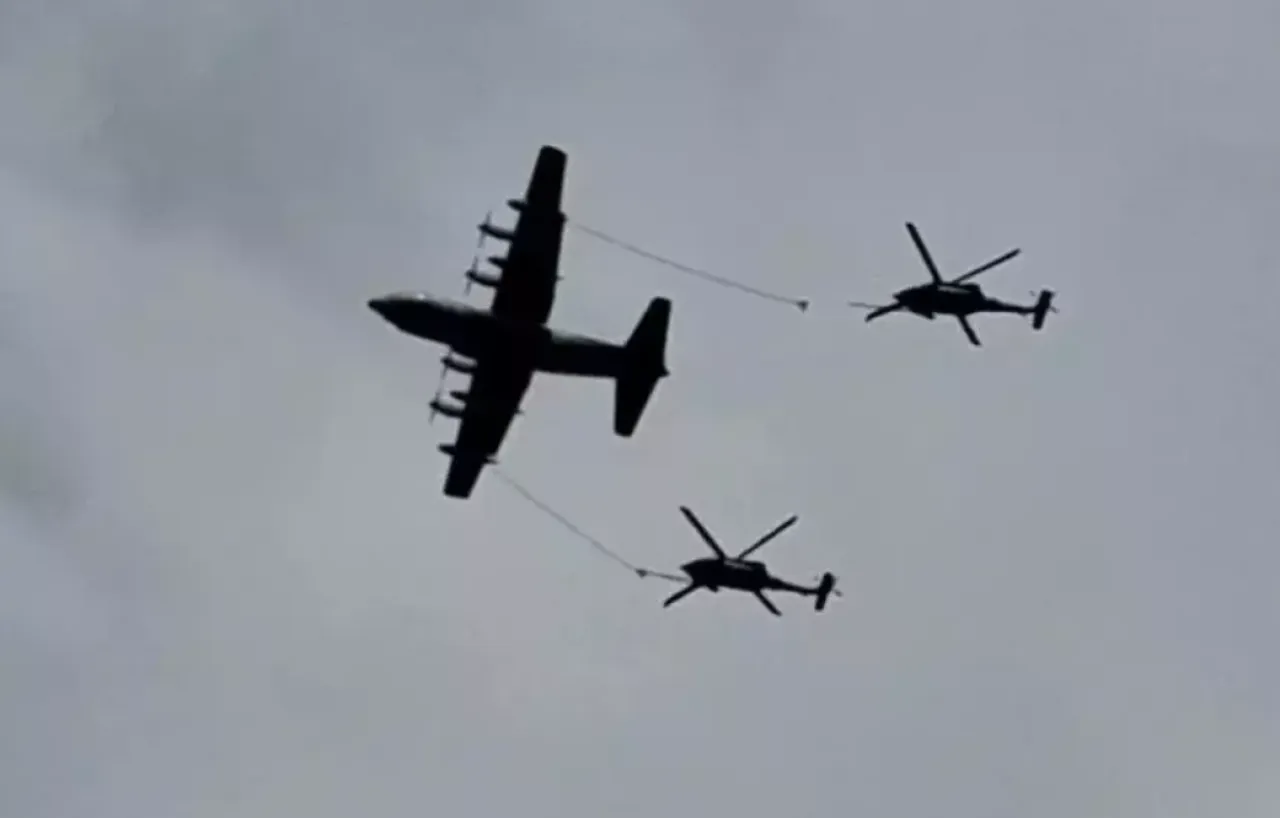
Khaberni - In a significant development within the ongoing military conflict in the Middle East, American and Iranian sources - on Friday - announced the fall of an American fighter jet of type "F-15 Strike Eagle" inside Iranian territory, and damage to two helicopters, with reports of another American fighter jet crashing.
While American sources have confirmed the rescue of one of the pilots, the search is still ongoing for the second pilot amid uncertainty regarding his fate.
This incident represents the first American aircraft downing since the beginning of the current escalation, and raises questions about the extent of the U.S.' control over Iranian airspace, despite repeated assurances from President Donald Trump and his Defense Secretary Pete Hegseth that their country possesses absolute aerial superiority in Iranian skies.
What happened?
According to Jordanian military expert retired Major General Hilal Al-Khawaldeh, the downing of the "F-15" over Iranian territory is not impossible despite the difficulties, due to the presence of thermal radars and advanced Iranian air defense systems.
Al-Khawaldeh explained in a statement that the American aircraft may have approached the ground to execute precise strikes on specific targets inside Iran, noting that Tehran possesses a local air defense system with an engagement capability ranging between 200 and 300 km, comparable to the Russian S-300 system.
He added that the possibility of a technical malfunction or human error in the American "F-15" cannot be ruled out, especially with the recent depth-penetrating American sorties, making an encounter with modern air defense units and technologies likely.
Air supremacy
In turn, military expert and strategist Brigadier General Hassan Jouni stated that the downing of an American fighter jet in Iranian skies raises fundamental questions about the reality of the air control proclaimed by Washington, revealing potential gaps in the operational assessments that were built on the assumption that Iranian defenses were completely neutralized.
He explained that the downing of warplanes depends on integrated missile air defense systems, which rely on radars to detect aerial targets and then guide missiles to intercept them accurately, pointing out that any miscalculation in the effectiveness of these systems could lead to unforeseen field surprises.
He added that American assumptions had presumed the destruction of most of Iran's air defense capabilities, which facilitated discussions about near-absolute aerial superiority; however, the recent incident puts this assumption to practical test, particularly with indications of the persistence of some defensive capabilities.
Jouni noted that the downed fighter is likely of the "F-15 E" model, a heavy aircraft compared to the stealth "F-35", which makes it more detectable due to its larger thermal signature, especially when loaded with heavy munitions for precise strikes.
He pointed out that despite being equipped with advanced electronic warfare systems, these aircraft might need to fly at lower altitudes when targeting sensitive objectives, placing them within the range of air defense systems that may still be active or have been reactivated.
Defensive systems
He indicated that Iran possesses a mix of defensive systems, including the Russian "S-300" and the local "Khordad 15", as well as infrared systems like "Majid", which reduce reliance on radars and increase the difficulty of their detection by enemy aircraft.
This hypothesis is supported by field data that showed the ejection of a pilot's seat from the aircraft, indicating the successful escape of one of the pilots, aligning with Washington's announcement that one crew member was rescued, while the fate of the other remains undecided.
Jouni considered the downing of such an aircraft not just a tactical incident, but also one carrying strategic implications related to Iran's ability to challenge America's air superiority, especially since air operations represent a crucial element in this war.
Conversely, operations to locate the second pilot continue amid concerns about his potential capture, especially after Tehran announced a reward for information about him, adding a psychological and media dimension to the field confrontation.
Complex combat environment
He explained that the incident does not diminish its operational significance but indicates that the combat environment remains complex and prone to surprises, which might prompt Washington to reassess its aerial tactics, flying altitudes, and target priorities.
In a parallel development, American media reported the deployment of "B-52" bombers over Iran, in a move reflecting an operational shift towards using heavy firepower to strike deep and fortified targets without directly risking the fighters.
Jouni interpreted this move as an attempt to compensate for any deficiency in air control, as these bombers can carry heavy loads of munitions and execute multiple strikes from high altitudes, reducing the chances of exposure to air defense systems.
He confirmed that the future of the operations depends on the nature of the Iranian threat, as if air defenses had regained their effectiveness, this would lead to a change in engagement rules. However, if the incident is isolated, its impact might remain limited, yet it carries clear warning messages.
He concluded that the southern Iranian region, especially around the Strait of Hormuz—represents the current operational center of gravity due to its strategic importance, and the likelihood of a greater escalation if the bombing of vital targets in that area continues.