Khaberni - Below are the latest economic repercussions of the ongoing war since February 28 in the Middle East:
The Security Council postpones a meeting about the Strait of Hormuz
The international Security Council postponed the vote scheduled for Friday on a resolution proposed by Bahrain that authorizes the use of "defensive" force to secure navigation in the Strait of Hormuz amid the war.
The stated reason is that the United Nations considers Good Friday, which coincides with today, an official holiday, according to diplomatic sources, even though this was known when the voting date was announced. A new date for discussing the project has not been specified.
Trump escalates his threats
Donald Trump warned late Thursday that the U.S. forces have not yet begun "to destroy what remains in Iran," saying more of the country's bridges and energy infrastructure are among his targets.
Trump said on his platform "Truth Social", hours after he announced the destruction of Iran's largest bridge, "The U.S. military has not yet started destroying what remains in Iran. Bridges are the next step, then electric power plants!"
Damage to a power plant in Kuwait
A power and water distillation station in Kuwait was damaged due to an Iranian attack on Friday.
The official news agency (KUNA) quoted the spokesperson of the Ministry of Electricity and Water, Fatima Hayat, saying, "One of the power and water distillation stations was attacked by the sinful Iranian aggression early today, resulting in material damage,” confirming "the technical and emergency teams immediately began to deal with the repercussions of the incident to ensure the continuation of operations."
An attack by drones targeting Al-Ahmadi port oil refinery in Kuwait on Friday caused fires in several of its operational units, according to "KUNA".
Fire at a gas complex in Abu Dhabi
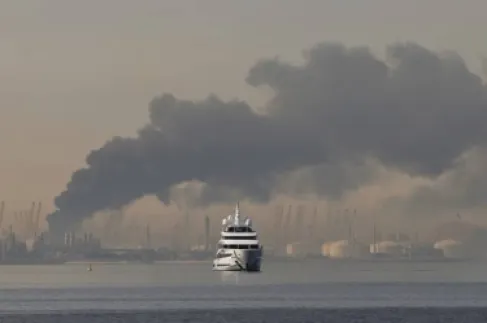
Abu Dhabi suspended operations at Habshan gas facilities following debris fallout that led to a fire at the site after an interception operation carried out by the air defenses, as announced by Abu Dhabi Media Office on Friday.
The office mentioned in a statement on "X" that "operations have been suspended at the facilities simultaneously with the relevant authorities dealing with a fire resulting from falling debris at Habshan gas facilities, following the successful interception by air defenses.” It confirmed that there were no injuries.
A container ship crosses Hormuz
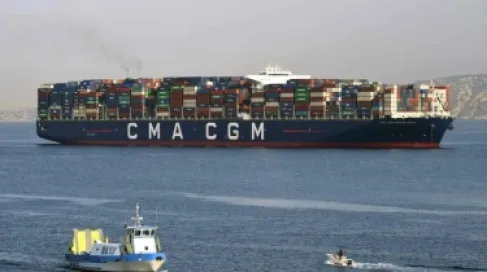
A container ship belonging to the French group "CMA CGM" crossed the Strait of Hormuz on Thursday to leave the Gulf, declaring via the tracking signal that it is "French-owned," according to data displayed by "Marine Traffic" for tracking marine navigation Friday.
The ship "Kribi," which flies the Maltese flag, sailed through the strait from west to east on Thursday afternoon, continuing its journey off the coasts of Oman on Friday, without specifying its destination.
Rise in food prices
The United Nations Food and Agriculture Organization (FAO) announced that the food price index, which measures the monthly changes in global prices for a basket of food commodities, rose by 2.4% in March compared to February due to rising energy and fertilizer costs.
Italy extends fuel tax cut
The Italian government announced on Friday the extension of the temporary reduction in fuel taxes, which was scheduled to end on the sixth of April.
Economy Minister Giancarlo Giorgetti said after a government meeting, "We are extending the operation of the fuel tax cut, which was scheduled to end on Easter Monday, until the first of May."
Easter holiday closure of stock exchanges
Tokyo Stock Exchange ended Friday's session higher, despite the uncertainty in the Middle East, amid weak trading due to the closure of most global markets and the oil market for Easter.
The Nikkei index rose by 1.25% at 53,123.49 points, while the broader Topix index increased by 0.93%, closing at 3,645.19 points.
Prime Minister of Thailand condemns oil traders
The Prime Minister of Thailand on Friday criticized oil traders for their "excessive profits," blaming those who store fuel or smuggle it abroad for the ongoing high prices.
Prime Minister Anutin Charnvirakul said, "Authorities have detected instances of fuel hoarding and smuggling for sale to neighboring countries," adding that this issue has cost the government 50 billion baht ($1.4 billion).
Bangladesh reduces working hours
The Bangladeshi government announced on Friday a reduction in official working hours and office working hours, and a reduction in energy consumption due to rising fuel prices caused by the war in the Middle East.
Bangladesh, with a population of 170 million, imports 95% of its oil and gas needs, a large portion of which comes from Gulf countries.
Fuel shortage at Australian stations
The Australian government on Friday urged drivers to refuel their vehicles at gas stations in cities if they are planning long trips during the Easter holiday, due to a fuel shortage affecting rural towns.
Energy Minister Chris Bowen said hundreds of stations across the country had run out of diesel, while unleaded petrol was unavailable at more than a hundred other stations.
New Zealanders turn to electric cars
Sales of electric cars in New Zealand saw more than a three-fold increase during March, according to official government data released this week, driven by rising fuel prices due to the war.
During the same period, the average price of gasoline increased by more than 30%, while diesel prices rose by 74%.