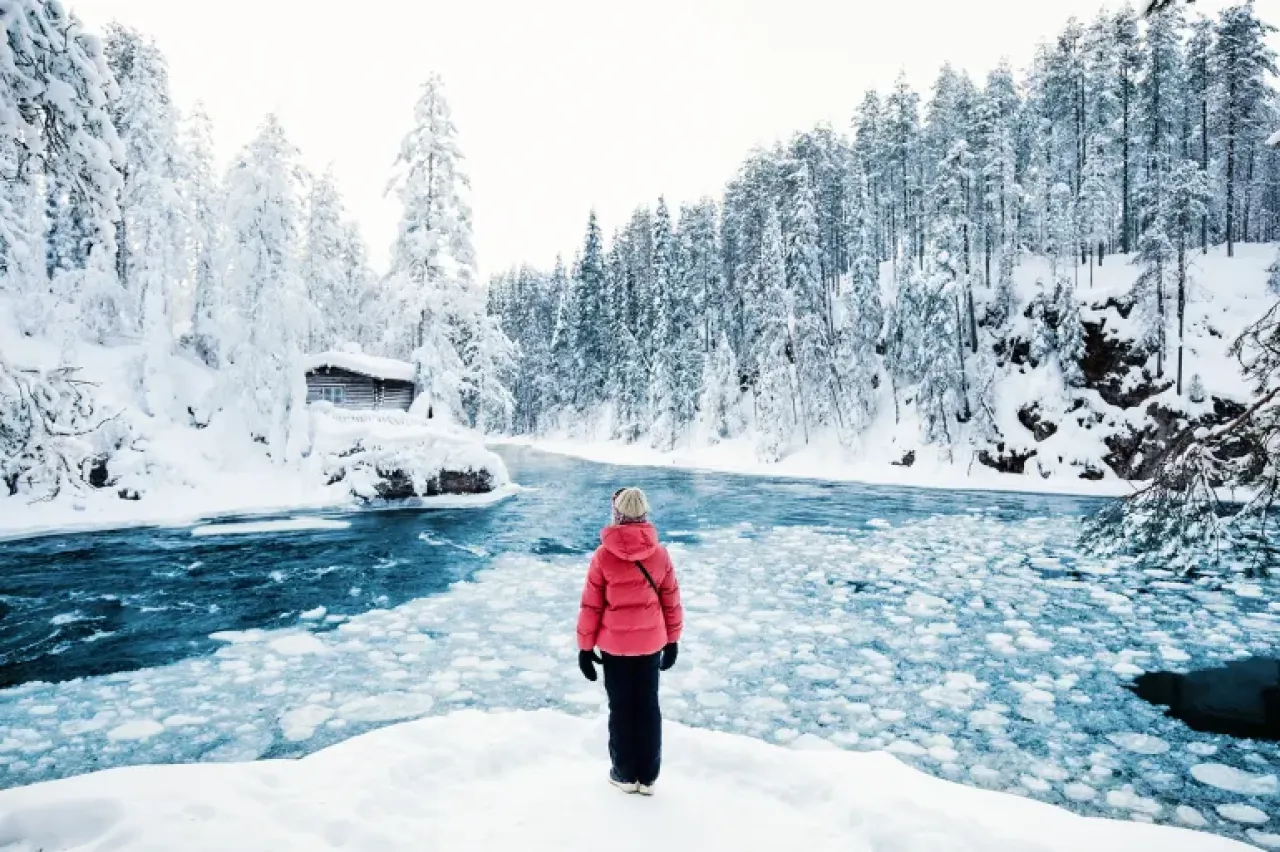
Khaberni - While many associate happiness with bright sunshine and golden beaches, the "cold north" countries (Finland, Denmark, Iceland) reign atop the World Happiness Report, with Finland emerging as a stunning case study, not only remaining at the peak but also securing the top spot globally for the ninth consecutive year.
In a country where the sun disappears for several months and temperatures can drop below zero, it seems that the inhabitants have cracked the code of a "social operating system" that transforms harshness into joy. Is happiness there merely a material luxury, or a life philosophy we can learn from?
1. Happiness is not "a bank balance"
One amazing fact is that these populations are not "the richest" globally in terms of net income, but they are "the safest". According to the United Nations World Happiness Report, the secret lies in trust, as Finns have a notable trust in their neighbors and institutions.
If you lose your wallet in the street, there is more than a 90% chance it will return to you intact, with every cent inside. Children walk to their schools on foot from the age of seven, without feeling in danger when returning home alone.
Happiness there resembles a "societal design" that removes anxieties about health, education, and the future, allowing individuals to focus on the quality of their day. Contrary to what we are accustomed to, working long hours is seen as a "failure" in time management rather than "hard work".
According to a report by the Organization for Economic Cooperation and Development, employees in these countries enjoy the longest paid vacations and one of the best childcare systems in the world.
2. The art of enjoying the little details
If you visit Denmark, you will frequently hear the term "Hygge" in every corner. It is not just a word, but an emotional state that means creating a warm atmosphere and enjoying the good things in life with good people.
According to Mike Wiking, director of the Happiness Research Institute in Copenhagen, in his famous book The Little Book of Hygge, Danes compensate for harsh weather with "social warmth". "Hygge" is the "antidote" to stress, pushing you to live in the present moment and appreciate what you have now.
They are among the highest consumers of candles in the world, with a Dane burning about 6 kilograms of wax annually, not due to a lack of electricity, but because "warm lighting" is a fundamental corner of their mental health. Sitting beside a heater wearing wool socks and holding a cup of coffee is not just a luxury but a "sacred" ritual to combat winter depression.
3. The power of will against the impossible
Contrary to the "softness" of Danish Hygge, comes the tough Finnish philosophy known as "Sisu", which is a mix of courage, flexibility, and perseverance that emerges when hope seems lost.
Finnish people apply "Sisu" in their daily lives through practices that might seem "suicidal" to some, like swimming in freezing waters. They believe that after the initial shock of cold, a deep relaxation occurs, releasing happiness hormones and training the mind to endure life’s hardships. Happiness there is not about avoiding pain, but conquering it, according to a study published by Visit Finland.
4. The right to roam for everyone
In Iceland and Finland, there is a community principle known as "everyman's right". According to an article published by the British newspaper The Guardian about nature in the north, this right transcends private property boundaries, granting anyone - citizen or tourist - the freedom to roam in forests, camp for a single night, and pick wild berries and mushrooms, as long as they do not disturb the landowner or harm the environment.
This right is not just a facilitation for hiking, but an acknowledgment that nature is a "public property" of the human spirit. In these countries, disconnection from nature is considered an "illness", while connection with it is a "biological necessity" as vital as food and water. A forest acts as an "open psychological clinic": a mere 20-minute walk among pine trees can lower blood pressure and reduce cortisol, the hormone responsible for stress.
And one of the amusing aspects of this culture is the term "forest brainwash", where employees escape after work hours not to enclosed cafes, but to the silence of trees to regain their psychological balance.
In Finland, official statistics published by the Finnish Natural Resources Institute indicate that about 70% of the country is covered with forests, making nature just steps away from every home door, and creating a generation with high mental flexibility and a unique ability to face the challenges of modern life with a positive "chill" derived from the serenity of nature.
5. The modesty that kills envy
In Norway and Denmark, there is a social secret called the "Jante Law", a set of unwritten rules that promote humility: "You are not better than others, nor smarter than them".
According to an article in "BBC Worklife", this law is the "antidote" to the social comparison disease that eats away at modern societies. In these countries, the manager does not boast about his luxury car in front of employees, everyone wears simple and practical clothes. When class display vanishes, jealousy and social resentment decrease, giving way to a greater degree of psychological satisfaction.
Danish society in particular gives individuals a wide freedom in choosing their lifestyle, as they often find themselves not trapped in the "traps" of social expectations or material pressures. This liberation is what makes them more content and grateful for their lives as they are.
Is happiness an individual decision or a societal design?
The experience of northern countries shows that the answer is: "both together". The society provides "security and trust" (the design), but the individual adopts "Hygge" and "Sisu" (the decision). Happiness in the north is not the absence of problems, but owning a "catalog" of ways to deal with them.
We may not be able to transfer the Finnish tax system to our country, but we can certainly borrow a "candle" from Denmark to light up our homes, and "determination" from Finland to face our challenges. Happiness, as the northern peoples teach us, begins when we stop chasing "more", and start appreciating "what's there".