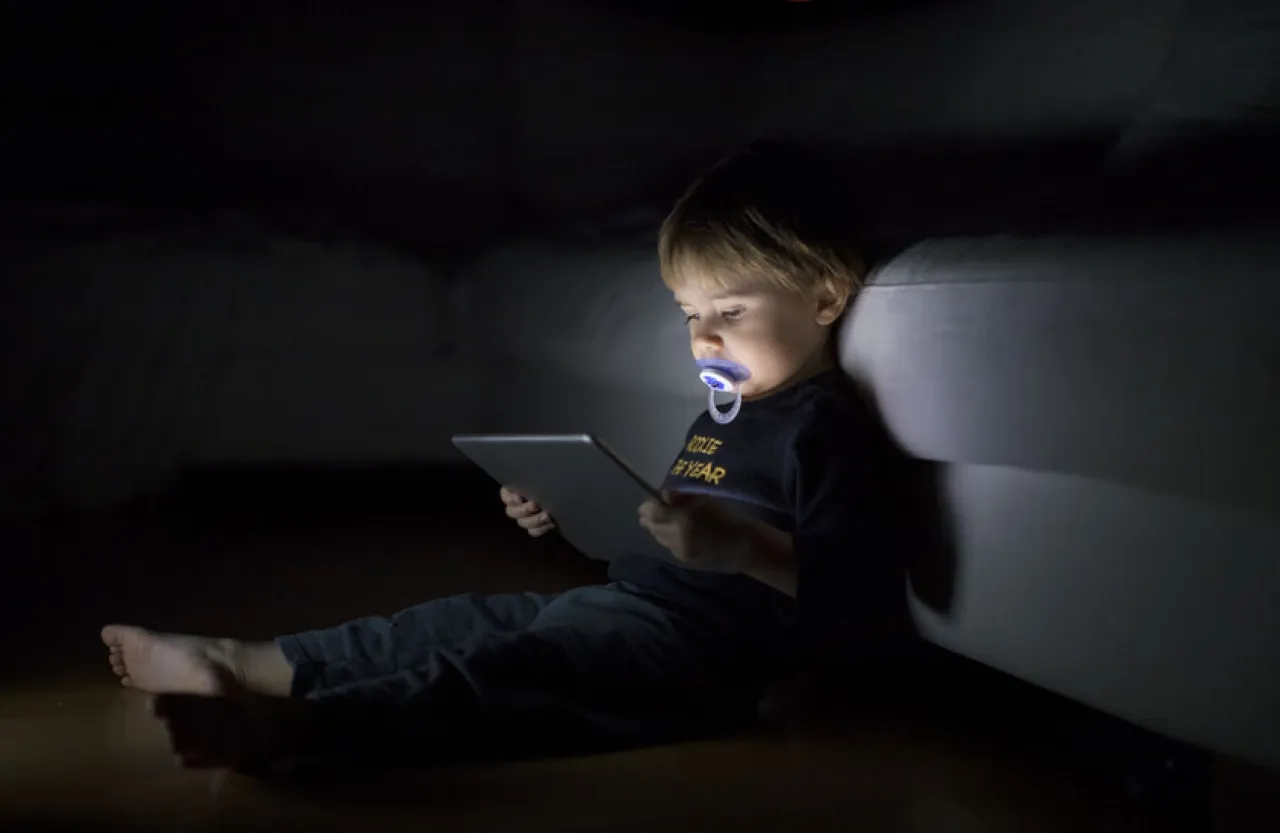
Khaberni - The first five years of a child's life are the most crucial in their development, during which they learn to walk, talk, think, and interact with others.
Because this period is so sensitive, introducing screens into a child's life can have significant effects.
For this reason, experts recommend that children under five should not have more than one hour of screen time per day, while children aged two years and younger should completely avoid screens, except for video calls with family.
However, the reality points to a different trend, as tablets and phones have become part of children's lives, and daily screen time exceeds the recommended duration.
A report from a consulting group on screen time in early childhood states: "Some evidence has linked large amounts of screen time to negative effects on children's health and development, including social, emotional, linguistic, and brain development, as well as sleep, vision, and healthy weight. The problem of using screens becomes particularly serious when they replace sleep, physical activity, parent-child interaction, creative play, home routines, and real-world exploration or learning."
Here, we reveal the ways excessive screen time can harm your child's health:
First: Speech problems
Spending a lot of time in front of screens can delay speech development in young children.
Research has found that children who use screens more frequently start talking later and have smaller vocabularies compared to their peers.
A recent study published in January found that a two-year-old who spends five hours a day on screens can utter significantly fewer words than a child who spends just 44 minutes.
Children who use screens more frequently uttered 53% of test words, while those who used them less uttered 65%.
A study from the University of Adelaide pointed out that a child engrossed in technology might miss hearing 1100 words a day due to fewer conversations with their parents.
Second: Tantrums
Parents may place their angry child in front of a screen to temporarily calm them down, but this strategy may have long-term adverse effects.
A Canadian study involving 315 children found that 3.5-year-olds who spent more time on tablets were more prone to anger and frustration after a year. Specifically, each additional hour and 15 minutes above the daily average was linked to a 22% increase in tantrums later. Experts suggest that "overstimulating content," such as bright colors and fast-paced scenes, may be the cause.
Experts recommend that content appropriate for children should be slow and calm, with few characters and static shots.
Third: Type 2 Diabetes
The biggest harm from screen time comes from encouraging sedentary behavior, where children spend long hours sitting without movement. This inactivity is directly linked to increased weight and obesity, especially in children.
Obesity in childhood can significantly increase the risk of developing type 2 diabetes later.
Fourth: Vision problems
Spending long hours staring at a screen can adversely affect a child's eye health in the long term, as a 2021 research review found that children who used computers more were more prone to myopia. Researchers have not definitively concluded that screens directly cause myopia, but the figures are concerning.
Fifth: Reduced sleep
The blue light emitted from phone and tablet screens can disrupt the natural sleep cycle in children.
This light can confuse the body's biological clock, making sleep more difficult and reducing its quality.
Research indicates that children who spend more time in front of televisions and tablets sleep fewer hours compared to others.
Sixth: Attention problems
Long exposure to screens at an early age can alter the way a child's ability to focus and pay attention develops.
Experts particularly warn against "short, fast-paced videos" that are thought to negatively affect children's attention. These clips feature rapidly changing scenes and highly stimulating content, which might condition a child's brain to be distracted and have difficulty maintaining attention for longer periods. Since evidence is still limited, the report recommends a precautionary approach, avoiding this type of content entirely for young children and sticking to content that is slow, repetitive, and predictable.
In conclusion, experts confirm that screen time becomes a real problem when it replaces fundamental activities essential for a child's growth, such as sleep, creative play, physical activity, and real interaction with parents. Therefore, the goal is not to completely ban screens but to use them cautiously and in limited quantities, choosing content that is calm and age-appropriate. The most important point is that screen viewing should be an additional activity and not a substitute for playing, moving, and talking with the child. Only in this way can a balance between the benefits of technology and its risks to children's health and development be achieved.