Khaberni - While the Middle East stands on a hotbed in 2026 due to the direct confrontation between the United States and Israel on one side, and Iran on the other, "invisible" wartime tools have surfaced that have redefined the concept of power and influence. Conflicts are no longer decided only in traditional battlefields, but are managed through complex digital networks and hybrid supply chains that go beyond borders and international oversight.
This report examines the dangerous intersection between two means that have reshaped the current military landscape; the first is the increasing reliance on cryptocurrencies and "blockchain" technologies as a parallel financial lifeline independent from the domination of the dollar, and the second is what some describe as the "evasion axis" which includes China, Russia, and Iran.
This alliance has managed - according to a number of reports - not only to exchange political support but also to build an "integrated system" that combines anonymous digital financing on one hand, and distributed military manufacturing technology on the other, thus enabling Tehran and Moscow to sustain their arsenals of drones and missiles despite severe sanction waves and increasing military operations.
Cryptocurrencies as a Tool for Financing Drones
The latest report from "Chainalysis," specializing in blockchain analytics, reveals the growing role of cryptocurrencies as a means of financing the purchase of drones and low-cost military components by groups associated with Russia and Iran.
As commercial drones are available on global e-commerce platforms, cryptocurrencies have become a means through which the identity or true intentions of the buyer are difficult to trace, especially since these purchases often remain obscure when using traditional financial channels.
The report mentions that since the start of the Russian war on Ukraine in 2022, pro-Russian groups have received donations in cryptocurrencies exceeding $8.3 million, specifically used for the purchase of drones and their components.
When tracing the flow of cryptocurrencies from individual wallets associated with drone developers and paramilitary groups, through to sellers, it reveals the possibility to purchase low-cost drones and their components from sellers on e-commerce websites.
The report also disclosed that groups linked to Iran use cryptocurrencies for the sale and purchase of military equipment, and specifically for buying spare parts for drones and selling military equipment. A digital wallet associated with the Iranian Revolutionary Guard was recorded buying drone spare parts from a supplier based in Hong Kong.
Andrew Foreman, the head of national security intelligence at the company, views that "blockchain" technology provides an exceptional opportunity for investigators. Once a seller is identified, the activities of the counterpart can be clearly seen and assessed for usage and intent, information that isn’t necessarily available through traditional methods.
Yet, the report pointed out that the overall volume of drone purchases with cryptocurrencies is small compared to total military expenditure, but that blockchain technology could help authorities better track purchases which might otherwise have remained obscure.
Supply Chain Structure
Moving from "payment method" to "supply method," Beijing and Moscow have enabled Tehran to continue its military operations through what is called "evasion axis."
This axis - according to the report - hinges on tools that allowed it to circumvent Western sanctions and export controls, through the use of alternative payment systems, money laundering, and barter trade. The ongoing war has drawn attention to another system or tactic for this axis: integrated supply chains, according to the Atlantic Council.
China plays a major role in this axis, as it imports sanctioned oil from Iran and Russia, and in return, exports advanced "dual-use" technology. Despite US restrictions, Western components - American, Japanese, and European - still flow to the Iranian drones through distributors, shell companies, and shipping hubs in China and Hong Kong.
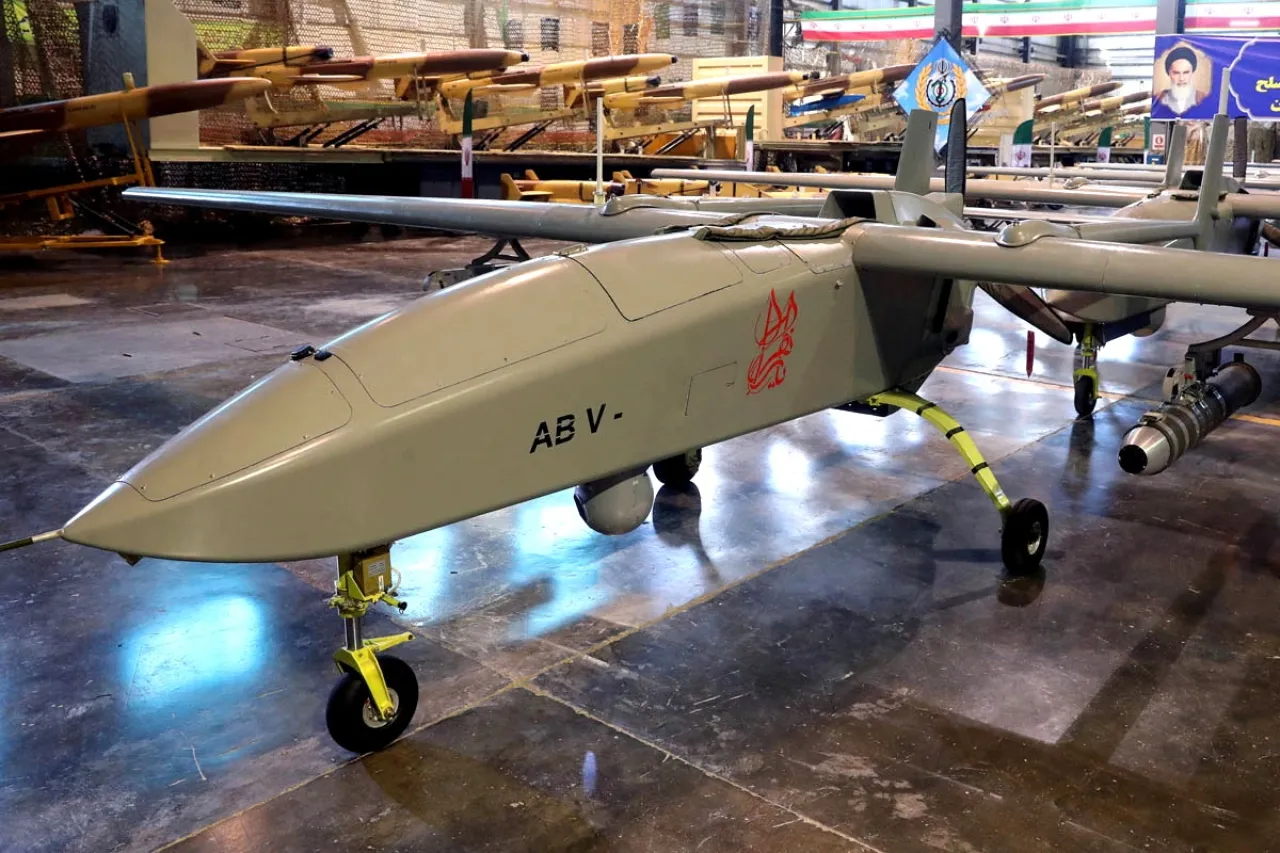
Subsequently, the relationship has evolved from merely exporting Iranian "Shahed" drones to Russia, to establishing massive factories inside Russia (like the Alabuga Economic Zone). By 2025, 90% of drone assembly operations had moved inside Russia, and Russia developed improved versions (like Garpiya-3) with the help of Chinese experts and a Russian drone factory in China.
This partnership now seems complete, as recently stated by Ukrainian President Volodymyr Zelensky, Russia is now supplying Iran with Russian-made "Shahed" drones for use in attacks against the United States and Israel.
China facilitates the transfer of Chinese and Western-made navigation technology to Iran, while Russia shares satellite images and technology of modified Shahed drones to enhance navigation and targeting, based on its experience using drones in Ukraine.
Chinese electronic markets and distributors play a crucial role, where components made for civilian applications (like inertial sensors or satellite navigation units) can be purchased through Chinese intermediaries and integrated into Iranian weapon systems. In February 2025, the US Treasury imposed sanctions on Chinese companies that were supplying gyroscopic navigation devices to enhance Iranian drones.
China has granted Iran access to its BeiDou global satellite system, enabling Tehran to enhance the accuracy of its drone targeting, use deceptive signals to mislead US and Israeli air defense systems during the ongoing war.
Iran relies on Chinese chemical companies to secure the "precursors" necessary for producing solid rocket fuel and explosives, which are shipped via "shadow fleet" vessels sailing from Chinese ports, making it difficult for regulators to trace the final destination of these shipments.
Iranian procurement networks operate by disguising the destination of shipments through exploiting gaps in global export controls and enforcement mechanisms, and the magnitude and diversity of the Chinese chemical sector complicate the task of tracking the final use of each exported chemical compound.
What began as an attempt to circumvent sanctions has evolved into a "self-enhancing production network," where Western components, Chinese purchasing channels, and Russian manufacturing capabilities contribute to building a sustainable and pressure-resistant Iranian military arsenal.